
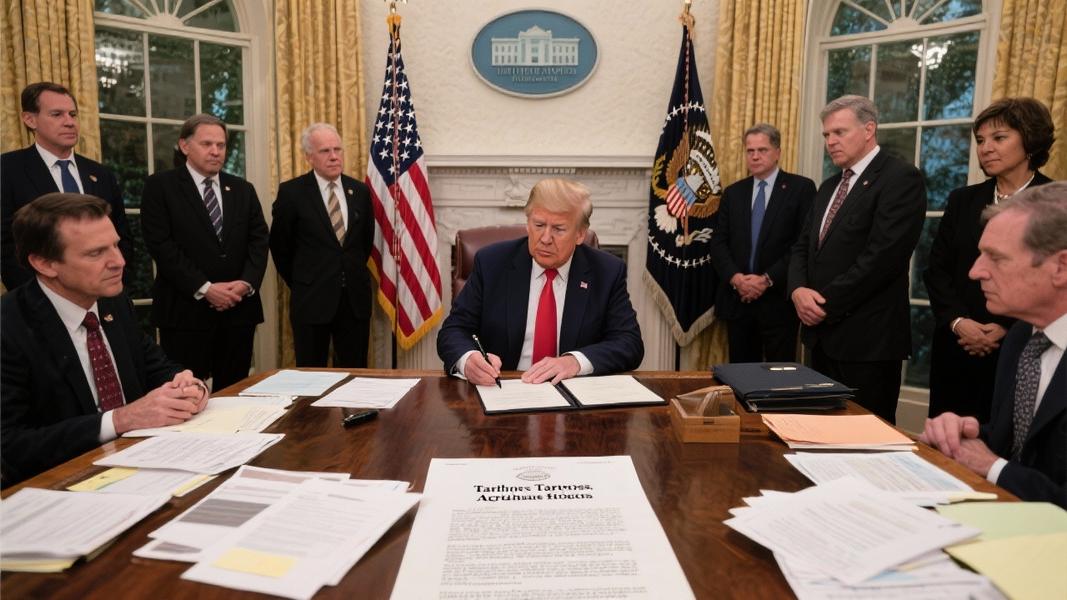
President Trump has modified his sweeping tariff policy to provide relief for certain agricultural products, according to a new executive order signed Thursday that carves out exceptions for foods not grown domestically.
The order, which took effect November 13, amends the controversial reciprocal tariff framework established earlier this year that Trump had declared necessary to combat “an unusual and extraordinary threat to the national security and economy of the United States.”
“I have determined that certain agricultural products shall not be subject to the reciprocal tariff imposed under Executive 14257, as amended,” Trump stated in the executive order.
Progress in Trade Negotiations Drives Policy Shift
Why the change of heart? The White House points to substantial diplomatic progress, citing the completion of “9 framework deals, 2 final agreements on reciprocal trade, and 2 investment agreements” as key factors in the decision to modify the tariff scope.
The administration also acknowledged domestic market realities, noting that “current domestic demand for certain products, and current domestic capacity to produce certain products” influenced the decision. In practical terms, this means foods not grown in the United States will no longer face the additional import duties.
The modification represents a significant shift in the implementation of Executive Order 14257, which Trump signed on April 2, 2025. That order established the sweeping tariff framework aimed at addressing what the administration characterized as persistent U.S. goods trade deficits.
Agricultural Focus Reflects Economic Pragmatism
The exclusions appear targeted at agricultural products that simply can’t be sourced domestically in sufficient quantities. “Certain qualifying agricultural products will no longer be subject to those tariffs, such as certain food not grown in the United States,” the White House explained in an accompanying fact sheet.
That’s a practical consideration that acknowledges the realities of global agricultural production. Many U.S. trading partners produce substantial volumes of food products that simply aren’t grown domestically due to climate or other factors.
The modified tariff scope became effective immediately, with the White House specifying it “shall be effective with respect to goods entered for consumption, or withdrawn from warehouse for consumption, on or after 12:01 a.m. eastern standard time on November 13, 2025.”
Trade experts note this carve-out could ease inflationary pressures on food prices while maintaining Trump’s broader strategy of using tariffs as leverage in trade negotiations. Still, questions remain about which specific agricultural products will qualify for exclusion, with importers eagerly awaiting detailed guidance from customs officials.
For consumers facing high grocery bills, the exemption of certain imported foods from Trump’s tariff regime may provide modest relief — though the full impact won’t be clear until the administration publishes comprehensive product lists and implementation guidelines in the coming days.
