
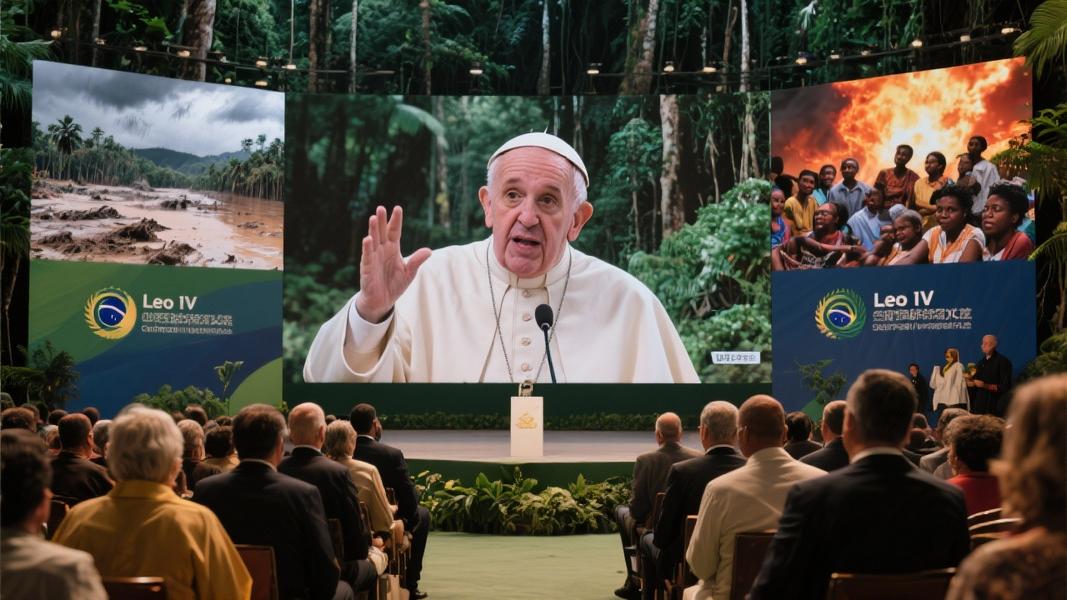
Pope Leo XIV delivered a stark warning at the COP30 climate summit in Belém, Brazil, declaring that “God’s creation is crying out in floods, droughts, storms and relentless heat.” His passionate address marked one of the most forceful papal interventions on climate change since Pope Francis’s landmark Laudato Si’ encyclical.
The pontiff’s message to world leaders was unambiguous: despite progress since the Paris Agreement, humanity is failing to protect both the planet and its most vulnerable inhabitants. “One in three people live in great vulnerability because of these climate changes,” Leo warned. “To them, climate change is not a distant threat, and to ignore these people is to deny our shared humanity.”
Time Running Out for 1.5°C Goal
With negotiations at COP30 entering a critical phase, Leo emphasized that while keeping global temperature rise below 1.5°C remains possible, “the window is closing.” The pope urged leaders to move beyond aspirational rhetoric: “Hope and determination must be renewed, not only in words and aspirations, but also in concrete actions… As stewards of God’s creation, we are called to act swiftly.”
Leo didn’t mince words when addressing climate skeptics, either. “Some have chosen to deride the increasingly evident signs of climate change, to ridicule those who speak of global warming and even to blame the poor for the very thing that affects them the most,” he stated.
What makes the pope’s intervention particularly notable is its framing of climate action as not merely environmental but fundamentally moral. “It is only by returning to the heart that a true ecological conversion can take place,” Leo explained. “We must shift from collecting data to caring; and from environmental discourse to an ecological conversion that transforms both personal and communal lifestyles.”
Following Francis’s Green Legacy
The address builds upon the environmental advocacy of Leo’s predecessor. “Pope Francis emphasized that ‘the most effective solutions will not come from individual efforts alone, but above all from major political decisions on the national and international levels’,” Leo noted, cementing the continuity between the two papacies on climate matters.
But can moral authority translate to political action? That remains the central question hanging over COP30, where negotiators are haggling over emissions targets and climate finance mechanisms that many activists consider too modest given the scale of the crisis.
Leo concluded his remarks with a passionate plea: “I, therefore, renew my strong appeal for unity around integral ecology and for peace!” The call for unity resonated with attendees frustrated by years of fractured global climate politics.
UN Climate Change Executive Secretary Simon Stiell welcomed the papal message, saying the pope “reminds us that the Paris Agreement is delivering progress and remains our strongest tool — but we must work together for more, and that bolder climate action is an investment in stronger and fairer economies, and more stable world.”
The Laudato Si’ Movement, a Catholic environmental organization, described Leo’s intervention as a profound moral statement. “He reminds the world that creation is crying out and that vulnerable communities cannot be pushed aside,” a spokesperson commented. “His voice cuts through the noise of negotiations and calls leaders back to what truly matters: our shared humanity and the urgent duty to act with courage, compassion, and justice.”
As delegates continue their work in Belém, the question remains whether this papal call will help break through the political inertia that has characterized much of the global climate response — or become just another eloquent appeal lost in the diplomatic shuffle.
