
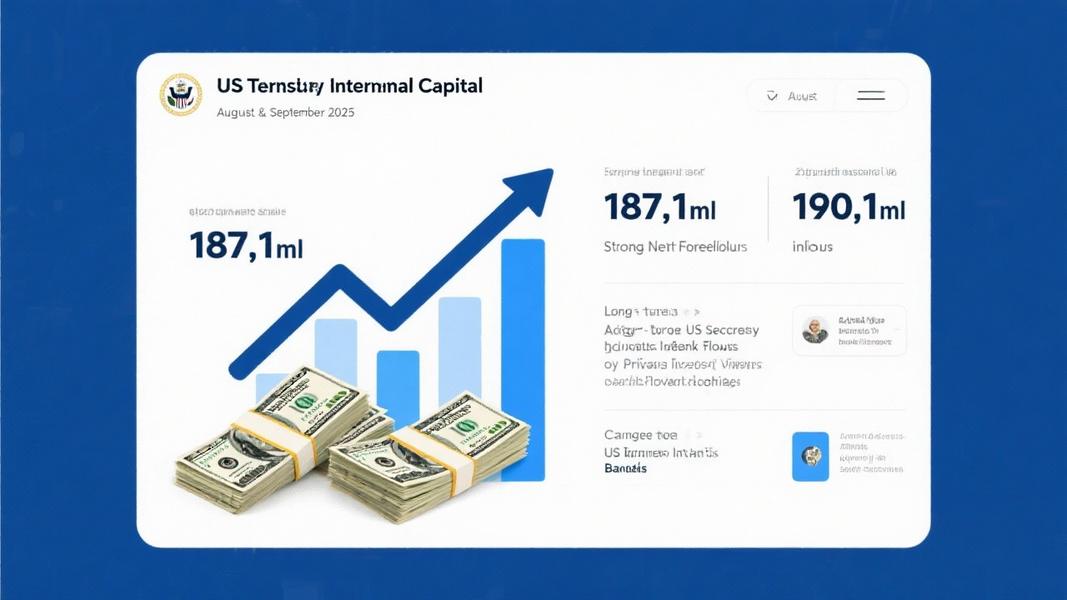
Foreign investors poured more than $190 billion into U.S. securities in September, capping off a strong two-month stretch that signals continued confidence in American financial markets despite global economic uncertainties.
The U.S. Treasury Department revealed that total net foreign acquisitions of U.S. securities and banking flows reached $187.1 billion in August before climbing slightly to $190.1 billion in September 2025. These substantial inflows come at a time when many analysts have been closely watching international investment patterns for signs of changing sentiment toward U.S. assets.
Private Investors Lead the Charge
What’s driving these numbers? Primarily private foreign investors, who contributed a whopping $224.9 billion in August and $213.9 billion in September. This enthusiasm stands in stark contrast to the behavior of foreign official institutions — central banks and sovereign wealth funds — which pulled $37.9 billion out of U.S. markets in August and another $23.7 billion in September.
“The sum total of all net foreign acquisitions of long-term securities, short-term U.S. securities, and banking flows was a net TIC inflow of $187.1 billion in August and $190.1 billion in September,” the Treasury stated in its release of the Treasury International Capital (TIC) data.
Long-term U.S. securities proved particularly attractive to foreign buyers, who increased their holdings by $181.2 billion in August and $208.5 billion in September. Private investors accounted for the bulk of these purchases — $196.4 billion in August and $210.7 billion in September — while foreign official institutions continued their selling streak, offloading $15.1 billion in August and a more modest $2.2 billion in September.
Americans Also Shopping Abroad
Meanwhile, U.S. residents haven’t been sitting on the sidelines. American investors increased their holdings of long-term foreign securities, with net purchases of $47.0 billion in August and $28.7 billion in September — though this outbound investment was dwarfed by the inflows coming the other direction.
After adjustments for portfolio acquisitions through stock swaps and other factors, the Treasury estimates that overall net foreign purchases of long-term securities reached $134.2 billion in August before jumping to $179.8 billion in September.
Short-Term Holdings Show Volatility
The picture for short-term securities tells a more mixed story. Foreign residents boosted their holdings of U.S. Treasury bills by $25.0 billion in August but then reversed course in September, reducing those same holdings by $22.0 billion.
This pattern extended to all dollar-denominated short-term U.S. securities and other custody liabilities, which saw an increase of $12.1 billion in August followed by a decline of $8.3 billion in September. Banks’ own net dollar-denominated liabilities to foreign residents grew by $40.8 billion in August and by an additional $18.6 billion in September.
Data Limitations
The Treasury cautions that while these figures provide valuable insights into foreign ownership of U.S. securities, they come with inherent limitations. “These data help provide a window into foreign ownership of U.S. securities, but they cannot attribute holdings of U.S. securities with complete accuracy,” the department noted.
For instance, if a foreign resident purchases a U.S. Treasury security but holds it in a custodial account in a third country, the true ownership won’t be accurately reflected in the data. This makes it challenging to draw precise conclusions about changes in foreign holdings by individual countries.
The Treasury also mentions that the August figures in its press release use the most recent revised data, which may differ from what was originally published.
Despite these caveats, the consistently strong inflows over these two months suggest that global investors remain confident in U.S. markets as safe havens for capital — even as questions linger about inflation, interest rates, and long-term economic prospects both domestically and abroad.
