
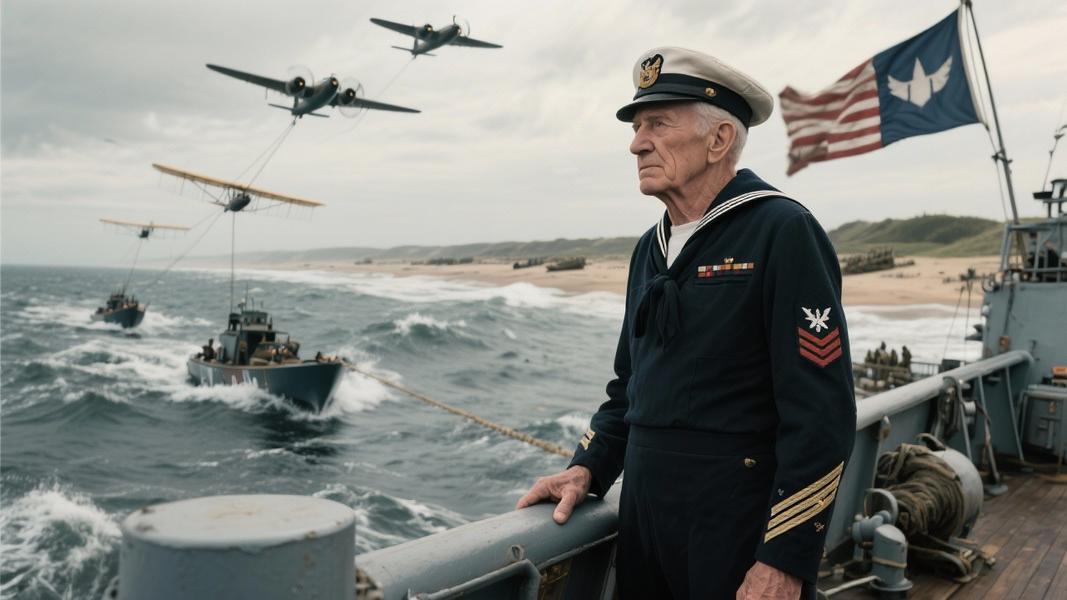
When Clyde O. Combs described his experience during the D-Day invasion as “just a bad day at the office,” he wasn’t being flippant. The former Navy Quartermaster was simply displaying the characteristic humility of many World War II veterans who viewed their extraordinary service as merely doing what needed to be done.
Born in Louisville, Kentucky on September 15, 1924, Combs witnessed firsthand two pivotal moments in American history: the Great Depression, which he recalled as a “horrible… horrible” experience for his family, and the bombing of Pearl Harbor, which he remembered vividly as “a day that will go down in my memory log for sure… 10 o’clock in the morning, on a Sunday morning.”
From Kentucky to Combat
Like many young men of his generation, Combs answered his nation’s call, enlisting in the Navy in March 1943. After training at Naval Station Great Lakes, he was assigned as Quartermaster to PT Boat Squadron 35 on PT-515 — one of the fast, nimble vessels that would play a crucial role in the coming invasion of Europe.
That role became reality when Combs and his shipmates found themselves protecting the western flank of Utah Beach during the D-Day invasion. The scene above them was unforgettable: “The sky was full of bombers, and each one was towing a glider. So, whenever they got inland, they would cut ’em loose and they would circle down, no engine, just lookin’ for a place to land,” Combs recounted years later.
His PT boat didn’t escape unscathed. During operations in enemy territory, PT-515 took a hit to its bow. Despite the damage and the danger, Combs and his fellow sailors managed to escape — one of many close calls that defined the war experience for so many.
A Life After Service
What does a veteran do after witnessing history? For Combs, who left the Navy in November 1945, the answer was to build, design, and innovate. He joined General Motors and later helped design some of the first machinery capable of burying oil pipelines at ocean depths — a technical challenge that would have seemed impossible just years earlier.
In his later career, Combs became an ADA-certified inspector, helping businesses understand and comply with accessibility regulations. “He became an ADA-certified inspector, inspecting businesses and then drawing designs to help those that did not pass inspection come into compliance,” according to records from the Texas History collection.
Looking back on his military service, did Combs harbor any regrets about the years he gave to his country during one of its darkest hours?
“The military is a good adventure, an exposure to the ‘rules of the road,'” he reflected. “It gives you a lot of experiences you wouldn’t have otherwise […] I have no regrets. I’ve lived a wonderful, wonderful, fruitful life.”
Preserving Veterans’ Voices
Combs’ story might have faded into history if not for efforts like the Voices of Veterans oral history program, championed by Texas Land Commissioner and Veterans Land Board Chairwoman Dawn Buckingham, M.D. The program ensures that veterans’ firsthand accounts are preserved and made accessible to the public, creating a permanent record of their experiences.
Through such initiatives, the matter-of-fact heroism of veterans like Clyde Combs — who downplayed extraordinary courage as simply “a bad day at the office” — will continue to inspire and educate future generations about the true meaning of service and sacrifice.
