
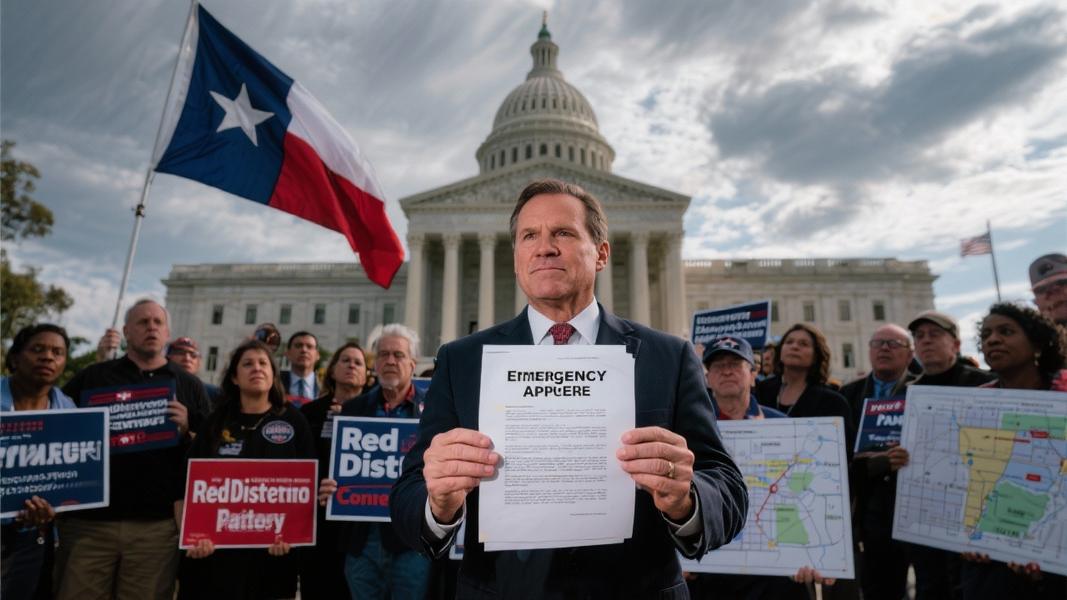
Texas Attorney General Ken Paxton has launched a last-ditch effort to salvage the state’s controversial congressional maps, filing an emergency application with the U.S. Supreme Court that could determine which party controls the House of Representatives after 2026.
The move comes after a federal three-judge panel, including one Trump-appointed judge, blocked Texas from implementing its newly drawn 2025 congressional districts, finding that racial gerrymandering — not just partisan politics — motivated the redistricting effort.
“Radical left-wing activists are abusing the judicial system to derail the Republican agenda and steal the U.S. House for Democrats,” Paxton claimed in the filing. “I am fighting to stop this blatant attempt to upend our political system.”
Racial Intent or Partisan Politics?
At the heart of the legal battle is whether Texas lawmakers drew district lines to diminish minority voting power or simply to maximize Republican advantage. The three-judge panel concluded that while partisan goals played a role, the evidence showed race was the “controlling rationale” behind the 2025 map — a distinction with profound legal implications.
“The public perception of this case is that it’s about politics,” the court wrote in its opinion. “To be sure, politics played a role in drawing the 2025 Map. But it was much more than just politics. Substantial evidence shows that Texas racially gerrymandered the 2025 Map.”
The ruling means Texas must revert to using its 2021 district boundaries for the upcoming election cycle — a map that, while still Republican-leaning, offers Democrats more competitive districts.
Governor Greg Abbott rejected the court’s findings, stating: “The Legislature redrew our congressional maps to better reflect Texans’ conservative voting preferences – and for no other reason. Any claim that these maps are discriminatory is absurd and unsupported by the testimony offered during ten days of hearings.”
Republican Judge’s Ruling Draws Fire
Notably, the opinion finding racial gerrymandering was authored by Judge Jeffrey Brown, a Trump appointee and former Texas Supreme Court justice. His involvement hasn’t shielded him from criticism within conservative circles, as some Republicans have attacked the ruling despite Brown’s conservative background.
Paxton has been particularly vocal, arguing: “For years, Democrats have aggressively gerrymandered their states and only cry foul and hurl baseless ‘racism’ accusations because they are losing.”
The Attorney General doubled down on this narrative, declaring: “The radical left is once again trying to undermine the will of the people. The Big Beautiful Map was entirely legal and passed for partisan purposes to better represent the political affiliations of Texas.”
The Numbers Tell a Different Story
What do the maps actually show? Under the challenged 2025 configuration, white voters in Texas would control 70% of Congressional districts despite comprising only about 40% of the state’s population, according to evidence presented in court.
Civil rights advocates celebrated the court’s intervention. “Today’s ruling is a victory for Black voters and other communities of color in Texas,” said Rob Weiner, Voting Rights Project Director. “The court recognized the problems with the redistricting process and halted a map that stripped power from voters of color. It is a clear violation of the Constitution to design a plan to purposefully dismantle districts where Black and Brown voters together are a majority of voters. That’s discrimination by design and that is illegal.”
Supreme Court Appeal
Texas has filed its appeal directly to the U.S. Supreme Court under a statute (28 U.S.C. § 1253) that allows for immediate review of three-judge panel decisions. The state is seeking an emergency stay of the injunction, which would allow the new maps to be used in the 2026 elections.
“I will be appealing this decision to the Supreme Court of the United States, and I fully expect the Court to uphold Texas’s sovereign right to engage in partisan redistricting,” Paxton announced.
The stakes couldn’t be higher. With Republicans currently holding a razor-thin majority in the House of Representatives, the outcome of this legal battle could determine which party controls Congress after the next election cycle.
For now, the map remains blocked as both sides prepare for a showdown at the nation’s highest court — a venue that has shown increasing skepticism toward voting rights claims in recent years but has maintained that explicit racial gerrymandering violates constitutional protections.
