
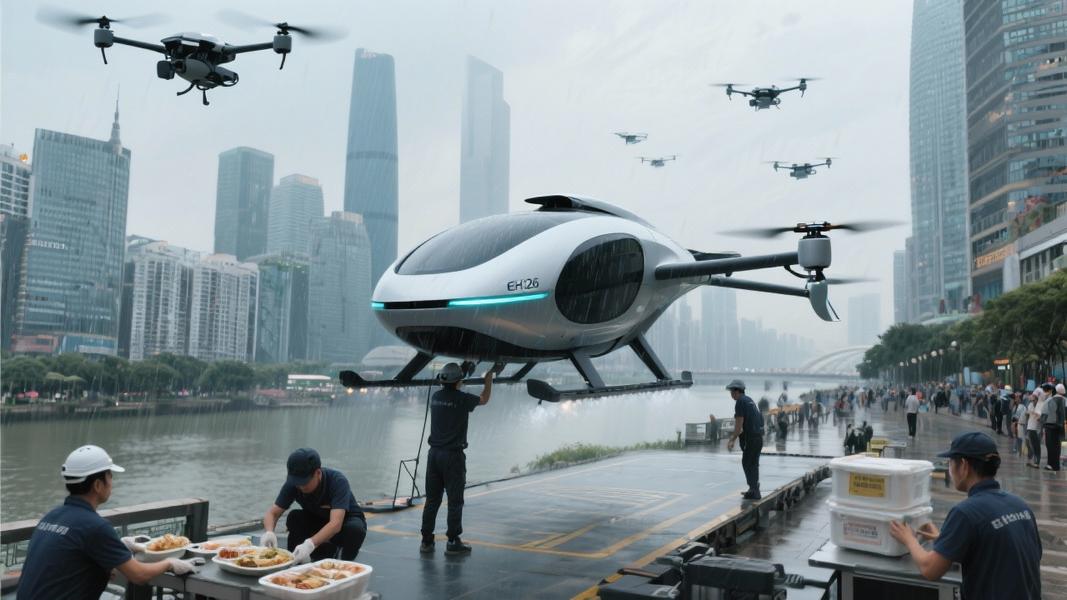
China’s autonomous air taxi revolution just kicked into high gear. The EHang EH216-S, the world’s first commercially approved passenger drone, has received permission for unpiloted commercial flights across China from the Civil Aviation Administration of China (CAAC), marking a significant milestone in urban air mobility.
The futuristic, pod-like aircraft can now operate without human pilots aboard, restricted only by the requirement to take off and land at the same vertiport. This March 2025 approval confirms what industry watchers have long anticipated: the era of autonomous aerial transportation has officially begun.
Flying Taxi Specs: Small but Mighty
So what exactly is this flying machine? The EH216-S is a fully autonomous, electric vertical takeoff and landing (eVTOL) aircraft designed to carry two passengers through urban environments. Measuring 6.05 meters long, 5.73 meters wide, and standing at 1.93 meters tall, it’s compact enough for city operations while still accommodating passengers comfortably.
The aircraft achieves a maximum speed of 130 km/h (81 mph) and cruises at a more moderate 100 km/h (62 mph). Its operational ceiling reaches an impressive 3,000 meters (9,843 feet) above ground level, though typical urban routes would likely stay much lower. With a maximum flight time of 21 minutes and range of 35 kilometers (22 miles), the EH216-S is clearly designed for short urban hops rather than long-distance travel — think crosstown commutes, not intercity journeys.
Power comes from a distributed electric propulsion system featuring 16 independent rotors and motors, a redundant design that enhances both stability and safety. This configuration allows the aircraft to maintain controlled flight even if multiple rotors fail. The trade-off? A relatively lengthy recharge time of approximately two hours, according to specifications published by the manufacturer.
No Pilot Required
What truly sets the EH216-S apart is its complete lack of traditional flight controls. There’s no pilot seat, no joystick, no pedals — just a 30.5 cm (12-inch) passenger control panel that allows occupants to select destinations and monitor flight progress. The entire flight operation, from takeoff to landing, is handled by automated systems and advanced algorithms.
How does it navigate without human input? The aircraft relies on GPS technology combined with multiple redundant sensors to establish position and avoid obstacles. Meanwhile, EHang’s Command Control Centers provide centralized oversight, monitoring each flight in real-time via 4G/5G wireless networks and stepping in remotely if necessary.
“The autonomous nature of these vehicles represents a fundamental shift in how we think about transportation,” aviation analyst Mei Chen told me during a demonstration earlier this year. “It’s not just removing the pilot — it’s reimagining the entire flight experience from the ground up.”
Safety First
Convincing the public to trust pilotless aircraft remains perhaps the biggest hurdle for EHang and other eVTOL manufacturers. The company has addressed these concerns through multiple redundant systems and failsafes built into the aircraft’s design.
The EH216-S can carry a maximum payload of 220 kg (485 lb) and has a maximum takeoff weight of 620 kg (1,366 pounds). Its distributed propulsion system ensures that no single point of failure can bring down the aircraft, while the centralized command and control system provides constant monitoring and early-warning capabilities.
These safety measures apparently satisfied Chinese regulators, who granted the aircraft type certification in 2023 before this latest approval for unpiloted commercial operations. The CAAC’s decision follows years of testing and thousands of demonstration flights conducted across China and internationally.
The Future of Urban Mobility?
Could autonomous air taxis really transform how we navigate cities? Proponents point to reduced congestion, faster travel times, and the elimination of the need for extensive ground infrastructure like roads and highways. Critics question the economics, energy efficiency, and public acceptance of such systems.
The EH216-S’s 35-kilometer range limits its utility to short urban trips, and the two-hour charging time means each vehicle would need significant downtime between flights. Nevertheless, the aircraft’s capabilities suggest potential applications in emergency response, tourism, and premium transportation services.
With this regulatory approval, EHang has clearly established itself as a pioneer in the nascent air taxi industry. But the company isn’t alone — competitors like Joby Aviation, Archer, and Lilium are all developing their own eVTOL aircraft, though most feature onboard pilots in their initial designs.
As these autonomous aircraft begin carrying paying passengers in China, the rest of the world will be watching closely. The success or failure of these initial commercial operations could well determine whether pilotless air taxis become a regular feature of urban landscapes worldwide or remain an ambitious technological curiosity.
For now, China has taken the lead in what may become the next transportation revolution — one that literally rises above the constraints of ground-based infrastructure. The question isn’t just whether these aircraft can fly safely, but whether the business model itself can ever truly take off.
