
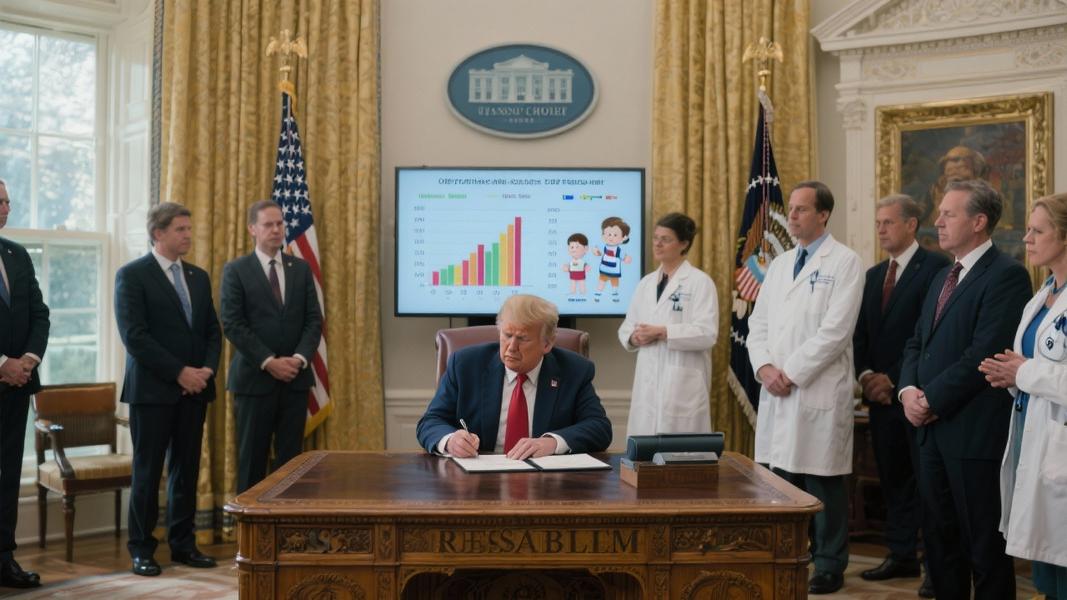
President Trump has signed a Presidential Memorandum directing health officials to review America’s childhood vaccination schedule, potentially aligning it with practices from other developed nations where fewer vaccines are routinely recommended.
The directive, signed Monday, instructs the Secretary of Health and Human Services and the CDC Director to examine whether the current U.S. childhood vaccination recommendations — which include shots for 18 diseases including COVID-19 — are out of step with peer countries like Denmark, which recommends vaccines for just 10 diseases, or Japan, which covers 14.
“If the HHS Secretary and the CDC Director determine that those best practices are superior to current domestic recommendations, they are directed to update the United States core childhood vaccine schedule to align with such scientific evidence and best practices from peer, developed countries while preserving access to vaccines currently available to Americans,” the White House stated in a fact sheet.
International Outlier Status
The move comes amid growing recognition that American vaccination practices differ significantly from those of other developed nations. “Among peer nations, the United States is a high outlier in the number of vaccinations recommended for all children,” the administration noted in supporting documents.
Several specific practices set the U.S. apart. American health authorities recommend yearly flu shots beginning at six months of age, while many peer countries don’t include annual influenza vaccination as a core recommendation for all children. The administration also highlighted that “practices like the hepatitis B vaccination at birth are standard in the United States, but uncommon in most developed countries, where it is typically only recommended for newborns of mothers who test positive for the infection.”
Why such differences? That’s the question the review aims to answer, determining whether these variations reflect superior science or simply different approaches to public health.
Part of a Broader Health Initiative
This vaccination review fits within Trump’s broader health agenda established earlier this year. “In February, President Trump signed an Executive Order establishing the President’s MAHA Commission, tasking the Commission with investigating and addressing the root causes of America’s escalating health crisis—with an initial focus on childhood chronic diseases,” the administration explained.
The MAHA (Make America Healthy Again) Commission has been busy. In May, it released an assessment summarizing current knowledge about childhood chronic disease in America, and by September had produced a comprehensive strategy featuring over 120 initiatives aimed at reversing what they describe as “failed policies that fueled America’s childhood chronic disease epidemic.”
The administration has already made changes to some vaccine recommendations. “The Trump Administration ended the blanket recommendation for all children to get the COVID-19 vaccine, updating its recommendation to be based on shared clinical decision-making between patients and clinicians,” according to the White House document.
Maintaining Access
Despite the review, the administration emphasizes that access to currently available vaccines will be maintained. The memorandum specifically instructs officials to preserve availability of existing vaccines even if the recommended schedule changes.
Still, the move is likely to spark debate among public health experts, some of whom may argue that America’s more comprehensive vaccination schedule provides broader protection against preventable diseases.
What remains to be seen is whether this review will lead to meaningful changes in how American children are vaccinated — or simply confirm current practices with greater transparency about the reasoning behind them. Either way, it signals a shift toward comparing U.S. health policies with international standards rather than treating American approaches as inherently optimal.
