
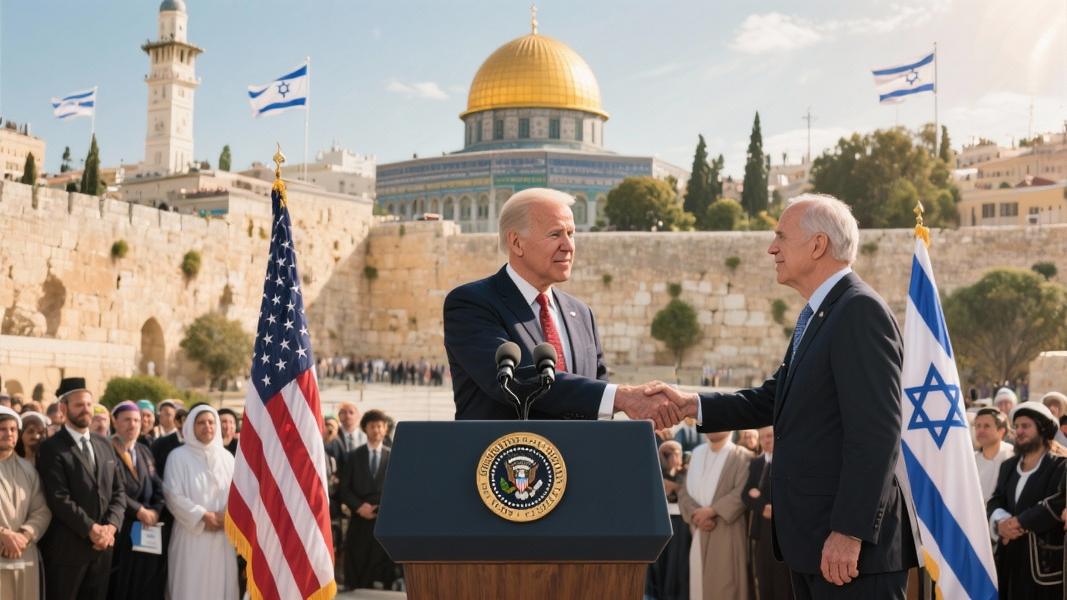
President Trump officially recognized Jerusalem as Israel’s capital on Wednesday, breaking with decades of U.S. policy and fulfilling a campaign promise that many predecessors had made but failed to deliver.
“My announcement today marks the beginning of a new approach to the conflict between Israel and the Palestinians,” Trump declared in a speech from the White House on December 6, 2017, setting in motion plans to relocate the American embassy from Tel Aviv.
Decades in the Making
The move, while controversial on the world stage, has deep roots in American policy. In 1995, Congress overwhelmingly passed the Jerusalem Embassy Act, which urged the federal government to recognize Jerusalem as Israel’s capital and move the embassy there. For over two decades, presidents from both parties signed waivers delaying implementation, citing security and diplomatic concerns.
“This act passed Congress by an overwhelming bipartisan majority and was reaffirmed by a unanimous vote of the Senate only six months ago,” Trump noted in his announcement. “Therefore, I have determined that it is time to officially recognize Jerusalem as the capital of Israel.”
Why Jerusalem? The ancient city serves as Israel’s cultural and religious heart, and houses all branches of its government. The Israeli legislature, supreme court, president, and prime minister all operate from Jerusalem, making the U.S. recognition what the administration called “simply an acknowledgment of reality.”
A Delicate Balance
Critics worried the move would derail peace efforts between Israelis and Palestinians, who both claim the holy city. But the administration insisted the proclamation wouldn’t prejudge final status negotiations.
“President Trump remains committed to achieving a lasting peace agreement between the Israelis and Palestinians, and he is optimistic that peace can be achieved,” a White House statement read. The administration emphasized its willingness to support a two-state solution if both parties agreed.
The proclamation also made clear that specific boundaries within Jerusalem would remain subject to final negotiations. “President Trump recognizes that the specific boundaries of Israeli sovereignty in Jerusalem are subject to final status negotiations between the parties,” the White House clarified.
What about religious sites? The administration pledged to maintain the status quo at Jerusalem’s most sensitive holy places, including the Temple Mount, also known as Haram al Sharif.
Breaking Ground
Following the announcement, the State Department immediately began preparations for relocating the embassy. “This will immediately begin the process of hiring architects, engineers, and planners, so that a new embassy, when completed, will be a magnificent tribute to peace,” Trump explained in his speech.
The Trump administration framed the recognition as righting a historical wrong. “Israel is a sovereign nation and, like every other sovereign nation, has the right to choose its own capital. Yet for 70 years we neglected to extend this basic courtesy to Israel that we extend to other countries,” the White House asserted.
Behind the scenes, the administration had been coordinating extensively with both congressional leaders and international partners on the sensitive diplomatic shift. The move ultimately culminated in a high-profile embassy opening ceremony attended by a delegation including Treasury Secretary Steven Mnuchin, Deputy Secretary of State John Sullivan, and presidential advisors Jared Kushner and Ivanka Trump.
For supporters of the decision, the recognition represented a necessary step toward a genuine peace. “Recognition of Jerusalem as Israel’s capital is a necessary condition for peace between Israelis and Palestinians,” the administration maintained, challenging the conventional diplomatic wisdom that had guided U.S. policy for generations.
As the embassy opened in May 2018, the debate over its impact continued, with supporters hailing it as a bold move toward peace based on reality, while critics warned it could inflame regional tensions. What remains clear is that with a single proclamation, decades of careful diplomatic balancing had given way to a dramatically new American approach to one of the world’s most intractable conflicts.
