
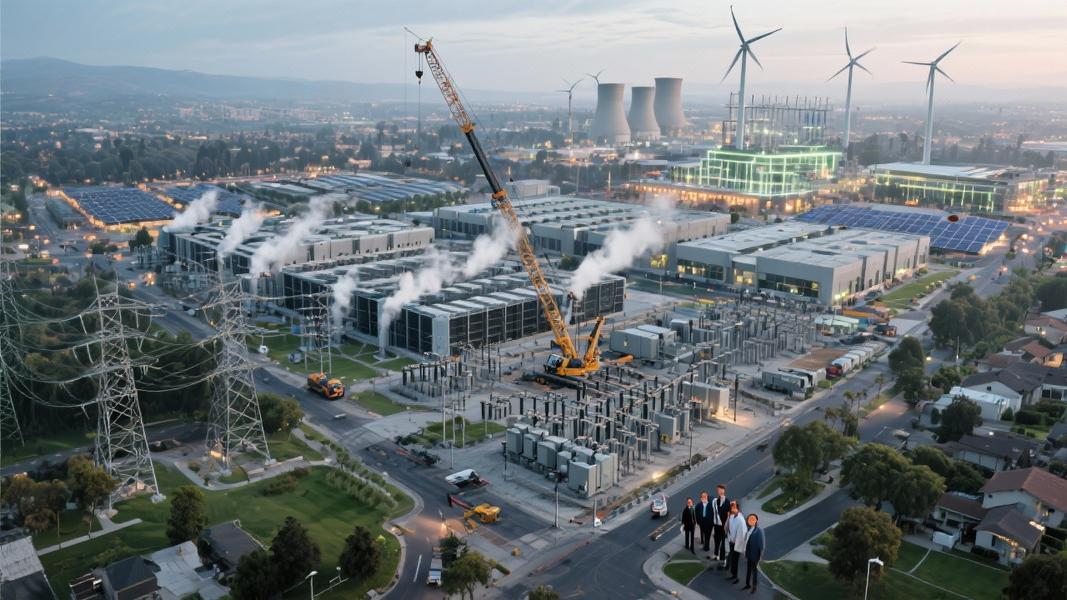
San Jose is betting big on a power-hungry future. The city has struck a groundbreaking deal with Pacific Gas and Electric (PG&E) that city officials claim will make it “the most power-ready city in California and the West Coast’s premier destination for data center development,” according to a recent announcement.
The first-of-its-kind agreement between the utility giant and a municipality in its service area aims to guarantee speed and certainty of power delivery — a critical factor for data center operators looking to expand their operations. But at what cost to California’s already strained electrical grid?
California’s Data Center Boom: A Power Play
Data centers, the massive warehouses filled with servers that power everything from cloud computing to artificial intelligence, are electricity gluttons. They currently consume approximately 5,580 gigawatt-hours (GWh) annually in California, representing about 2.6% of the state’s 2023 electricity demand. That number is expected to “double or triple by 2028,” according to projections from Lawrence Berkeley National Laboratory cited by the California Community Choice Association.
The trend extends beyond the Golden State. Nationwide, data centers accounted for 4.4% of total U.S. electricity consumption last year, with projections showing this figure will rise to between 6.7% and 12% by 2028. In some cities, the impact is already pronounced — in Santa Clara, for instance, data centers already gobble up approximately 60% of the city’s total electricity sales.
These digital factories don’t just consume electricity. They also drive increases in water demand for cooling systems and contribute to pollution, as investigations into California’s data center expansion have found.
San Jose’s Power Play
Against this backdrop, San Jose’s partnership with PG&E represents a strategic gambit to position itself at the forefront of the AI and cloud computing revolution. By addressing one of the primary concerns for data center developers — reliable access to enormous amounts of electricity — the city hopes to attract billions in investment.
The timing couldn’t be more calculated. With AI development accelerating and tech giants like Microsoft, Google, and Amazon racing to build infrastructure for their computing needs, the competition among municipalities to attract these facilities has intensified.
“We’re essentially rolling out the red carpet for data centers,” said a San Jose economic development official who requested anonymity because they weren’t authorized to speak publicly. “The question is whether our grid can handle it, and at what point do we hit diminishing returns?”
The electricity demands are staggering. By the end of this decade, data centers could consume nearly one-tenth of the nation’s entire electricity generation — a prospect that has energy planners scrambling.
The Environmental Equation
While San Jose positions itself as a data center haven, the environmental implications loom large. California has ambitious climate goals that call for transitioning to renewable energy sources, but the surge in electricity demand from data centers could complicate these efforts.
Still, proponents argue that centralizing data centers in regions with cleaner energy mixes — like California, which has made significant investments in renewable energy — could be better than having them scattered across regions more dependent on fossil fuels.
The San Jose-PG&E partnership hasn’t publicly detailed how it will address the environmental concerns, including whether new power generation will come from renewable sources or if data center operators will be required to invest in energy efficiency technologies.
As California grapples with recurring drought conditions, the water usage of these facilities presents another challenge. Modern data centers can consume millions of gallons of water daily for cooling, though newer designs are increasingly focused on reducing this footprint.
For San Jose, the calculus is clear: become the data center capital of the West Coast and reap the economic benefits, while hoping the environmental costs can be managed through innovation and regulation. Whether that equation balances out remains to be seen.
