
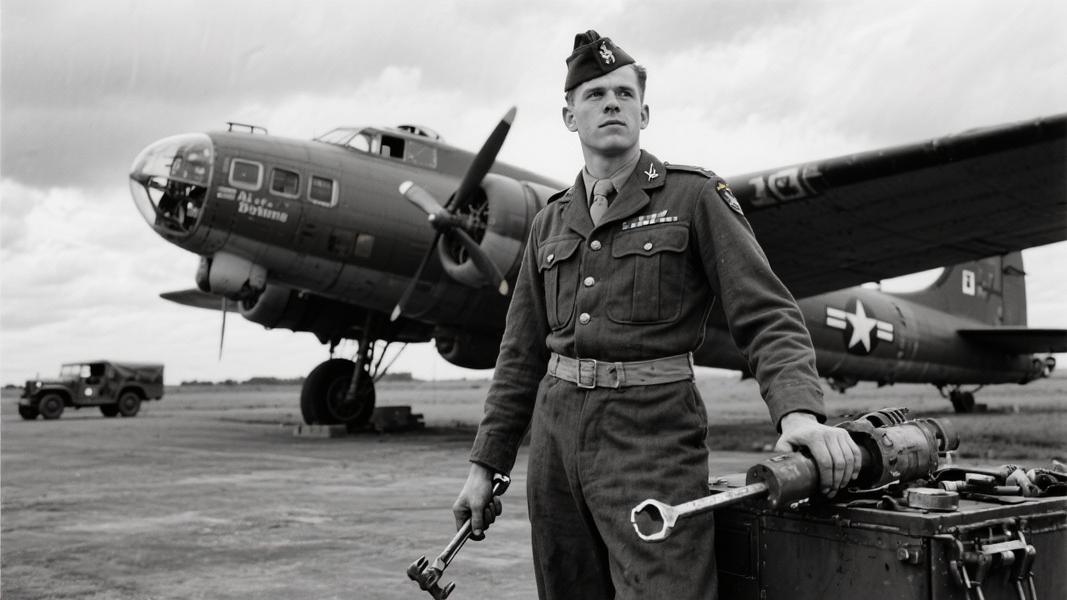
From engine mechanic to aerial gunner, Staff Sergeant John F. Bremer Jr. embodied the immigrant’s journey in America’s greatest conflict. Born in Germany and later serving in the U.S. Army Air Corps during World War II, Bremer’s story represents thousands who fought for their adopted homeland against the country of their birth.
Bremer’s military career took a dramatic turn when he transitioned from his role as a B-17 aircraft mechanic to a waist gunner position with the 379th Bomb Squadron. In this capacity, he would complete 30 combat missions over Nazi-occupied Europe, flying in the vulnerable “Flying Fortress” bombers that faced intense anti-aircraft fire and enemy fighters on each sortie.
From Immigrant to American Warrior
What drives someone to take up arms against their homeland? For Bremer, like many German-Americans during WWII, the answer likely lay in a profound commitment to American democratic values that stood in stark contrast to the Nazi regime. His service history has been documented by the Texas General Land Office as part of their Voices of Veterans oral history program.
“Thirty missions was considered a full tour,” explains military historian Dr. James Wilson, who wasn’t involved in Bremer’s documentation but has studied bomber crew experiences extensively. “Each mission carried roughly a 4% chance of not returning. Do the math – that’s extraordinary risk these young men accepted.”
The 379th Bomb Squadron, where Bremer served, was part of the Eighth Air Force, the principal American bomber force stationed in England. Their daylight precision bombing strategy, while tactically important, resulted in heavy casualties among aircrews.
Dual Expertise: Mechanic and Gunner
Bremer’s transition from mechanic to gunner reflects the Air Corps’ practice of cross-training personnel. As a waist gunner, he would have manned one of the .50-caliber machine guns positioned on the midsection of the aircraft, scanning the skies for enemy fighters while enduring sub-zero temperatures at high altitude.
The survival of Bremer through 30 missions stands as a testament to both skill and fortune. Many bomber crews didn’t make it past their first five missions.
Still, the psychological toll of combat missions cannot be overstated. Veterans like Bremer returned home carrying memories of fallen comrades and close calls that would remain with them for a lifetime.
Legacy of Service
Immigrant soldiers like Bremer represented a significant portion of America’s fighting forces during WWII. Approximately 300,000 foreign-born Americans served in the U.S. military during the conflict, with many facing the painful reality of fighting against their countries of origin.
Extraordinary, isn’t it? These men often faced suspicion at home while proving their loyalty in the most definitive way possible – risking their lives for their adopted nation.
Bremer’s story, preserved through oral history initiatives, offers valuable insights into the immigrant experience during America’s most consequential military conflict. His 30 successful missions represent not just personal courage but also the technical proficiency of the mechanics-turned-gunners who kept America’s air campaign operational.
As the greatest generation continues to fade from living memory, accounts like Bremer’s serve as crucial reminders of both the human cost of war and the contributions of America’s immigrant communities to securing victory against fascism – a victory won by Americans of all backgrounds, including those who once called enemy nations home.
