
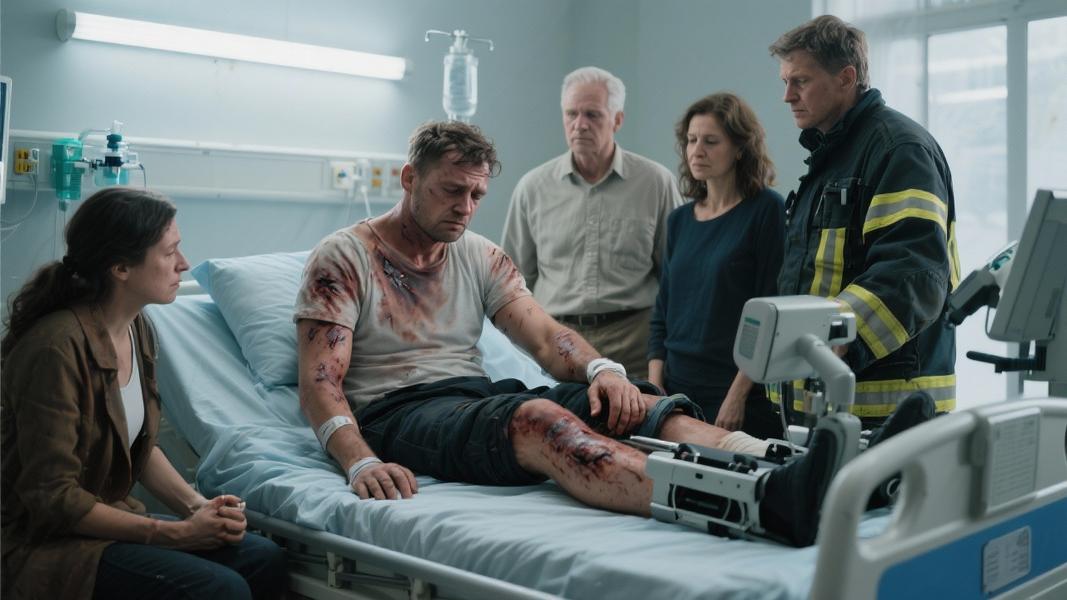
Fort Worth firefighter Caleb Halvorson has finally returned home after a harrowing 34-day stay in Parkland Hospital’s burn unit, but his path to recovery hasn’t been straightforward. The firefighter, who suffered extensive injuries after being pinned under a collapsed roof during a residential structure fire on September 3rd, found himself fighting not just for his health, but against a bureaucratic system that initially denied him critical care.
A Double Family Crisis
As if Halvorson’s injuries weren’t challenging enough, his family was simultaneously navigating another medical crisis. His son Hudson was born 13 weeks premature, spending a grueling 112 days in the NICU before finally joining his father at home. The dual medical emergencies created what can only be described as an overwhelming situation for the Halvorson family, who are now finally healing together under one roof after months of separation and uncertainty.
What should have been a straightforward workers’ compensation case quickly became a public controversy when Sedgwick, the workers’ compensation company handling Halvorson’s claim, initially denied medical care for the severely burned firefighter. “[The doctor] said I needed this, and it was denied,” Halvorson explained in describing how the company rejected specialized medicine, equipment, and even his chosen doctors.
The denial sparked immediate outrage. How could a first responder injured in the line of duty be denied the very care his medical team deemed necessary? The public’s reaction was swift and forceful, with community members, fellow firefighters, and local media rallying to Halvorson’s defense.
Public Pressure Forces Reversal
Facing mounting backlash, Sedgwick ultimately reversed course. The company approved the previously denied care after the story gained traction across Texas news outlets. The pressure from public opinion proved too significant to ignore, highlighting the power of community advocacy when systems designed to protect first responders fail.
Halvorson’s ordeal began during what started as a routine response to a house fire in Fort Worth. The situation quickly deteriorated when part of the structure collapsed, leaving him pinned under a fallen roof. Fellow firefighters rescued him from the wreckage, but not before he sustained serious burns requiring specialized treatment.
A fundraising campaign was quickly established to help support the Halvorson family through their dual medical challenges. The campaign page details the severity of Caleb’s injuries and the extended recovery period he faces in the months ahead, compounded by the special care needed for his premature son.
A Family Healing Together
The silver lining in this difficult story is that both father and son are now finally home. After more than three months of separation—with Hudson in the NICU and Caleb in Parkland’s burn unit—the family has been reunited under one roof to continue their healing journey together.
Still, Halvorson’s case raises troubling questions about how workers’ compensation systems treat first responders injured in the line of duty. Would his care have been approved without the media spotlight and public outcry? For many firefighters and other emergency personnel watching this case unfold, the initial denial represents a concerning precedent about the support systems in place for those who risk their lives for public safety.
For now, the Halvorson family is focused on recovery and reunion, taking each day as it comes while the community continues to rally behind them in their time of need.
