
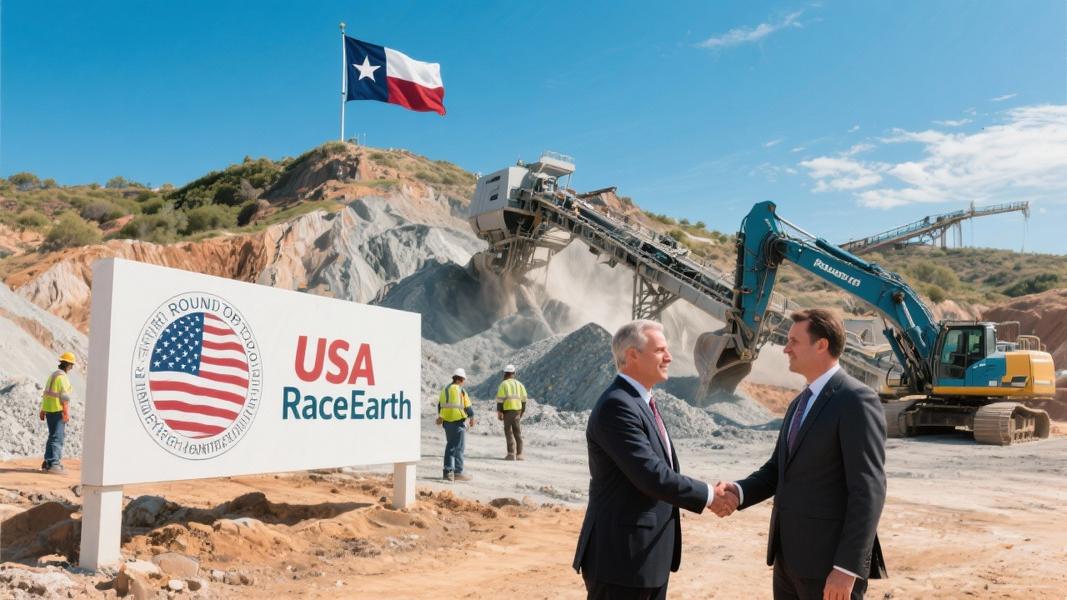
The Trump administration is placing a $1.6 billion bet on American rare earth minerals in a high-stakes move to break China’s dominance in critical materials essential to national security and advanced technology.
In what officials describe as a strategic investment, the Department of Commerce has committed to providing USA Rare Earth with $277 million in direct funding and $1.3 billion in loans to develop the company’s Round Top deposit in Texas. The financing package, authorized under the CHIPS Act, grants the federal government an ownership stake between 8-16% in the venture, which aims to begin commercial production by 2028.
“This partnership between the U.S. Department of Commerce and USA Rare Earth will help break China’s hold on rare earth minerals, strengthen our national security, and create jobs here in Texas,” said Texas Land Commissioner Dawn Buckingham, who applauded the investment in state-owned land.
Why does this matter? The Round Top Mountain project targets elements like praseodymium, terbium, and yttrium — obscure names with outsized importance in semiconductors, aerospace, defense systems, and clean energy technology. China currently controls the vast majority of the global rare earth supply chain, creating what national security experts have long identified as a critical vulnerability for American industries.
Building Domestic Supply Chains
Under the agreement, USA Rare Earth plans to extract approximately 40,000 metric tons of rare earth feedstock daily from the Round Top deposit. The company has entered a non-binding letter of intent with the Commerce Department and will also collaborate with the Department of Energy on the project, which includes both the Texas mine and a magnet manufacturing facility planned for Oklahoma.
Commerce Secretary Howard Lutnick emphasized the strategic importance of the investment. “USA Rare Earth’s heavy critical minerals project is essential to restoring U.S. critical mineral independence,” Lutnick stated. “This investment ensures our supply chains are resilient and no longer reliant on foreign nations.”
The financial package includes the government receiving 16.1 million shares of common stock in USA Rare Earth, plus rights to acquire an additional 17.6 million shares — cementing the unusual public-private partnership structure that gives taxpayers a direct stake in the venture’s success.
Part of a Broader Strategy
This isn’t the administration’s first foray into rare earth investments. The Pentagon has already committed $400 million to MP Materials, along with a $150 million loan, while a separate $1.4 billion partnership with Vulcan Elements and ReElement Technologies was announced earlier.
But can these investments truly shift the global balance of power in critical minerals? Experts note that China’s decades-long head start in processing capacity and technical expertise won’t be overcome quickly, even with significant financial backing.
The timeline for USA Rare Earth’s project underscores this challenge. Despite the substantial investment announced today, commercial production isn’t expected until 2028 — highlighting the long-term nature of developing alternative supply chains for these strategic materials.
For now, the administration is betting that this combination of public funding and private expertise will finally establish a domestic rare earth industry capable of meeting America’s growing needs — a gamble whose outcome will likely be determined long after the current political moment has passed.
