
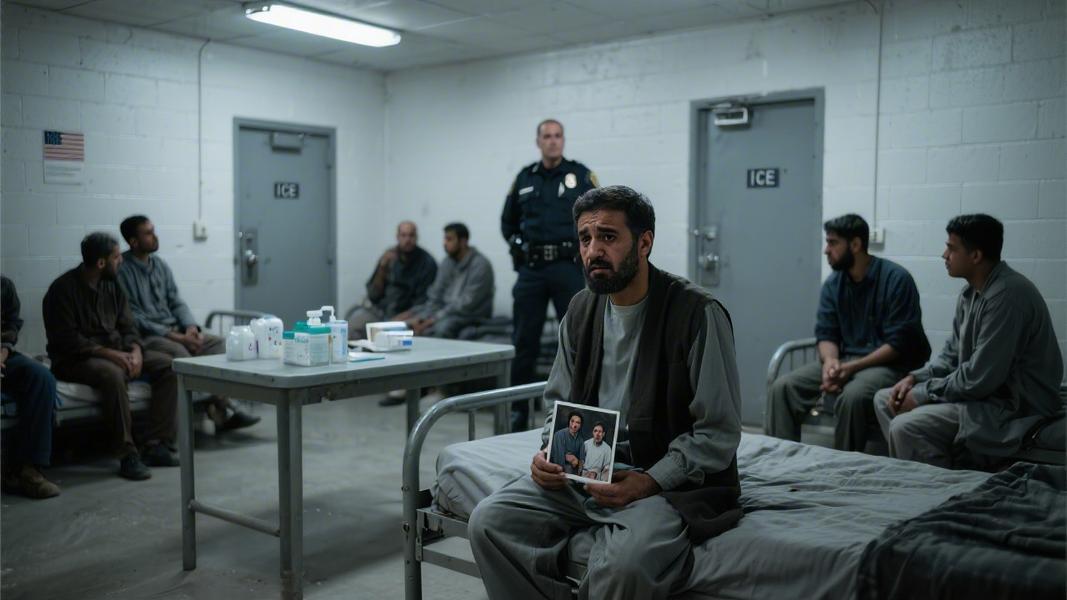
An Afghan father of six who once worked alongside U.S. Special Forces was dead within 24 hours of being arrested by immigration agents outside his children’s school. Now his family, his community, and at least one member of Congress want to know why.
Mohammad Nazeer Paktiawal, 41, died on the morning of March 14, 2026, at Parkland Hospital in Dallas while in the custody of U.S. Immigration and Customs Enforcement. His death — rapid, largely unexplained, and following a medical emergency that unfolded inside an ICE holding room — has drawn scrutiny over the agency’s detention practices and its treatment of Afghan nationals who served as allies during the two-decade American war in Afghanistan.
Arrested at the School Drop-Off Line
The morning of March 13 started the way most mornings do for a father with six kids. Paktiawal was driving his children to school in Richardson, Texas, when masked ICE agents intercepted him in what the agency described as a targeted enforcement action. It was around 7 a.m. He never made it home. CBS News reported that Paktiawal had no prior convictions — the charges cited by ICE, SNAP fraud filed in September 2025 and a theft charge filed in November 2025, had not been adjudicated in court.
His parole status, which had allowed him to remain in the United States after fleeing Afghanistan, had technically expired in August 2025. But that’s not the whole picture. At the time of his arrest, Paktiawal held valid work authorization and had a pending asylum case — a legal process that, in theory, should have kept his immigration status in a kind of protected limbo while the courts caught up. The Dallas Express quoted Rep. Julie Johnson relaying what ICE agents told her: “His legal status had expired, that he had not renewed the process to stay here with his permit intact.” Whether that explanation satisfies the legal or moral threshold for detention — given his service record and pending case — is exactly what critics are now challenging.
What Happened Inside That Hold Room
After his arrest, Paktiawal was taken to ICE’s Dallas Field Office. He began complaining of shortness of breath and chest pains. Agents transported him to Parkland Hospital, where he received breathing treatment and was held for observation. He had no known prior medical history, according to the Texas Tribune.
Then came the morning of March 14. During breakfast, Paktiawal’s tongue swelled. Medical staff administered an epinephrine drip and performed CPR. At 9:10 a.m., he was pronounced dead. He had been in federal custody for less than 24 hours.
What exactly caused the cascade of symptoms — the breathing trouble, the apparent allergic reaction, the cardiac arrest — has not been officially explained. And that silence is where grief turns into something sharper.
“Thousands of Questions and No Answers”
How do you begin to make sense of something like this? His brother, Naseer Paktiawal, didn’t mince words. “All I want,” he said, “is justice for my brother. I don’t need anything else from this government.” It’s a sentence that carries the full weight of what his family has been through — the flight from Afghanistan, the years building a life in Texas, and now this.
His body was returned to a mosque in Richardson on March 17, three days after his death, as community members gathered and demanded transparency. Asad Noorzay, a friend of the family and community member, put it plainly in statements following the return of his remains: “We have thousands of questions and no answers yet.”
Rep. Julie Johnson, who represents the Richardson area, has also raised pointed concerns about the detention itself — questioning why a man with a pending asylum case, a history of cooperation with U.S. Special Forces, and no criminal convictions was arrested at all, let alone held in a way that ended with his death. Fox4 noted that Paktiawal’s work authorization was still valid at the time agents took him into custody.
A Complicated Legacy, A Simple Demand
Still, federal agencies have said little. ICE has not publicly released a detailed account of the medical timeline or any internal review findings. The charges that formed the basis for his arrest remain unresolved in court. His asylum case — the one that was supposed to give him a path forward — sits in a docket somewhere, now moot.
Paktiawal’s story sits at the intersection of several fault lines in American immigration policy: the treatment of Afghan allies brought over after the 2021 Kabul withdrawal, the use of pending criminal charges as grounds for detention before any conviction, and the question of what duty of care ICE holds for people in its custody. None of those questions are new. But his death makes them impossible to look away from.
Six children lost their father outside a school in Richardson, Texas, on an ordinary Thursday morning. Whatever the government’s eventual explanation turns out to be, that part doesn’t change.
