
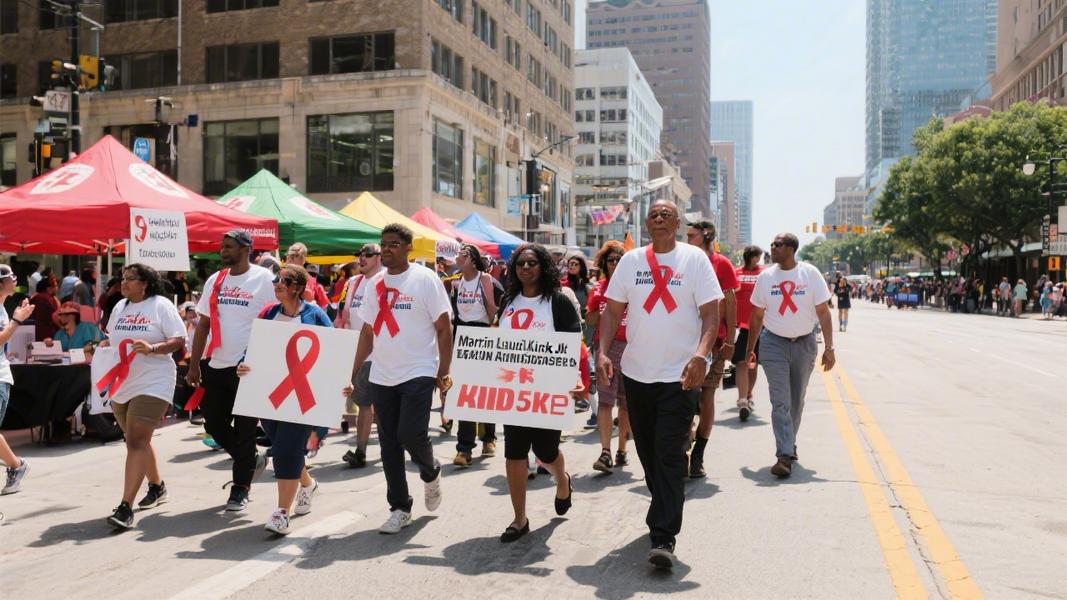
For sixteen years, a stretch of South Dallas has transformed one morning a year into something between a protest and a prayer — thousands of people walking together to say, plainly, that HIV hasn’t been forgotten. This past Saturday was no different.
The 16th Annual AIDS Walk South Dallas took place on March 21, 2026, drawing crowds to the Martin Luther King Jr. Community Center at 2922 Martin Luther King Jr. Blvd. for a 5K walk and run that doubled as a community health fair, testing site, and, for many attendees, something closer to a lifeline. The theme this year: “WE ALL MATTER.” Three words. Simple enough that they shouldn’t need to be said. And yet.
A Walk That Does More Than Walk
More than 21,000 people in Dallas County are currently living with HIV/AIDS, according to organizers — a number that puts the epidemic in sharp local relief. AIDS Walk South Dallas, Inc., the 501(c)(3) nonprofit behind the event, has spent years trying to close the gap between that statistic and the silence that too often surrounds it. In 2025 alone, the organization served over 1,500 people living with or affected by HIV through education and direct services funded by donor and walker support.
Registration wasn’t free — walkers were required to raise a minimum of $25, with teams encouraged to reach $1,000 — but the barrier to entry was deliberately low. The point, organizers have long argued, is getting people there first. Everything else follows.
“Some of the people that come to this walk would never walk into a clinic, would never walk into a hospital, would never walk into an organization,” said Auntjuan Wiley, President and CEO of AIDS Walk South Dallas, “but they will come out and participate in this community event.” That quote, noted ahead of the event, has become something of a mission statement for the walk itself.
Still a Taboo — And That’s the Problem
How do you fight a disease when people still won’t say its name out loud? That’s not a rhetorical question for Christopher Walker, a board member with the organization who’s been living with HIV since his diagnosis in 2017 — the year he graduated college. “HIV is still very much a taboo topic,” he told reporters. “Folks are not having conversations around HIV, and society makes people living with HIV feel like they are less than and not worth it.”
It’s a candid admission, and a brave one. Walker’s willingness to speak publicly about his status reflects exactly the kind of visibility the walk is designed to create — not just awareness in the abstract, but faces, names, and stories that make it harder to look away.
Board member Helen Zimba put it more bluntly. “People need to know that it does not discriminate, anybody can get HIV,” she emphasized. “They need to know people are people, everybody needs help.” Short sentences. Heavy weight.
Testing, Counseling, and a 6:30 AM Call Time
The event kicked off at 8:00 AM, but volunteers were asked to arrive by 6:30 AM — a detail that says something about the operational scale involved. The organization needed 30 volunteers, all aged 16 or older and vaccinated, handling everything from setup to food service to vendor monitoring. It’s the unglamorous infrastructure that makes community events like this actually function.
On-site, more than a dozen HIV/AIDS prevention groups set up booths offering free testing and counseling — making the walk simultaneously a 5K and a pop-up public health clinic. That dual purpose is intentional. For some attendees, the walk route may be the least important part of the morning.
Sixteen Years and Counting
Still, there’s something worth sitting with here. Sixteen years is a long time to hold an annual event. It means sixteen years of showing up, raising money, and reminding a city that a crisis it might prefer to forget is still very much present — on its streets, in its clinics, in its families.
“WE ALL MATTER” isn’t just a theme. For the more than 21,000 Dallas County residents living with HIV, it’s a direct rebuttal to a stigma that, as Christopher Walker can tell you firsthand, doesn’t ease up just because the calendar turns.
The walk happened Saturday morning. The work, as it always does, continues Monday.
