
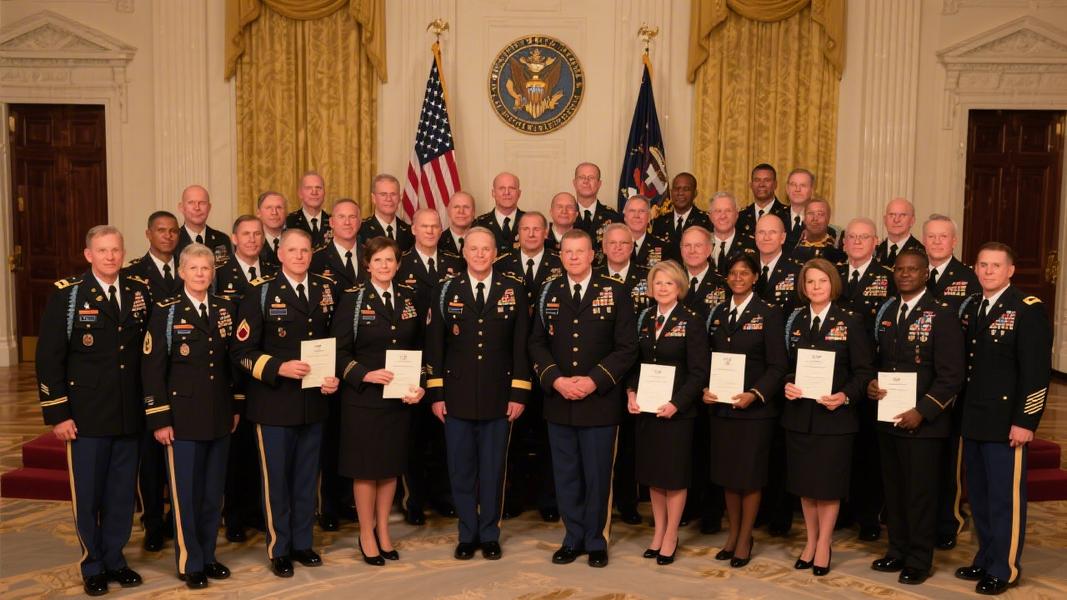
Twenty-six Army colonels are headed for a star — if the Senate has anything to say about it. Secretary of War Pete Hegseth announced Thursday that President Trump has nominated the group for appointment to the grade of brigadier general, a sweeping slate of promotions spanning roles from cybersecurity command to nuclear weapons oversight to frontline diplomatic posts.
The nominations, announced on March 27, 2026, represent one of the Army’s most significant single-day general officer promotion pushes in recent memory. The selected colonels currently hold positions across the globe and throughout the military’s most sensitive commands — a signal, defense analysts say, of where the Army believes its future leadership priorities lie.
From Baghdad to the Pentagon
Among the nominees, Army Col. Stephanie A. Bagley stands out for her current posting. She’s serving as senior defense official and defense attaché at the U.S. Embassy in Iraq — a role that puts her at the intersection of military diplomacy and active regional tensions. Her nomination suggests the Army isn’t just rewarding operational command experience; it’s increasingly valuing officers who can operate in complex political and diplomatic environments.
Col. John D. Bishop, meanwhile, comes from the other end of the operational spectrum. He’s currently the deputy commander for operations at 1st Special Forces Command (Airborne) at Fort Bragg, North Carolina — the kind of posting that tends to produce hard-nosed, mission-first general officers. Special Forces commands don’t exactly breed bureaucrats.
The Emerging Domains: Cyber and WMD
Two nominations in particular reflect just how much the Army’s threat landscape has shifted. Col. Stephen J. Miko is currently deputy commander of Joint Force Headquarters-Cyber at U.S. Army Cyber Command in Fort Gordon, Georgia — a post that didn’t exist in its current form a decade ago. The fact that a cyber commander is on the brigadier general track underscores how seriously the service is treating digital warfare as a core military domain, not an afterthought.
Then there’s Col. Jarrod J. Gillam, whose current role as director of the U.S. Army Nuclear and Countering Weapons of Mass Destruction Agency at Fort Belvoir, Virginia, might be the most quietly consequential job on the entire list. Nuclear readiness and WMD countermeasures aren’t glamorous headlines — until they are. His nomination sends a clear message about institutional priorities.
Inside the Building
Not every path to a star runs through a combat zone or an exotic posting. Col. Kelly K. Steele is currently chief of the General Officer Management Office in the Office of the Chief of Staff of the Army at the Pentagon. That’s the office, in other words, that essentially manages the Army’s generals. There’s a certain symmetry — maybe even a wink — in nominating its chief for generalship.
Still, it’s worth noting what these nominations represent procedurally. They’re just that — nominations. The Senate must confirm each one before any colonel pins on a star. In today’s political climate, that’s not always a rubber stamp. Defense nominations have faced unexpected delays and holds in recent years, and there’s no guarantee this slate moves quickly through a chamber that’s had no shortage of other priorities.
That said, brigadier general nominations historically enjoy broad bipartisan support, and a list this large typically moves in bulk rather than individual scrutiny — confirmed en masse as part of the chamber’s routine military business.
A Broader Reshaping
The full list of 26 nominees — only a portion of whom are detailed in Thursday’s release — reflects an Army in the middle of a generational leadership transition. The officers being tapped now are, by and large, products of the post-9/11 era: shaped by Iraq, Afghanistan, the rise of near-peer competition, and the emergence of cyber and space as genuine warfighting domains.
Whether the Senate moves swiftly or slowly, the nominations themselves tell a story. The Army is betting its next generation of generals will need to be as comfortable in an embassy in Baghdad as they are in a command post at Fort Bragg — or staring down a spreadsheet of nuclear vulnerabilities in a windowless office in Virginia.
Twenty-six colonels are waiting to find out if the institution’s bet pays off for them personally. For now, the stars are within reach — but not yet on the collar.
