
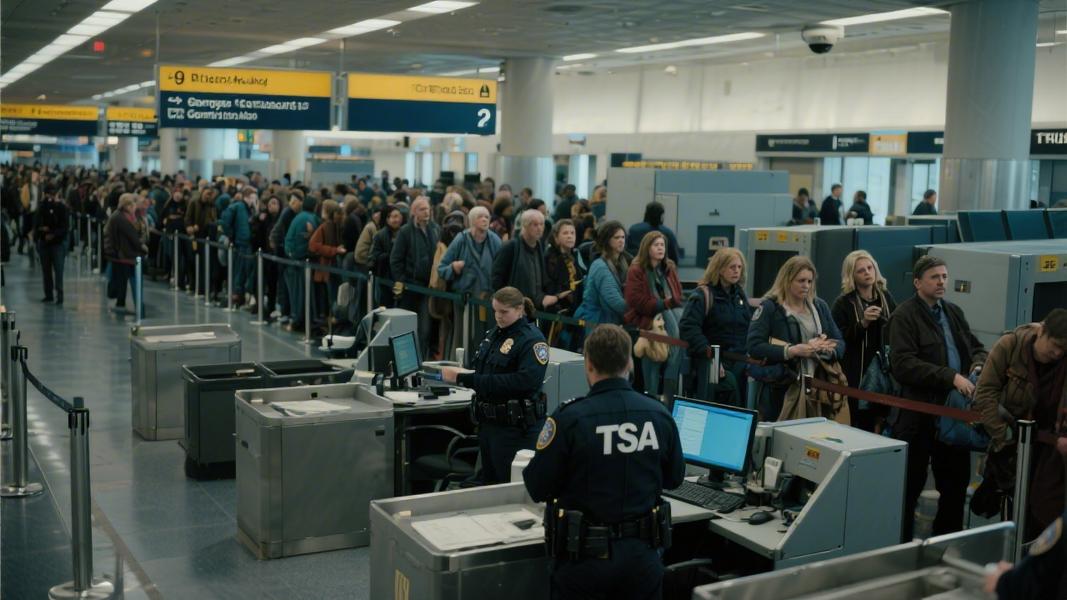
The airport security lines are still moving — for now. But behind the scenes, the agency keeping them that way is coming apart at the seams.
The Transportation Security Administration is facing one of the most severe operational crises in its two-decade history, as a prolonged government shutdown has triggered a wave of worker callouts, mass resignations, and missed paychecks that have left airport security staffing levels dangerously thin across the country. President Trump signed a memorandum on March 27, 2026, directing emergency measures to stabilize the agency — but whether those measures arrive in time is an open question, and not a comfortable one.
A Workforce on the Edge
The numbers are stark. Callout rates at major TSA checkpoints have surged to levels that administrators privately describe as unsustainable, with some airports reporting that one in five scheduled officers simply didn’t show up for their shifts. It’s not hard to understand why — these are federal workers who’ve gone weeks without a paycheck, many of them living paycheck to paycheck like most Americans do.
Some didn’t just call out. They quit. Resignations have climbed sharply since the shutdown began, as TSA officers — who are already among the lower-paid federal employees — made the cold, practical calculation that a retail job or a warehouse shift would actually put food on the table. The agency confirmed it has lost a significant portion of its frontline workforce since the funding lapse began, though officials have been reluctant to release precise figures.
Trump Acts — But the Timeline Is Tight
On March 26, Trump announced his intention to intervene, and the memorandum followed the next day. The directive instructs relevant agencies to explore emergency pay mechanisms and retention incentives for TSA personnel deemed essential to national security operations. It’s a move that acknowledges the severity of the situation — even as the administration that presided over the shutdown is the one now scrambling to contain its consequences.
That’s the catch, isn’t it? The White House is essentially trying to patch a wound it helped open. Democrats on Capitol Hill have been quick to point that out. “You don’t get credit for putting out a fire you started,” one senior Democratic appropriator told reporters this week, declining to be named because negotiations are still ongoing.
Airlines Are Watching Nervously
The airline industry, never shy about making its anxiety known, has been lobbying hard behind the scenes. CEOs from several major carriers have raised alarms about potential flight delays and the downstream economic damage if checkpoint wait times balloon into hours-long ordeals. One executive, speaking on background, described the situation as “a slow-motion disaster that hasn’t fully hit the traveling public yet.” The key word being yet.
Spring break travel is either approaching or already underway depending on the region, which means passenger volumes are climbing precisely when the TSA’s capacity to handle them is shrinking. The timing could hardly be worse.
On the Hill, Talks Grind On
Congressional negotiators have been locked in talks to end the broader shutdown, but progress has been fitful at best. Republicans have insisted on spending cuts as a condition of any continuing resolution, while Democrats have refused to accept what they characterize as cuts to essential services. The TSA’s staffing collapse has injected new urgency into those conversations — though urgency, in Washington, has a habit of not being quite urgent enough.
How bad does it have to get before a deal gets done? That’s the question rattling around both chambers right now. A few high-profile security incidents or a viral video of a three-hour security line could change the political calculus quickly. Public patience with abstract budget disputes tends to evaporate fast once the disruption becomes personal.
Workers Caught in the Middle
Still, it’s the workers themselves who are absorbing the sharpest end of this crisis. TSA officers interviewed by multiple outlets this week described a workplace demoralized by uncertainty, short-staffed to the point of exhaustion, and deeply skeptical that Washington will resolve anything before the damage becomes permanent. “I love this job,” one officer at a mid-sized Midwestern airport said, “but I’ve got rent due and I can’t keep doing this on goodwill.”
That sentiment — loyalty colliding with economic reality — is exactly what federal agencies lose first in a prolonged shutdown. And once experienced officers walk out the door, they don’t always come back. The institutional knowledge that walks out with them is the part that never shows up in any budget line.
What Comes Next
The memorandum signed by Trump gives agencies some room to maneuver, but it isn’t a substitute for a funding agreement, and everyone in the process knows it. Emergency directives can buy time; they can’t replace paychecks indefinitely or reverse a resignation already submitted. The real fix requires Congress to act — and Congress, as of this writing, hasn’t.
Travelers heading to airports this week will likely notice little. The lines will move. The blue uniforms will be there. But fewer of them will be, and the ones who remain are running on fumes and frustration — doing a job that the country depends on, for a government that still hasn’t figured out how to pay them for it.
