
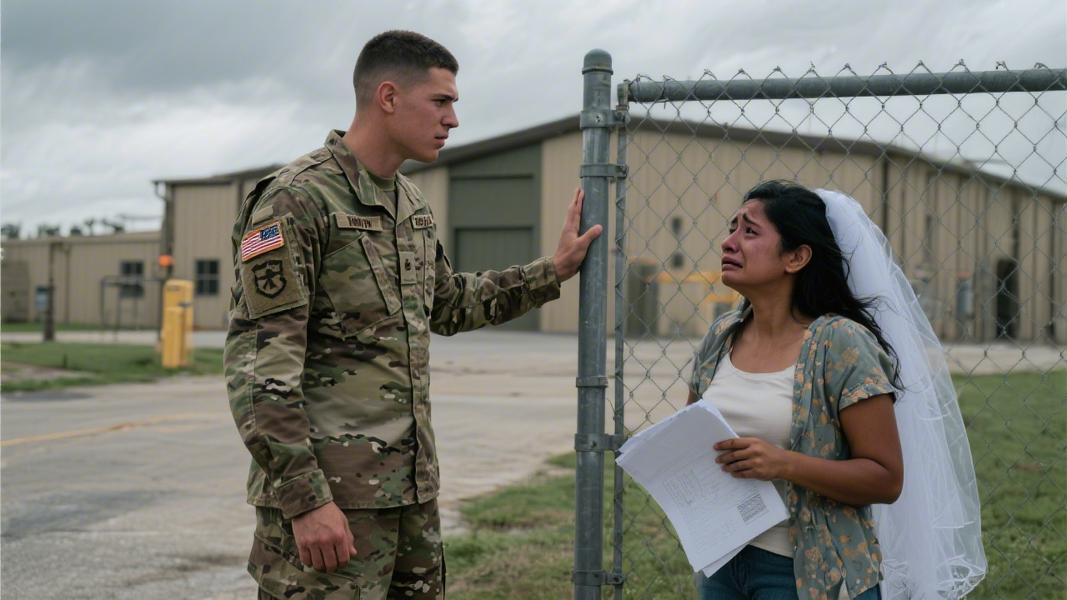
A U.S. Army staff sergeant brought his new wife to his own military base to start the legal process of building their life together. She left in handcuffs.
The case of Staff Sgt. Matthew Blank and his wife, Annie Ramos, has drawn sharp national attention to the collision between aggressive immigration enforcement and the families of active-duty service members. On April 2, 2026, Blank — a 23-year-old soldier stationed at Fort Polk, Louisiana — accompanied his 22-year-old wife to the base’s visitor center to register her for military benefits and begin her green card application following their March 2026 marriage. Instead, she was detained by Immigration and Customs Enforcement agents and transported to a detention facility. The question isn’t just whether the law was followed. It’s what the law is doing.
What Happened at the Gate
Ramos, who was born in Honduras and brought to the United States as a toddler in 2005 — she was under two years old — presented her Honduran passport, birth certificate, and marriage license at the visitor center. When she disclosed she had neither a visa nor a green card, base officials contacted ICE. She was handcuffed on the installation and taken to a detention center in Basile, Louisiana, according to reporting on the incident.
Blank had done everything by the book — or tried to. The couple had already hired an immigration attorney to navigate the green card process through marriage, a standard and legal pathway for spouses of U.S. citizens. “I never imagined that trying to do the right thing would lead to her being taken away from me,” Blank said in a statement to The Associated Press. He is 23 years old. He is also set to begin deployment training at the end of April.
A Removal Order From 20 Years Ago
Here’s the legal knot at the center of all this. When Ramos’s family arrived in the U.S. in 2005, they failed to appear for an immigration hearing, and a judge issued a final order of removal — against a child who was barely old enough to walk. That two-decade-old order is now the government’s primary justification for her detention. The Department of Homeland Security didn’t soften its position. “She has no legal status to be in this country,” DHS said in an emailed statement. “This administration is not going to ignore the rule of law.”
Ramos has no criminal record. She’s a college student. She applied for DACA — Deferred Action for Childhood Arrivals — in 2020, but that application remains unresolved, caught in the same legal limbo that has defined the program for years. She is, in almost every practical sense, American. She just doesn’t have the paperwork to prove it.
A Policy Shift With Real Consequences
It wasn’t always this way — at least not entirely. For years, federal policy treated the military service of a family member as a meaningful factor in immigration enforcement decisions. A 2022 DHS policy formally recognized military service as a mitigating consideration. Programs like parole in place had long provided a degree of protection for spouses of active-duty service members, allowing them to remain in the country while pursuing legal status. Last April, that 2022 policy was eliminated.
The result is a system where a soldier preparing to deploy — one of the more consequential things a person can be asked to do — has no special standing to shield his spouse from deportation. That’s not a loophole. That’s a choice. And it’s one that critics say punishes military families for trying to follow the exact process the government designed for them.
The Broader Stakes
Blank’s unit is scheduled to begin deployment training within weeks, according to reports. The timing is brutal in a way that feels almost too on-the-nose — a young soldier facing separation from his country while simultaneously facing the forced separation of his family. His attorney has been working to halt Ramos’s deportation, and the case has drawn attention from immigration advocates and military family organizations alike.
DHS’s position is technically defensible under current law. The removal order exists. The administration has been clear that it intends to enforce such orders without exception. Still, there’s something uncomfortable about the optics — and more than the optics — of ICE agents arresting a soldier’s wife on a military base while he was actively trying to bring her into compliance with federal immigration rules. She walked onto that base voluntarily. She brought her documents. She disclosed everything.
That, in the end, may be the sharpest detail in this whole story: Annie Ramos was detained not because she was hiding, but because she showed up.
