
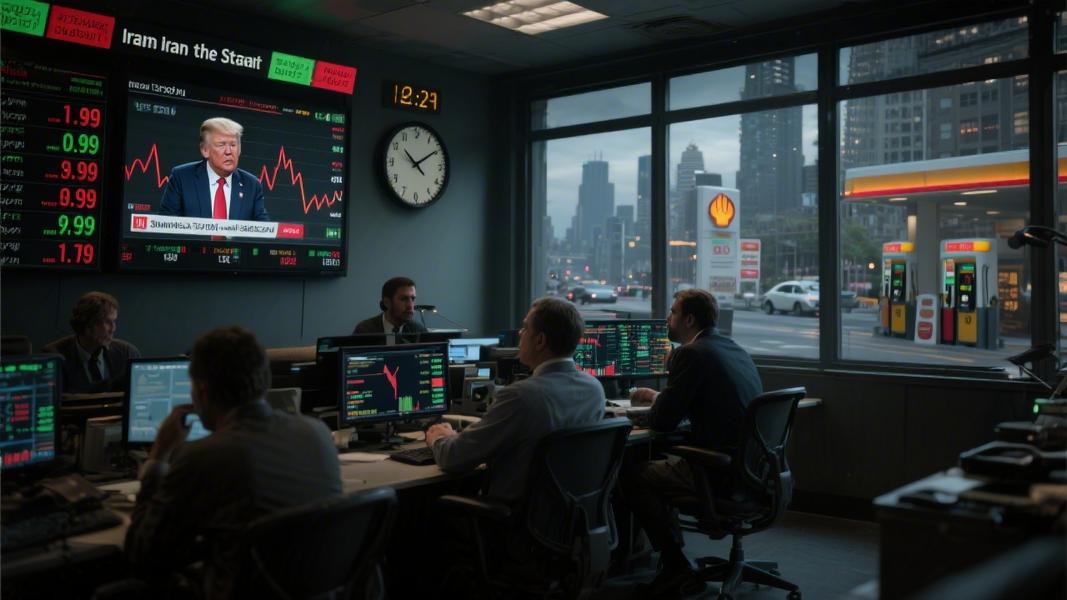
Markets don’t lie — and on Monday, they were telling a very clear story. With President Trump’s 8 p.m. EST deadline bearing down on Tehran, traders made their bets early, sending oil surging and stocks sliding in a tense, pre-deadline scramble that underscored just how seriously the financial world is taking the standoff over the Strait of Hormuz.
A Deadline With Real Teeth
The crux of it: Trump has demanded Iran reopen the Strait of Hormuz — the narrow, critical waterway through which a significant chunk of the world’s oil supply flows — or face consequences. Markets, never patient, didn’t wait around to see what happens next. Brent crude climbed 1% to $110.81 per barrel, while West Texas Intermediate jumped a sharper 2.9% to reach $115.70, as traders reported their anxiety in the most direct language they know — price.
Stocks, meanwhile, fell. That’s the other side of this equation, and it’s not a subtle one. Rising oil prices act like a tax on the broader economy — they inflate costs, squeeze margins, and spook investors who’d rather not price in a geopolitical crisis on a Monday afternoon. Europe’s markets felt it too, with the pressure rippling across the Atlantic well before New York’s closing bell.
What’s Actually at Stake
The Strait of Hormuz isn’t just a geographic footnote. It’s the jugular of global energy supply — roughly 20% of the world’s oil transits through that narrow passage between Iran and Oman. Any disruption, even a threatened one, sends shivers through commodity desks from London to Singapore. The fact that WTI moved nearly 3% in a single session says everything about how traders are handicapping the risk.
Still, markets have a habit of overreacting to deadlines that come and go without incident. Diplomacy has a way of extending itself past stated cutoffs, and there’s always the possibility that the pressure itself — rather than any military action — produces some form of movement from Tehran. That said, the mood on the floor wasn’t exactly optimistic.
The Broader Market Picture
How bad is it? Bad enough that equities couldn’t find their footing, even with investors who are typically willing to buy the dip. The combination of elevated oil and geopolitical uncertainty is a particularly nasty cocktail — it’s the kind of environment where no sector feels entirely safe. Energy stocks might benefit from higher crude prices in the short term, but broader indices don’t have the luxury of that hedge.
It’s worth noting that this isn’t happening in a vacuum. Global markets were already navigating a complicated macro environment — inflation concerns, interest rate pressures, and slowing growth signals haven’t disappeared. A Middle East flashpoint layered on top of all that is, to put it mildly, not what the bulls ordered.
Eyes on the Clock
As the deadline approached, the question hanging over every trading desk was simple and unanswerable in real time: does this escalate, or does it defuse? History suggests these moments rarely resolve cleanly — they tend to drag, mutate, and surprise. The market’s best guess, expressed in oil above $115 and falling stock indices, was that the risk isn’t going away quietly.
Whatever happens after 8 p.m., one thing is already true — the world’s financial markets have decided this particular deadline is worth taking seriously. And in a room full of people who bet money on outcomes for a living, that’s not nothing.
