
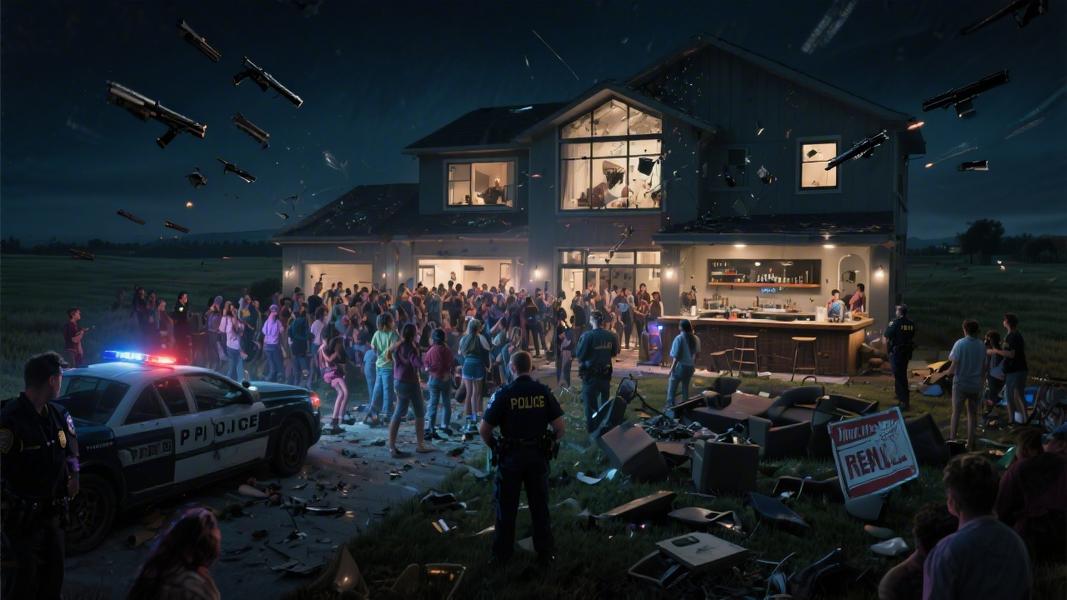
What was supposed to be a quiet weekend rental turned into something closer to a small riot. A house party at a Celina, Texas Airbnb property spiraled wildly out of control over the weekend, drawing an estimated 500 to 800 teenagers before gunshots rang out and police moved in to disperse the crowd.
The incident has renewed urgent questions about how social media can transform an ordinary suburban home into a flash point — fast, and with consequences that are hard to walk back. Two people were arrested: one on a charge of driving under the influence as a minor, and another on an active aggravated assault warrant out of Dallas County. Nobody, it seems, was supposed to be there in the first place.
A Rental Gone Sideways
The property owner had listed the home on Airbnb and rented it to a group of six people, with a clearly stated cap of no more than 20 guests. That limit, apparently, meant nothing. When the owner returned to assess the property after the party, they found furniture moved, wall hangings disturbed, and a broken bar countertop — the kind of damage that tells a story before anyone says a word, as documented by CBS Texas.
Five hundred to eight hundred people. In a home meant for six.
Social Media’s Role in the Chaos
So how does a house party get that big, that fast? The answer, increasingly, is the same one authorities keep running into: social media. Invitations spread beyond any original guest list the moment they hit a platform, and by then there’s no putting the genie back in the bottle. Fox4 noted that police were explicit about what drove the crowd to that particular address on that particular night.
“Scenes like these highlight the very real risks and dangers associated with large, unsupervised gatherings, especially when fueled through social media,” authorities said in a statement. It’s a warning that has been issued before — and will almost certainly be issued again.
A Broader Problem With No Easy Fix
That’s the catch, really. Platforms like Airbnb have policies against unauthorized parties, and hosts can set occupancy limits. But enforcement depends almost entirely on trust — trust that renters will honor the terms, that neighbors will call it in early enough, that police can respond before a crowd of hundreds has already assembled. When gunshots enter the equation, the window for a quiet resolution has long since closed.
Still, the Celina incident isn’t entirely without precedent. Party houses have plagued short-term rental markets in cities across the country for years, and the problem tends to spike during warmer months when teens are out of school and boredom is its own accelerant. What’s different now is the speed — the way a location can go from a private listing to a viral destination in a matter of hours.
For the property owner in Celina, what’s left is a broken countertop, a displaced set of wall hangings, and the particular frustration of having done everything right — the lease, the guest limit, the platform — and still ending up here. The rules existed. They just didn’t matter.
