
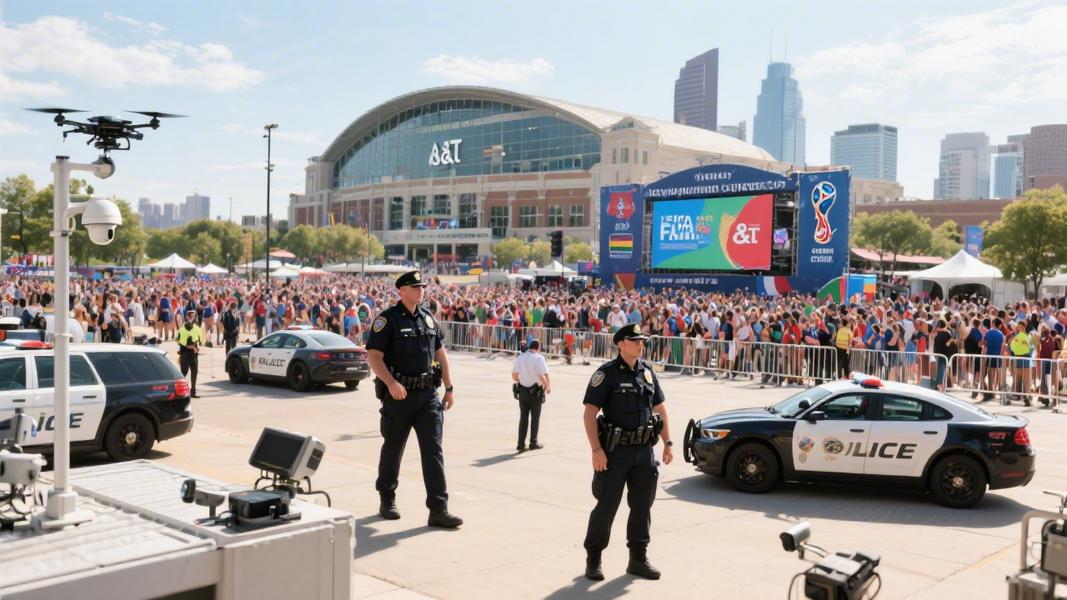
Dallas is gearing up for the biggest security operation in North Texas history — and officials say the money, while still partly tied up in Washington, isn’t going to slow them down.
With the 2026 FIFA World Cup now less than a year away, the Dallas area is preparing to host nine matches over 39 days, including a coveted semi-final, across an estimated 27 venues and event sites. Tens of thousands of visitors — international fans, global media, foreign dignitaries — are expected to pour into North Texas every single day. The planning effort involves 25 local public safety agencies alongside multiple state and federal partners, and it is, by any honest measure, an undertaking that dwarfs anything this region has tackled before.
A Scale Unlike Anything Before
“Basically, the scale is unlike anything we’ve hosted here in North Texas,” said Travis Houston, deputy director of emergency management and crisis response for the city of Dallas. That line has become something of a mantra for local officials — and it’s easy to see why. Fair Park’s Fan Fest alone is expected to draw roughly 35,000 visitors per day for nearly the full 40-day stretch. That’s not a weekend surge. That’s a sustained, months-long security marathon, and planners know it.
To handle it, preparations include tactical equipment upgrades, a dramatic expansion of camera infrastructure, vehicle-ramming barriers at high-traffic sites, and an FBI-led Joint Operations Center designed to coordinate real-time response across agencies. Weekly interagency coordination meetings are already underway, according to reporting from KERA News.
The Funding Picture — Complicated, But Moving
Here’s where it gets a little messy. The Dallas Police Department stands to receive $22 million from a $51 million Department of Homeland Security award granted to the Dallas Host Committee, earmarked primarily for officer salaries and overtime. But federal reimbursement funds have faced delays, leaving some agencies in a holding pattern — at least on paper.
Still, Assistant Chief Mark Villarreal made clear that the department isn’t flinching. “From my perspective, the funds are reimbursable anyway,” he said. “We’re not canceling anything or scaling back staffing or security postures just because the funding is tied up.” The message was blunt: the planning continues, full stop.
That confidence appears to have some backing in Washington. Congress recently appropriated a substantial $625 million for World Cup security through the One Big Beautiful Bill, with Texas expected to receive approximately $100 million to cover local law enforcement costs including overtime, equipment, and operational expenses. Separate DHS funding has also been designated for counter-drone technologies — a sign that planners are thinking well beyond traditional crowd management.
Keeping Everyone Safe, Money or Not
So what happens if the reimbursements get tangled up longer than expected? Dallas Police seem almost unbothered by the question. “Money is not going to be the issue,” Deputy Chief Reuben Comeaux told CBS News Texas. “Whether we have the money or not, whether we get the money back as a police department, we’re going to make sure we have the proper resources out there to keep everyone safe.” It’s the kind of statement that sounds like a press line — until you look at the operational tempo behind it, and realize they might actually mean it.
The sheer coordination involved is staggering. Twenty-five local agencies, state partners, federal bureaus, and private stakeholders are all being threaded together into a unified command structure that’s been built to handle not just crowd surges, but cyber threats and high-profile dignitary protection. North Texas is hosting more World Cup matches than any other American city. That’s a point of civic pride — and a logistical weight that no one in the planning rooms seems to be taking lightly.
What Comes Next
Months of tabletop exercises, interagency drills, and infrastructure hardening lie ahead before the first match ball drops. The venues need to be locked down, the command structures tested, the camera grids verified. Counter-drone protocols have to be rehearsed. Dignitary motorcade routes need to be mapped and re-mapped. It is, in every sense, a rolling operation — and it’s accelerating.
The world will be watching Dallas next summer. And if the people running this operation have anything to say about it, Dallas will be ready long before the cameras turn on.
