
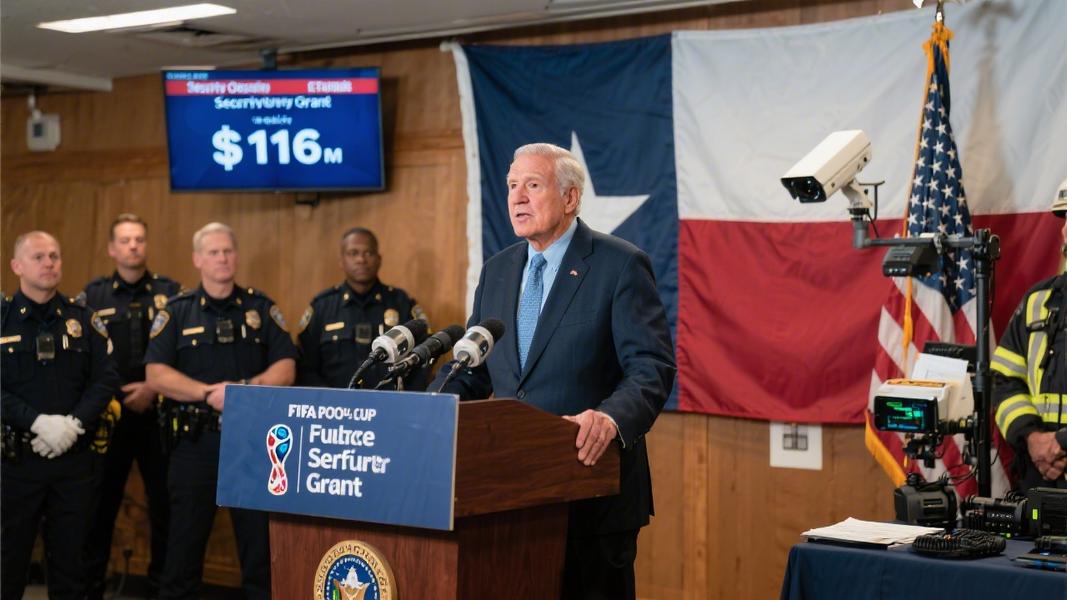
Texas is putting serious money behind its World Cup moment — and it’s not messing around with the numbers.
Governor Greg Abbott announced this week that the Governor’s Public Safety Office has awarded $116 million in grants to the City of Houston and the North Central Texas Council of Governments, directing the funds toward security infrastructure ahead of the 2026 FIFA World Cup. The grants are part of a broader federal program that’s pouring hundreds of millions of dollars into host cities across the country, all with the goal of keeping one of the planet’s most-watched sporting events from becoming a security nightmare.
A Once-in-a-Generation Security Challenge
Hosting the World Cup isn’t just a tourism win — it’s a logistical undertaking that strains even the most prepared cities. Millions of international fans, high-profile athletes, dignitaries, and media descend on host regions over the span of weeks. That kind of exposure demands planning that starts years in advance, and funding that matches the scale of the threat environment. Abbott, for his part, framed the moment as an opportunity as much as an obligation. “The FIFA World Cup coming to Texas gives our state a premier opportunity to showcase all it has to offer,” he stated. “These public safety grants will help ensure that travelers visiting and traveling throughout Texas can enjoy our great state safely, will bolster Texas’ efforts to combat crime, and help prevent potential acts of violence.”
That’s the pitch. And the dollars behind it are substantial.
Where the Money Comes From
The funding flows from the FIFA World Cup Grant Program, established under the One Big Beautiful Bill Act, which allocates a total of $625 million to host cities nationwide through state-designated administrative agencies. The program is expected to produce roughly nine awards in total, spread across U.S. host cities, according to federal grant records. Senator John Cornyn, who helped shepherd the funding through Congress, didn’t shy away from claiming credit. “I am proud to have worked with President Trump and my colleagues to secure $625 million in World Cup security funding in the Working Families Tax Cuts Act to reimburse Dallas and other host cities for developing a robust public safety apparatus ahead of the 2026 games,” he noted.
North Texas, in particular, stands to benefit significantly. The Dallas Host City Committee Task Force has been designated to receive $51,584,327 in federal grant funding — money earmarked for planning, equipment, training, exercises, and the protection of venues and critical infrastructure. It’s a specific, operational list, not a vague promise. As Cornyn put it, “These critical resources will improve law enforcement’s ability to manage crowds, identify potential threats, and respond quickly in emergencies to keep fans, visitors, and athletes safe.”
What It Means on the Ground
So what does half a billion dollars in security spending actually look like in practice? Think expanded surveillance networks, additional law enforcement training, coordinated emergency response drills, hardened perimeters around stadiums and fan zones, and the kind of interagency cooperation that doesn’t happen overnight. These aren’t simple line items — they’re years of groundwork compressed into a tight operational window before the first whistle blows in the summer of 2026.
Still, the scale of the investment raises a reasonable question: is this the new normal for major international events? Between the security costs, the infrastructure upgrades, and the logistical coordination required, hosting the World Cup has become as much a government undertaking as a sporting one. The federal grant program essentially acknowledges that reality — that cities can’t absorb these costs alone, and that the national security implications are too significant to leave to local budgets.
Texas, at least, appears ready to lean into that reality fully. With Houston and Dallas both serving as host cities, the state has more skin in this game than almost anywhere else in the country. The $116 million flowing through Abbott’s office is a down payment on an event that will put Texas — and its capacity to manage a global spotlight — on full display.
Whether all that money can truly buy safety at the scale the World Cup demands, of course, is the one question no grant program can answer in advance.
