
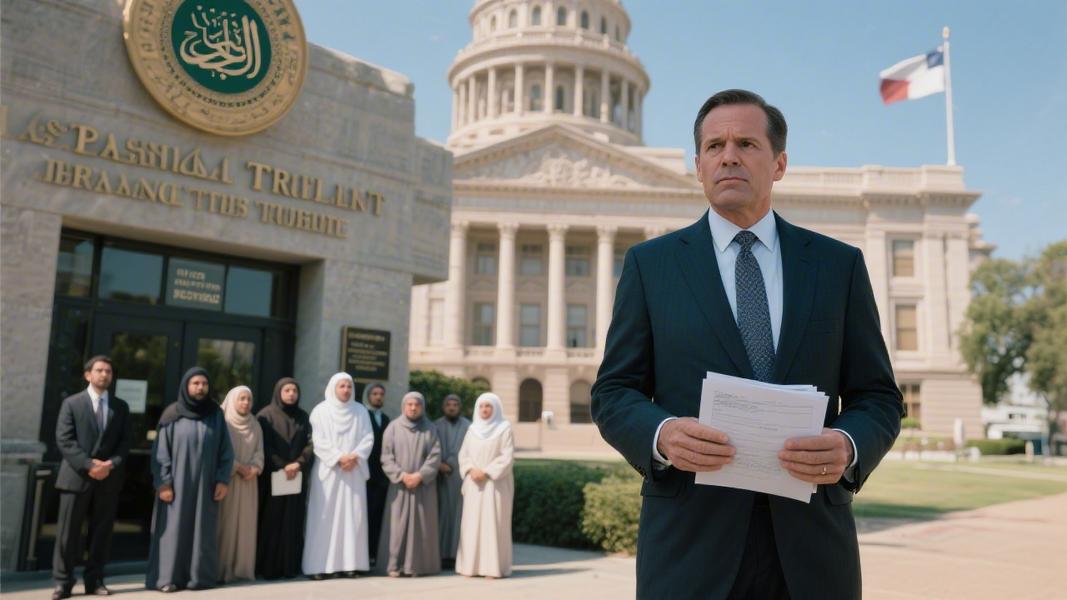
Texas Attorney General Ken Paxton has set his sights on a Dallas-based organization that critics say has been operating as a shadow court — and he wants answers, in writing, now.
Paxton’s office issued a formal demand for documents from the Islamic Tribunal, a North Texas entity that has drawn scrutiny for allegedly issuing judicial rulings grounded in Sharia law and, more provocatively, positioning itself as a legitimate alternative to the state’s actual court system. The move signals an aggressive posture from the attorney general’s office on what it views as a direct challenge to the legal sovereignty of Texas courts — and it’s unlikely to be the last word on the matter.
A Court That Isn’t a Court — Or Is It?
That’s the central question Texas officials appear determined to answer. The Islamic Tribunal has described itself as a faith-based mediation body, the kind of voluntary arbitration service that exists across religious communities — Jewish rabbinical courts, Christian conciliation ministries, and others have operated in similar capacities for decades in the United States. But the accusation that this particular organization has sought to replace civil courts rather than simply supplement them is what’s drawing the legal heat.
It’s not a trivial distinction. Voluntary religious arbitration, when both parties freely consent, has generally survived legal scrutiny in American courts. But any body that claims binding judicial authority outside the state’s recognized legal framework is on far shakier constitutional ground. Paxton, it seems, believes the Islamic Tribunal may have crossed that line — or at least that the documents will tell the story.
Paxton Makes His Move
The attorney general’s demand for records is a significant escalation. Texas’s top law enforcement officer doesn’t typically fire off document requests without some indication of where an investigation is headed. Whether the evidence ultimately supports the most serious allegations against the tribunal remains to be seen, but the political weight of the action is immediate and considerable. Paxton has long cultivated a reputation for using the AG’s office as a vehicle for high-profile confrontations — with the federal government, with major corporations, and now, apparently, with a small religious arbitration body in Dallas.
Still, the legal questions here are genuinely complex. Religious institutions occupy a peculiar and carefully protected space in American law. The First Amendment doesn’t just permit faith communities to organize themselves — it actively shields them from certain kinds of government intrusion. Any investigation that wades into the internal workings of a religious body risks running straight into that wall. Paxton’s team will need to demonstrate that its concerns are rooted in civil legal authority, not theology, if the inquiry is going to hold up.
Why This Matters Beyond Texas
The Islamic Tribunal case — whatever its ultimate resolution — touches something much larger than one organization in one city. Debates over religious arbitration, parallel legal systems, and the boundaries of faith-based governance have been simmering in American legal circles for years. Several states have passed or attempted to pass legislation explicitly barring courts from applying foreign or religious law in their rulings. The outcomes have been mixed, legally and politically.
What Paxton is doing, in effect, is forcing that debate back into the open in one of the country’s most politically consequential states. Texas doesn’t do anything quietly, and neither does its attorney general. The document demand has been noted by observers tracking the intersection of religion, law, and state authority — a beat that’s only getting busier.
How the Islamic Tribunal responds — whether it cooperates, challenges the demand in court, or argues that the inquiry itself is a form of religious targeting — will shape what comes next. And what comes next could set a precedent that reaches well beyond Dallas city limits.
For now, the attorney general has asked his questions. The tribunal will have to decide whether it has answers it’s willing to give.
