
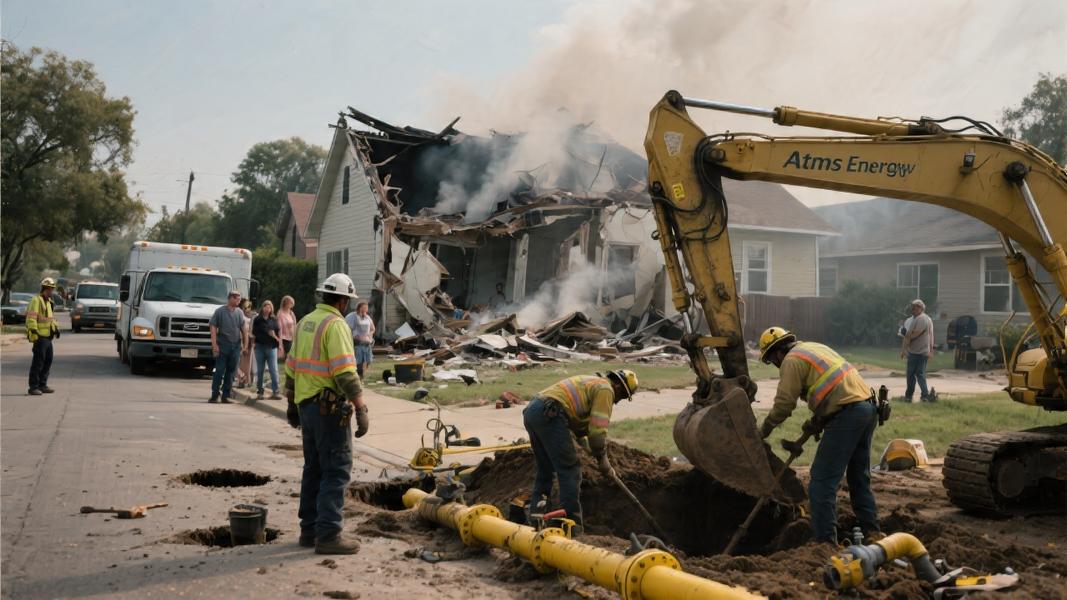
A home in Lake Dallas is gone. A woman nearly died. And the pipe that caused it all had been sitting underground, undetected, for more than five decades.
On March 19, a residential explosion rocked Lake Dallas, critically injuring a woman inside the home. Investigators quickly traced the blast to a natural gas leak — specifically, to a short section of aging plastic pipe that had been installed sometime in the 1970s by a predecessor company to Atmos Energy, the utility giant that now serves the Dallas-Fort Worth Metroplex. What makes it worse: federal safety officials had been warning about exactly this kind of pipe for nearly 30 years.
A Warning Decades in the Making
The National Transportation Safety Board isn’t new to this conversation. The agency issued a special report years ago cautioning that plastic gas pipes manufactured in the 1960s and early 1970s were vulnerable to sudden, catastrophic cracking — particularly when bent, shifted by soil movement, or pressed by surrounding infrastructure. The board warned that this type of pipe could fail without any obvious warning signs and urged gas utilities across the country to closely monitor and replace them. That was nearly three decades ago.
So how does a pipe like that still end up being the thing that levels a house in 2025? That’s the question Lake Dallas residents — and frankly, a lot of people — are now asking.
Atmos Says It Didn’t Know the Pipe Was There
At a Lake Dallas City Council meeting on April 3, 2026, Atmos Energy vice president Kyle Slaughter addressed the community directly. His explanation was, to put it gently, not reassuring. “The isolated leak was on a short section of pipe that was made of material installed in the 1970s by a predecessor company,” Slaughter said. The company acknowledged it had previously attempted to remove these older pipes — but this particular section slipped through. “It now appears this short section of pipe was not found during those removal efforts,” the company stated, “and for that reason, we did not know it was there.”
An unknown pipe. Carrying live gas. Underneath a home. For fifty-some years.
This Isn’t Atmos’s First Disaster
The Lake Dallas explosion doesn’t exist in a vacuum. In 2018, a home in Northwest Dallas exploded, killing 12-year-old Linda Rogers. That blast — also tied to aging gas infrastructure — triggered a massive public reckoning. The NTSB ultimately fined Atmos Energy $1.6 million for its role in the tragedy. In response, the company announced a sweeping infrastructure modernization program, committing $10.7 billion between 2019 and 2024 to replace older cast-iron and bare steel pipes across its network. Federal records show the company has since replaced nearly 600 miles of bare steel pipe and eliminated all cast-iron pipe in its Mid-Tex division.
Still, the plastic pipes from the early 1970s — a different material, a different era — appear to have fallen through the cracks of that effort. Literally.
‘Did They Have a Lot of Issues?’
For residents watching excavators tear up their streets and yards in the days after the explosion, the scene raised more questions than it answered. Eliana Saavedra, a Lake Dallas resident, watched the digging and felt her unease grow. “I’m worried because that could happen to anybody in this neighborhood,” she told reporters. “Seeing all the holes that they’ve dug up, I’m like, did they have a lot of issues or are they trying to fix everything that they think is wrong?”
It’s a fair question. And the honest answer, based on what’s known so far, is: probably both.
The broader implication here is uncomfortable but worth sitting with. If one undetected segment of 1970s plastic pipe can survive decades of infrastructure surveys, modernization campaigns, and federally mandated oversight — how many more are out there, in Lake Dallas or anywhere else, quietly waiting beneath someone’s kitchen floor?
Atmos says it’s now working to identify and replace any remaining legacy pipe in the area. Residents, understandably, are hoping the company finds them all before the ground does it for them.
