
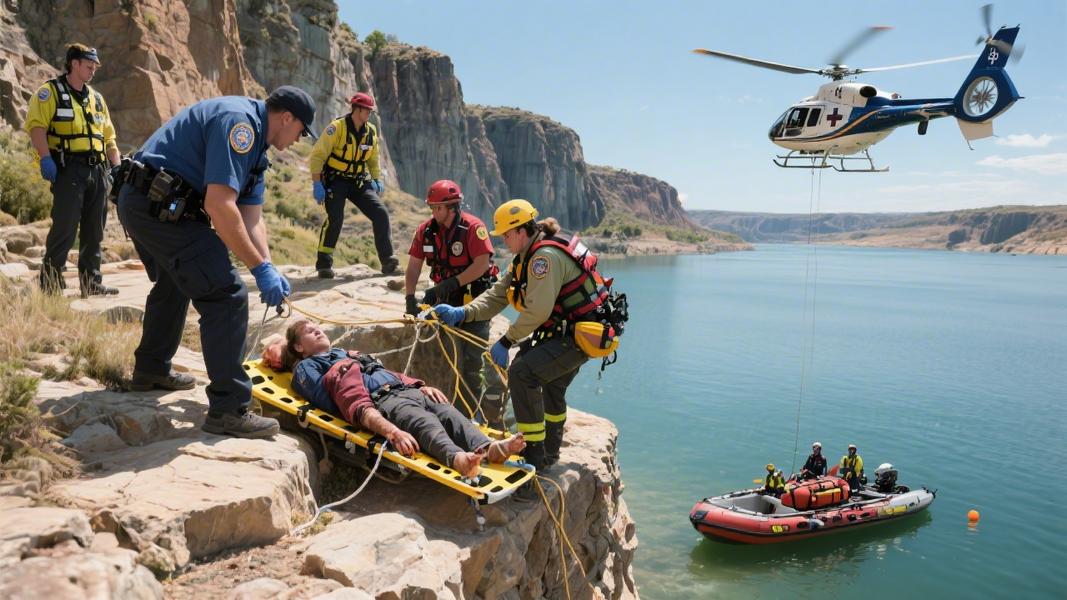
A recreational outing turned dangerous fast on Sunday when two people ended up stranded on a rock ledge at Lake Whitney — injured, exposed, and waiting for help that required an entire fleet of emergency responders to deliver.
The incident unfolded on March 22, 2026, in Bosque County, Texas, when the two individuals went cliff jumping at the lake and sustained injuries that left them unable to climb back up on their own. Pinned to a rock ledge with no clear path to safety, they had little choice but to wait. What followed was a multi-agency rescue operation that drew resources from across the region to bring them back to solid ground. Local outlets reported on the rescue as it unfolded.
Stranded on the Ledge
Cliff jumping at Lake Whitney isn’t exactly a rare occurrence. The lake, a popular recreational destination in central Texas, draws swimmers and thrill-seekers throughout the warmer months. But the gap between a clean jump and a bad one can be brutally thin — and on this particular Sunday, two people found that out the hard way.
Details on the exact nature of their injuries haven’t been fully disclosed. What is known, as documented in available records, is that the injuries were serious enough to prevent self-rescue, and that the ledge where they landed made a conventional approach by emergency crews anything but straightforward.
A Rescue That Required Numbers
Multi-agency responses of this kind don’t happen for minor scrapes. When you’ve got injured people on a rock face near open water, you’re suddenly looking at a scenario that demands technical rescue capabilities, water assets, medical personnel, and coordination — all at once, ideally without anyone else getting hurt in the process.
That’s the catch with water-adjacent cliff rescues. The terrain that makes a location attractive for jumping is often the same terrain that makes extraction a logistical nightmare. Steep rock faces, variable water depths, and limited approach angles can turn a rescue into a prolonged operation even when crews arrive quickly.
Still, both individuals were ultimately brought to safety. The operation was a success, though it’s a success that probably could have been avoided entirely.
A Broader Pattern Worth Noting
How many times does this have to happen before the warning sticks? Cliff jumping injuries at Texas lakes aren’t a new story. Every season brings a fresh round of incidents — some minor, some fatal — at sites across the state. Lake Whitney has its share of history on that front. The allure is obvious; the risk, apparently, keeps getting underestimated.
Emergency responders who show up to these scenes rarely express surprise anymore. The calls come in, the crews mobilize, and the same conversation about recreational safety gets had again in the aftermath. It’s a cycle that local agencies know well, and one that puts real strain on rescue resources that could be needed elsewhere.
For now, the two individuals rescued on March 22nd are alive — which, given the circumstances, is the only outcome that really matters. Whether the close call changes anything for the people who’ll show up at that same ledge next weekend is, honestly, another question entirely.
The lake doesn’t move. The rocks don’t soften. And the drop looks the same every time — right up until it doesn’t.
