
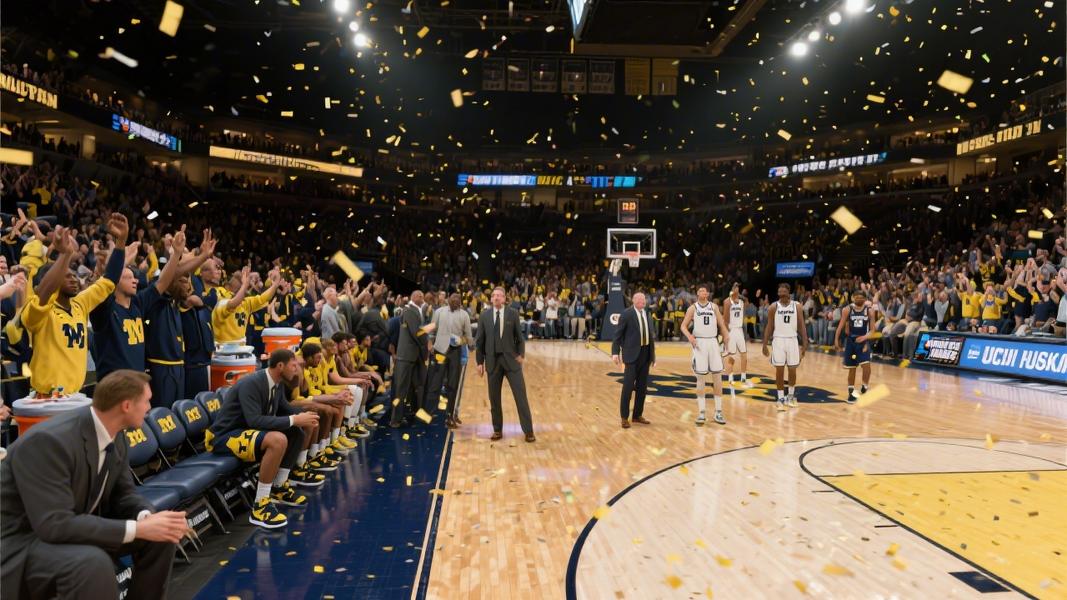
On April 6, 2026, two of college basketball’s most storied programs will meet under the brightest lights the sport has to offer — and the stakes couldn’t feel higher.
The Michigan Wolverines and the UConn Huskies are set to square off in the 2026 NCAA Men’s Basketball National Championship, a matchup that has already drawn a presidential congratulations to both programs ahead of tipoff. It’s the kind of moment the sport was built for — and one that nearly 90 years of tournament history has been quietly building toward.
A Tournament Unlike Any Other
The NCAA tournament has been running since the late 1930s, and it still hasn’t lost its grip on the American sports calendar. 68 teams. Three weeks. Single elimination. The format is almost ruthlessly simple, which is exactly why it works. One bad night and you’re done. One miracle shot and you’re immortal.
Speaking of miracle shots — it’s hard to talk about championship lore without going back to 2016, when Villanova’s Kris Jenkins buried a 25-footer at the buzzer to stun North Carolina. As Sports Illustrated described it, “Ryan Arcidiacono dribbled the ball down and shoveled a pass back to Kris Jenkins, who buried the 25-footer and was instantly mobbed by his teammates underneath piles of falling confetti.” That’s March Madness distilled into a single moment. It’s why people can’t look away.
Dan Hurley’s Case for Greatness
UConn arrives in San Antonio — or wherever the final is staged — carrying something rare: genuine dynasty energy. The Huskies claimed the 2024 national title, routing Purdue 75-60 and finishing 37-3 under coach Dan Hurley, as the NCAA documented. That gave UConn its sixth national championship overall, placing the program in elite company alongside North Carolina and just behind UCLA’s record 11 titles and Kentucky’s 8, according to NCAA data.
Now Hurley is chasing something more personal. His NCAA tournament record stands at an extraordinary 19-5 across 24 games — tied for the second most tournament wins ever by a coach, the NCAA noted. That’s not a fluke. That’s a system, a culture, and a staff that knows how to prepare for the moment when the margin for error disappears entirely.
The Numbers Behind the Madness
What does the path to Monday night look like statistically? One number that jumps out involves Illinois’s Keaton Wagler, who averaged a Final Four-leading 17.9 points per game this season. Impressive, until you factor in that he scored just 3 points in 14 minutes against Connecticut back in November, per the same Final Four portrait. Numbers tell stories — but sometimes they also bury the lead.
That’s the catch. Tournament basketball has a way of scrambling season-long résumés. The team that looked unstoppable in February can look very mortal by the second weekend. And the team that was supposed to lose? Sometimes they just don’t get the memo.
Ratings, Revenue, and Why This Matters Beyond the Court
The business of March Madness is booming. The 2025 championship game between Florida and Houston averaged 18.1 million viewers on CBS — a 22% jump from the prior year, the NCAA reported. Florida won that game 65-63, claiming their third national title and first since 2007 while finishing 36-4. It was a wire-to-wire thriller that reminded casual fans why they’d set their alarms in the first place.
Still, 18 million viewers is more than a number. It’s a signal. College basketball, in an era of fractured media and shrinking live audiences, keeps finding ways to hold the room. The tournament isn’t just surviving the streaming age — it’s thriving in it.
What’s at Stake on April 6
For Michigan, this is about arrival — a program asserting itself on the game’s grandest stage. For UConn, it’s about legacy. A third consecutive title run would cement Hurley’s place in the conversation with the all-time greats, full stop. No qualifiers needed.
Both programs received presidential recognition heading into Monday’s game, a ceremonial nod that nonetheless underscores just how much cultural weight this matchup carries. It’s college basketball. It’s also, in some ways, a national event.
Ninety years of tournament history has produced buzzer-beaters, upsets, dynasties, and heartbreaks that people still argue about at family dinners. Come Monday night, someone’s going to add another chapter. The only question left is whose story it’ll be.
