
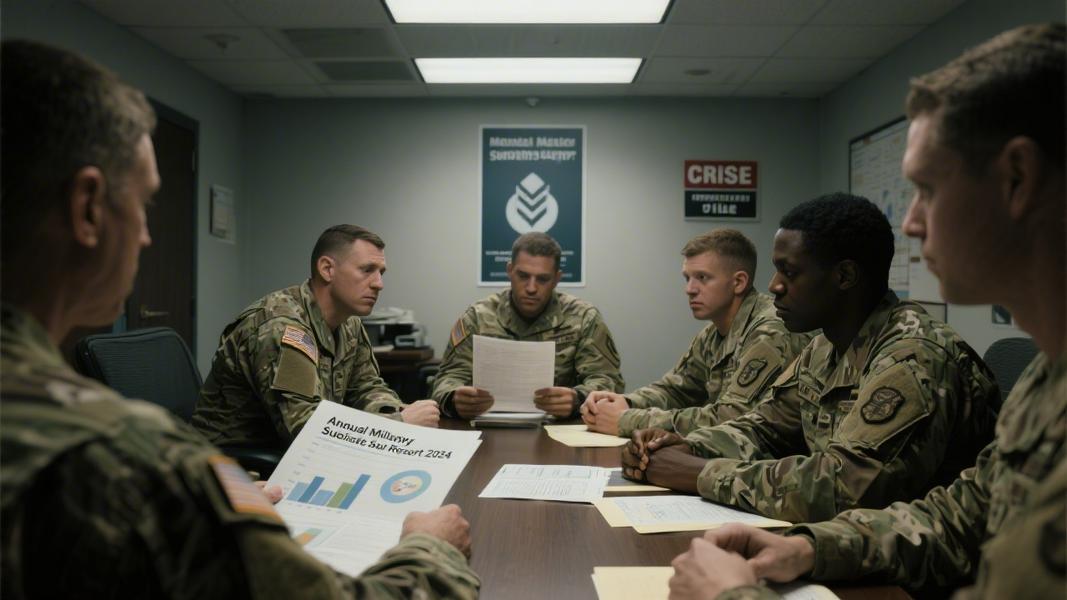
The U.S. military lost 471 service members to suicide in 2024 — still a staggering number, but the first meaningful drop in years, and one that Pentagon officials are cautiously calling progress.
The Department of Defense released its seventh Annual Report on Suicide in the Military on March 31, 2026, covering Calendar Year 2024. The figure — 471 deaths — marks a notable decline from the 531 suicides recorded in CY 2023, a year that had itself represented a grim high-water mark. For a military establishment that has struggled for over a decade to reverse this trend, the data offers something it hasn’t had much of lately: a reason to believe the needle can move.
A Broad Decline — With One Troubling Exception
Across nearly every component of the Total Force, the numbers improved. The overall suicide rate fell by approximately 11%, with the Active Component posting a 16% decrease and the Reserve Component dropping 14% compared to the previous year. Those are not trivial margins. In a crisis that has resisted intervention after intervention, double-digit declines in a single year are the kind of thing that makes researchers sit up straight.
But it’s not that simple. The National Guard bucked the trend entirely, recording an increase of roughly 13% in its suicide rate over the same period. That’s a significant outlier — and one that deserves far more scrutiny than a footnote in an annual report. Guard members often lack the same access to on-base mental health resources as their Active Component counterparts, and they frequently navigate the psychological weight of military service while embedded in civilian communities that may not fully understand what they’re carrying.
Quarterly data adds texture to the full-year picture. In Q1 of CY 2024, the Active Component recorded 94 suicides — actually three more than Q1 2023 — while the Reserve Component saw 24, up six from the prior year. The National Guard, meanwhile, saw 21, a decrease of five. By Q3, the picture had shifted: the Active Component reported 74 suicides, the Reserve just five — a drop of eleven from Q3 2023 — and the Guard posted 27, down three. It was an uneven, grinding improvement. Not a turnaround so much as a slow correction.
How Bad Had It Gotten?
To understand why 2024’s numbers feel like relief, it helps to remember where things stood before. In CY 2023, 523 service members died by suicide — up from 493 in 2022 — pushing the Total Force rate roughly 9% higher than the year prior. The Active Component’s rate climbed 12%, though statisticians noted it didn’t reach the threshold of statistical significance. Still, the direction was unmistakable and deeply alarming.
It was against that backdrop that officials pointed to the launch of a formal suicide prevention campaign. “In the first year since Secretary Austin’s establishment of the suicide prevention campaign plan, the Department has completed 20 SPRIRC recommendations and we have an aggressive path forward with unprecedented investments for FY25 to combat current trends,” an official stated in the report’s release. Whether those investments are what drove the 2024 decline — or whether other factors are at play — is the kind of question that takes years of data to answer properly.
The Surveillance Infrastructure Behind the Numbers
None of this data emerges from thin air. The DoDSER system — the Department of Defense Suicide Event Report — serves as the backbone of military suicide surveillance, standardizing how suicides, attempts, and related behaviors are tracked across all branches of the Armed Forces. It’s a system that monitors risk factors with a level of granularity that civilian public health agencies often envy. The data it produces is imperfect — no surveillance system isn’t — but it’s the most consistent lens the military has into a crisis that doesn’t announce itself in advance.
Veterans: A Separate, Parallel Crisis
The active-duty picture, grim as it is, represents only part of the problem. Among Veterans — those who’ve already left service — the toll is staggering by any measure. In 2022, the most recent year for which comprehensive data is available, 6,407 Veterans died by suicide, averaging 17.6 deaths per day. The VA’s 2024 Suicide Prevention Annual Report documented some encouraging shifts within that figure: female Veterans saw a 24.1% decline in their suicide rate, and younger Veterans aged 18 to 34 saw a 3.8% drop. Progress, but measured in lives still lost at a rate that would constitute a national emergency if it affected almost any other demographic.
The context is sobering. Suicide was the 12th-leading cause of death for Veterans overall in 2022 — but for those under age 45, it was the second-leading cause, ranking just behind unintentional injury. That’s not a footnote. That’s a defining feature of what it means to be a younger Veteran in America today.
What Comes Next
One good year doesn’t constitute a trend. The military has seen isolated dips in suicide rates before, only to watch them reverse. What’s different this time — if anything is — may come down to whether the structural investments being promised for FY25 actually materialize and reach the people who need them most. The National Guard numbers, in particular, suggest that whatever’s working for the Active Component isn’t reaching everyone in uniform equally.
Four hundred and seventy-one people. Each one a service member who made it through deployments, through training, through years of sacrifice — and didn’t make it through whatever came after. That number went down in 2024. The work of making sure it keeps going down has barely begun.
