
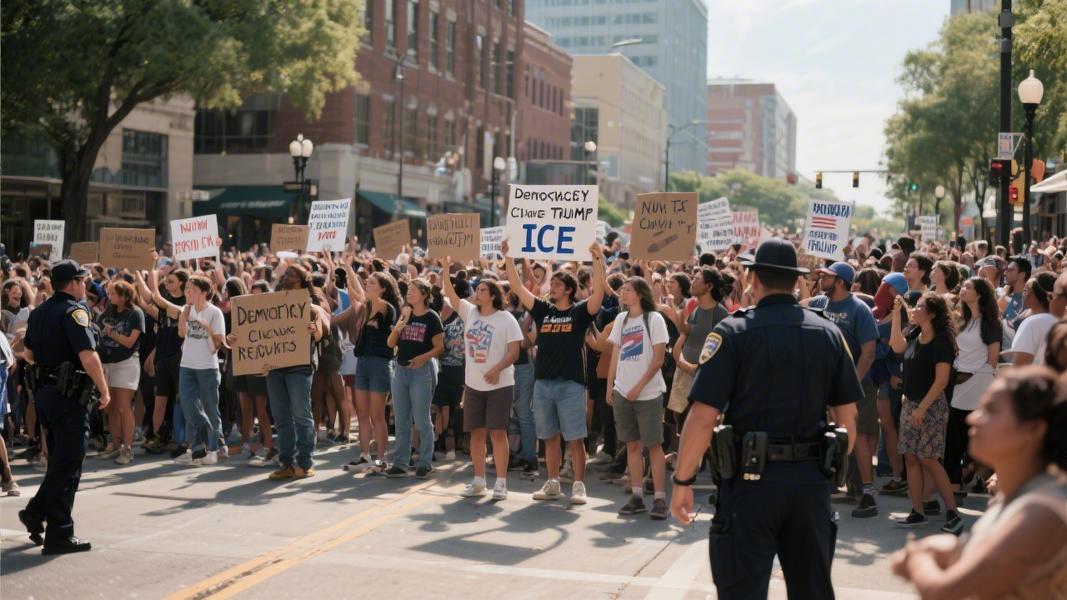
Thousands of North Texans poured into the streets on Saturday. They weren’t leaving until they’d made some noise.
The March 28, 2026 installment of the No Kings protest movement — officially dubbed “No Kings 3” — brought demonstrators to more than a dozen cities across the Dallas-Fort Worth metroplex, from the urban cores of Dallas and Fort Worth to suburbs like Plano, Denton, Arlington, Frisco, McKinney, Carrollton, and even smaller communities like Farmersville. The rallies were part of a sweeping nationwide mobilization — more than 3,000 events across the country — organized primarily by the ACLU and the No Kings Coalition, targeting what organizers describe as the Trump administration’s abuse of executive power, its aggressive immigration enforcement, and the ongoing U.S. war in Iran.
A Movement That’s Been Building
This wasn’t a one-off outburst. The No Kings movement has been organizing since June 2025, and the momentum has only compounded. Previous North Texas events drew over 18,000 participants combined in June and October alone. The October 2025 Dallas rally brought roughly 3,000 people to the streets, a figure that, by Saturday’s accounts, appeared likely to be surpassed.
The Dallas anchor event was held at City Hall Plaza, running from noon to 3 p.m. It was one of the more visible demonstrations in a region not typically associated with large-scale progressive activism — and yet here it was, drawing crowds in Allen, Garland, Southlake, and Irving, among others. Over two dozen separate rallies were planned across the metro area by Saturday morning.
What They’re Angry About
The grievances are layered, and they’re not entirely new. Protesters cited a mix of concerns: ICE enforcement operations that critics say have torn families apart, Department of Homeland Security policy changes under the current administration, and what many demonstrators characterize as an executive branch operating without adequate checks. The deaths of Renée Good, Keith Porter, and Alex Pretti — linked, according to organizers, to recent federal actions — were also cited as catalysts for the renewed mobilization.
Then there’s the war. The U.S. military conflict in Iran has become a flashpoint, drawing in protesters who might not otherwise attend a domestic policy rally. It’s a convergence of foreign and domestic frustration — a reminder that when public trust erodes on multiple fronts simultaneously, the streets tend to fill up.
The Voice Behind the Megaphone
Nationally, Deirdre Schifeling, the ACLU’s chief political and advocacy officer, framed the day’s events in explicitly democratic terms. “3,000 towns, cities, neighborhoods — we will be loud, proud, joyful, and determined in defense of our rights, defense of our democratic country,” she said ahead of the rallies. It’s the kind of line that reads like a slogan but lands differently when it’s being chanted by several thousand people standing in a Texas parking lot on a Saturday afternoon.
The tone across North Texas events, by all accounts, stayed that way — joyful, if charged. In Fort Worth, demonstrators marched without incident. No arrests were reported. The Fort Worth rally specifically targeted DHS policy changes and the Iran conflict, echoing the national message while keeping its own local texture.
Just How Big Was It?
Hard to say definitively — crowd counts at protests always carry an asterisk. But the sheer geographic spread is striking. From tracked events in dense urban centers to demonstrations in communities most people outside Texas couldn’t find on a map, Saturday’s turnout suggested that the No Kings movement has developed genuine organizational infrastructure rather than just viral momentum. That’s a different animal entirely.
Nationally, the coordination of more than 3,000 simultaneous rallies represents one of the largest single-day protest efforts in recent American history — a logistical undertaking that doesn’t happen without months of planning, local chapter building, and the kind of sustained anger that doesn’t cool between news cycles.
What Comes Next
Still, protests are only as consequential as what follows them. The No Kings Coalition has now staged three major national mobilizations. Whether that energy translates into electoral pressure, legislative pushback, or something else entirely remains an open question — and, frankly, the more interesting one. For now, though, the signs came down at City Hall Plaza sometime after 3 p.m., the crowds dispersed across the metroplex, and North Texas went back to its Saturday. Louder than it started.
