
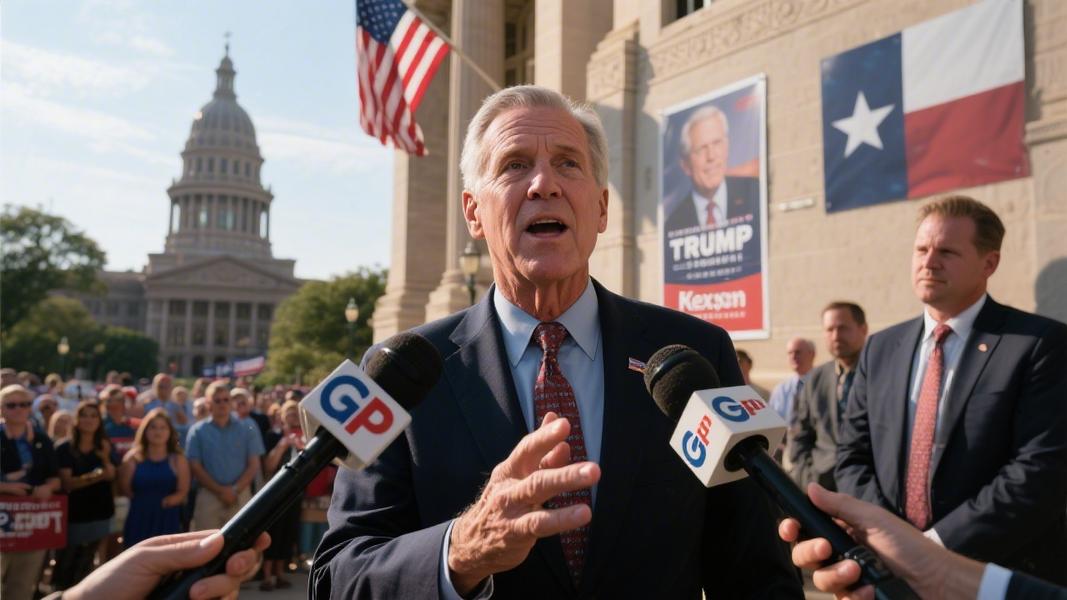
Texas Republicans have a full-blown Senate civil war on their hands — and the clock is ticking toward a May 26 showdown that neither side is willing to blink on first.
U.S. Senator John Cornyn and Attorney General Ken Paxton are locked in a bruising GOP primary runoff for Texas’s open Senate seat, after both advanced from the March 3 primary — Cornyn finishing first, Paxton second, and Congressman Wesley Hunt a distant third. Both candidates declined to withdraw before the ballot deadline passed, guaranteeing an expensive, grinding intraparty fight through late May. What happens next could reshape Texas Republican politics for a generation.
Paxton Surging — Or Is He?
A new Quantus Insights poll of 1,218 likely GOP voters puts Paxton ahead 48.8% to 41.3% — a margin that, if it holds, would be a stunning reversal from Cornyn’s first-place March finish. Perhaps more alarming for Cornyn’s camp: nearly 58% of Wesley Hunt’s former supporters have migrated to Paxton, a shift that suggests the runoff’s center of gravity may be moving fast and not in Cornyn’s direction.
Cornyn isn’t buying it. “There’s a lot of different polls generated from a lot of different people, based on different samples, some biased, some incomplete,” he said. “As you know, I won first place on March 3rd, and we continue to work very hard to earn the vote of everyone who’s going to come back to the polls on May 26th. But eventually, what’s going to count the most is not some poll like this two months out — it’s going to be who actually shows up to vote, and I’m encouraged by what we’re hearing.”
That’s a reasonable thing to say. It’s also exactly what a candidate says when a poll scares him. Pre-primary surveys showed Paxton leading or tied heading into March 3, making Cornyn’s first-place finish something of an upset — one he’s leaning on heavily now.
Cornyn is also making a pointed argument about Hunt’s voters specifically, suggesting they won’t flock to Paxton simply because the math would seem to demand it. “I assume the people who supported Wesley Hunt could not abide by a corrupt public figure like Ken Paxton,” he said bluntly. “So, I don’t expect them to go rushing to support somebody that they rejected on March 3rd.” That’s a direct line of attack — and it signals the ethics argument will be central to Cornyn’s closing strategy.
Paxton’s team, for their part, isn’t offering much elaboration. A spokesman said simply: “The poll speaks for itself about the Attorney General’s momentum.” Terse. Confident. Maybe a little too comfortable.
The Trump Question Nobody Can Answer
Here’s the one variable that could blow this race wide open: President Trump still hasn’t endorsed anyone.
Trump pledged an endorsement “soon” after the March 3 primary. Weeks later, nothing. Reports suggest he’s leaning toward Cornyn, but nothing is official — and in Trump-world, leanings have a way of evaporating. Cornyn is making the electability case directly to the White House, arguing that Paxton would be a general election liability against Democratic challenger Phil Talarico, potentially costing Republicans hundreds of millions of dollars in a race Cornyn says he’d win comfortably.
“We’ve made the argument to him, which I think he finds compelling, that I would be a much stronger top of the ticket than would Ken Paxton,” Cornyn said. “In fact, Ken Paxton would represent a vulnerability for Republicans and potentially lose to Talarico. Even if he didn’t lose, it would cost hundreds of millions of dollars, and he wouldn’t win by the kind of margin I would be expected to win by. I won by 10 points in 2020.”
And Cornyn’s Trump loyalty numbers? He’s leaning on them hard. His 99.3% voting record with the President, he notes, outpaces even Ted Cruz — a fact he mentioned by name. “I don’t know how much better you could get,” he said. “He’s called me a friend, and I am somebody who wants to see him succeed.” He also pointed out that Trump has reconciled with figures who’ve had public disagreements with him — Vance, Cruz, Graham, Rubio — as if to preemptively neutralize any loyalty attacks from Paxton’s side.
When asked directly whether Trump would endorse, Cornyn offered the only honest answer available: “Only one man knows the answer to that, and it’s not me.”
Meanwhile, Ted Cruz — whose own Senate seat Paxton once eyed — is staying firmly on the fence. His entire public statement on the matter, captured on Fox News, consisted of four words: “I like John. I like Ken.” Texas politics, ladies and gentlemen.
Iran, $200 Billion, and the Cost of War
Away from the runoff mud, Cornyn has been staking out firm ground on the month-old U.S. war against Iran — and aligning himself squarely with the Trump administration’s hawkish posture.
“I think President Trump should be commended for not tolerating the development of nuclear weapons by the number one state sponsor of terrorism, which is Iran, together with all of its proxies — Hezbollah, Hamas, the Houthis, the Shia militias — that have threatened American troops overseas,” Cornyn said. “The prospect of a nuclear Iran is just untenable, and I applaud the President for taking the steps necessary.”
But commendations don’t replenish munitions. The Pentagon is now requesting an additional $200 billion to restock interceptors, counter-drone technology, and other weapons expended in the conflict — and Cornyn is supporting that request while flagging a deeper structural problem. “We have a problem anyway with the fact that our defense industrial base is not producing what we need in order to replenish our stocks against a potential conflict somewhere, let’s say, like at the Indo-Pacific,” he said. “This has made it more urgent.” The implication is sobering: the U.S. may be fighting one war while quietly becoming less prepared for the next one.
The DHS Shutdown That Wasn’t — And Kind of Was
Back on the domestic front, a messy partial government shutdown left TSA agents going without paychecks for weeks, with more than 500 quitting and lines visibly lengthening at airports — including Houston. The Senate passed a voice-vote funding measure Friday covering most of the Department of Homeland Security, including TSA, the Coast Guard, and FEMA. A Trump executive order offered a parallel workaround to pay TSA workers in the interim. But House Republicans have blocked a full resolution, insisting any deal include funding for ICE and CBP — a provision left out of the Senate’s reconciliation package.
Cornyn’s framing is characteristically pointed. “One of the ironies of this shutdown are that the Democrats say their complaint is about ICE,” he said. “We’ve already pre-funded ICE for a number of years, and so punishing the innocent TSA agents, the Coast Guard, FEMA, and all these others was really taking the wrong hostage.” He called it a “political stunt” by Democratic colleagues — though the intra-Republican House-Senate standoff over ICE funding complicates that narrative somewhat.
The SAVE Act and the Filibuster Fight
Cornyn is also pushing hard for the SAVE America Act, which would require proof of citizenship to register for federal elections and mandate voter ID at the polls. It’s a priority item for the GOP base — and, notably, a centerpiece of Paxton’s own runoff pitch, giving the race an odd quality where both candidates are competing to be the most credible champion of the same legislation.
Cornyn says it’s getting done regardless of procedural obstacles. “We will deal with it either on the floor, using the current procedure, or we will deal with that as part of reconciliation,” he said. “But we’re going to get there, one way or the other.” Whether that confidence is earned or performative is something the next few months will answer.
What It All Comes Down To
Cornyn is making three arguments simultaneously: that he’s the safer general election bet, that he’s earned Trump’s loyalty even if Trump won’t say so publicly, and that Hunt’s voters are too principled to reward Paxton. Any one of those arguments could be decisive. None of them is guaranteed. The reality is that this race will almost certainly be decided by a single variable no poll can fully capture — whether Trump eventually picks up the phone and makes the call.
Until then, Texas Republicans are doing what they do best: fighting each other with the same intensity they usually reserve for Democrats — and leaving the rest of the country to watch and wonder who ends up holding the keys to one of the most powerful Senate seats in America.
