
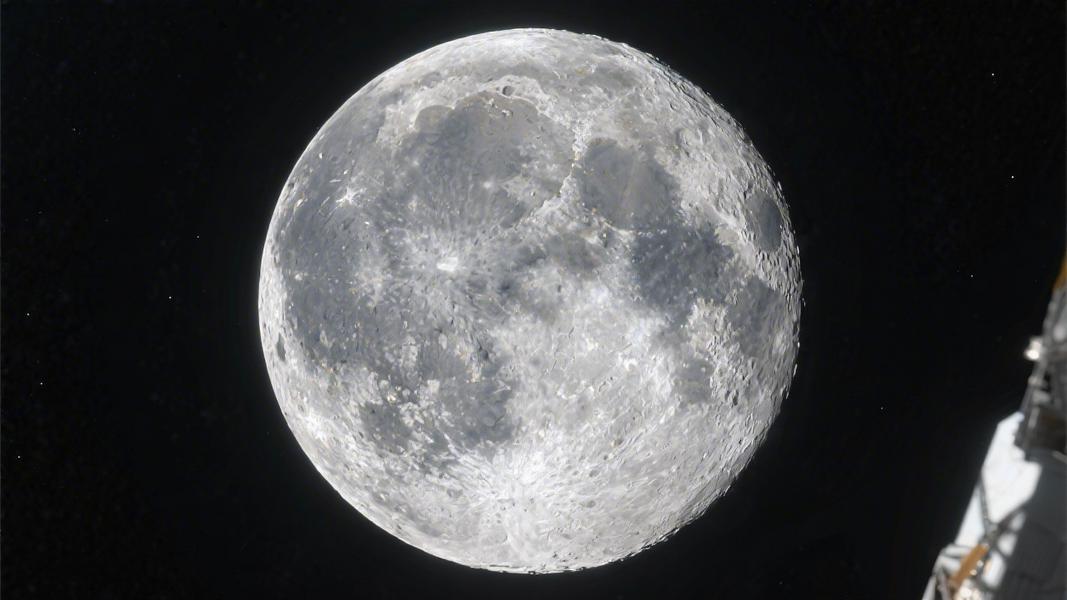
Four humans are currently farther from home than almost anyone in history — and they’ve been kind enough to send back pictures. The Artemis II crew is closing in on the Moon, and the images they’re transmitting are nothing short of extraordinary.
NASA’s first crewed lunar mission in more than half a century lifted off from Kennedy Space Center in Florida on April 1, 2026, setting the four-person crew on a trajectory that would carry them into the lunar sphere of influence by April 5, with a historic flyaround of the Moon’s far side scheduled for April 6. The mission isn’t a landing — but it doesn’t need to be. Every hour of this flight is a rehearsal for humanity’s return to the lunar surface, and the crew is already proving they have an eye for the dramatic.
A View No Camera Can Fully Prepare You For
Commander Reid Wiseman has emerged as the mission’s de facto photographer-in-residence, and his early work from the Orion spacecraft’s windows is already generating buzz back on Earth. Shortly after the translunar injection burn on April 2, Wiseman pressed his Nikon D5 to the glass — 22mm lens, F4.0, a quarter-second exposure at a jaw-dropping ISO 51,200 — and captured something genuinely rare: Earth nearly eclipsing the Sun, with both northern and southern auroras arcing across the frame alongside a faint wash of zodiacal light. The technical settings alone tell you something about how dark it gets out there.
NASA spokesperson Hawkins put the image in perspective during a briefing, noting that the backlit Earth in Wiseman’s shot represents virtually everyone who has ever lived. Noted Hawkins: “It’s great to think — with the exception of our four friends — all of us are represented in this image.” It’s the kind of line that sounds like a greeting card until you actually think about it.
Wiseman himself hasn’t been shy about describing what it’s like to watch Earth shrink behind them. “You can see the entire globe from pole to pole… It was the most spectacular moment and it paused all four of us in our tracks,” he said. Four trained astronauts — people who have spent years preparing for exactly this — stopped cold by a window view. That says something.
The Far Side, Finally
By the fourth day of the journey, the crew had something even rarer to photograph. On day four, the Orion spacecraft swung into position to capture the far side of the Moon — the hemisphere that faces permanently away from Earth, unseen by human eyes until the Space Age made it possible to go look. The image the crew shared is disorienting in the best possible way: the Moon appears upside down, its South Pole pushed to the top of the frame, with the ancient, multi-ringed Orientale basin visible along the right edge — a massive impact scar that looks almost geological in its scale, because it is.
It’s worth pausing on that detail. The Orientale basin is roughly 900 kilometers across. Seeing it casually framed along the edge of a handheld photo is a reminder of just how violent the early solar system was — and how small the spacecraft carrying these four people actually is in relation to any of this.
What Comes Next
Still, the mission’s most consequential moments lie just ahead. The crew is set to cross into the lunar sphere of influence — the point at which the Moon’s gravity dominates over Earth’s — on April 5, before making their close approach around the far side on April 6. NASA’s gallery of mission imagery is already growing by the day, and if the first few dispatches are any indication, the far-side flyaround is going to produce some of the most striking space photography since the Apollo era.
The technical photography details Wiseman has been working with — long exposures, extreme ISO, precise framing through a spacecraft window while traveling tens of thousands of miles per hour — aren’t accidental. NASA has clearly invested in making sure this mission is documented properly. The images aren’t just beautiful. They’re data, and they’re history.
And for the rest of us — all crammed together on that pale backlit dot in Wiseman’s aurora photo — they’re a reminder of what it looks like when our species actually does something remarkable.
