
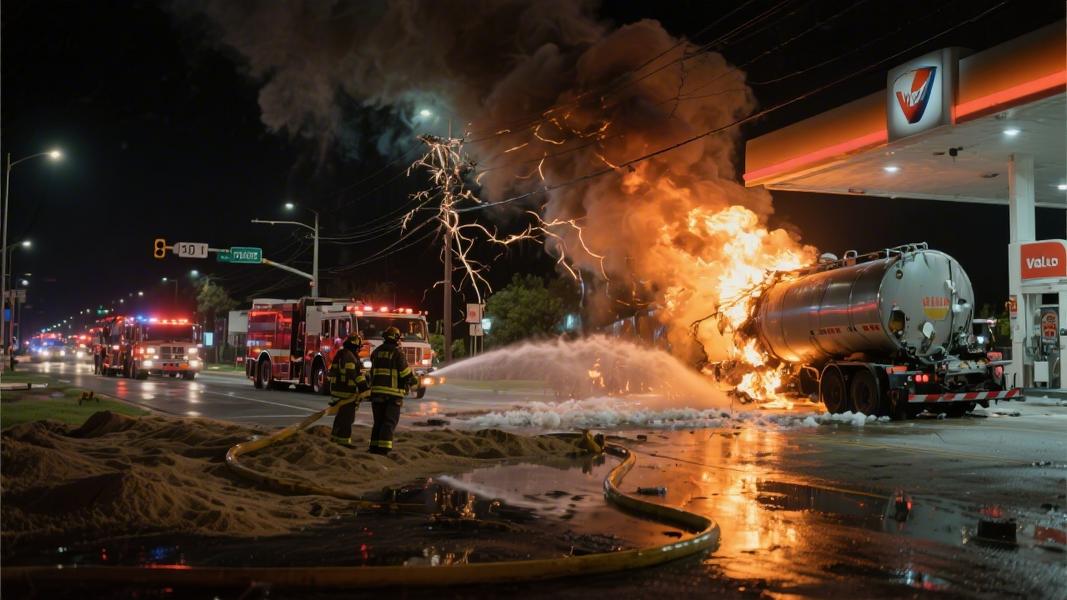
A gas tanker erupted in flames in the early hours of Sunday morning near Fort Worth, sending a driver to the hospital in critical condition and triggering one of the region’s more complex hazmat responses in recent memory.
The crash happened around 1 a.m. on April 5, 2026, when a tanker truck collided with another vehicle near a Valero station on Trinity Boulevard off Texas 360. The impact was bad enough — but then the fire started, and suddenly this wasn’t just a traffic accident anymore. It was a reported Level 2 hazardous materials event, with nearly 9,000 gallons of fuel sitting in a burning truck on a public roadway.
A Driver’s Quick Thinking, A Dire Outcome
Here’s where it gets both grim and remarkable. Despite the chaos — a collision, a fire, downed power lines — the tanker’s driver apparently managed to prevent the fuel from draining into the surrounding parking lot before losing consciousness. That single act almost certainly prevented a catastrophic spill. He was transported to a local hospital in critical condition, according to footage from the scene. A second person involved in the crash escaped without serious injury.
Still, the situation was volatile from the start. Knocked-down power lines — a casualty of the initial impact — fed directly into the fire’s ignition, complicating what crews could safely approach and when. Electricity and 9,000 gallons of fuel don’t mix well. That’s not an understatement.
The Response: Foam, Sand, and an Airport Truck
Fort Worth fire crews didn’t come to this one lightly. The response included water cooling operations, environmental containment units, and sand trucks deployed to build fuel dams around the vehicle — a precaution designed to stop any leaking fuel from spreading across the lot or into nearby drainage. Most notably, an Aircraft Rescue and Firefighting, or ARFF, truck was called in from DFW Airport, bringing specialized foam suppression capability that standard municipal rigs simply don’t carry. It’s the kind of mutual aid that doesn’t get requested unless the situation genuinely demands it, and this one warranted exactly that.
The Level 2 hazmat classification meant a coordinated, multi-agency posture — not just hoses and hope. These designations exist for a reason, and crews treated the scene accordingly.
Six Hours Later, It Was Over
By 7 a.m. — roughly six hours after the first call came in — fire crews had extinguished the blaze and completed cleanup operations. Trinity Boulevard had been a chaotic, smoldering stretch of road in the middle of the night; by Sunday morning, it was passable again. Whether any fuel ultimately reached storm drainage or surrounding soil remains a question for environmental assessors in the days ahead.
Downed power lines contributed to the hazard throughout the incident, a reminder of how quickly a traffic collision can cascade into something far more serious when infrastructure enters the picture. One crash. One tanker. One unlucky intersection of variables — and a small army of first responders spent the better part of a night making sure it didn’t become something much worse.
The tanker driver remains hospitalized. His condition, as of cleanup, was still listed as critical — a detail that tends to get lost once the fire’s out and the road reopens.
