
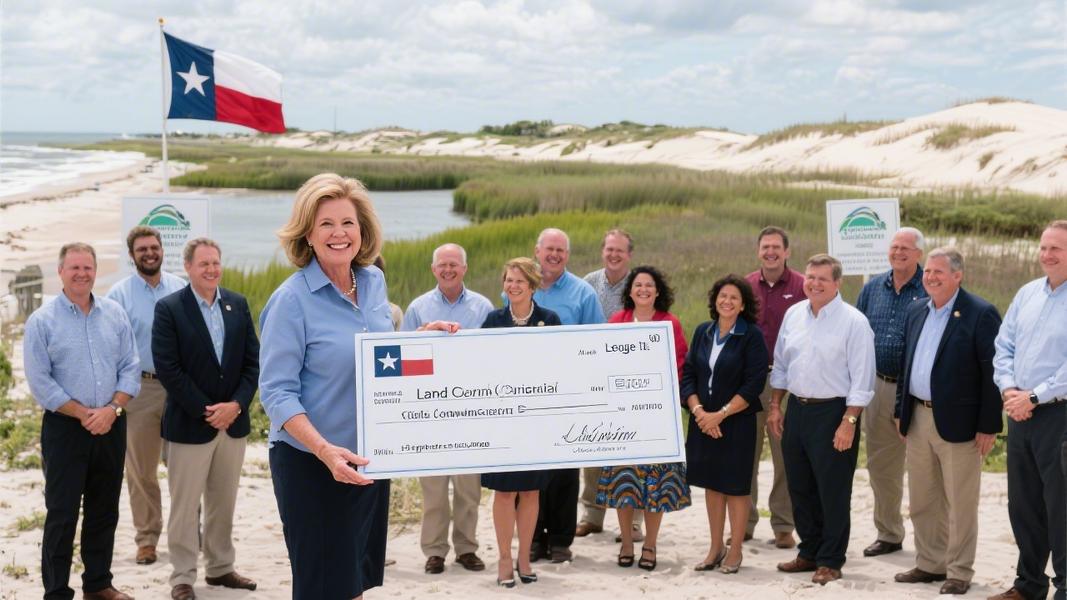
Texas is writing some big checks for its coastline — and the numbers are hard to ignore. State Land Commissioner Dawn Buckingham has announced more than $84.6 million in coastal improvement funding spread across 14 counties, with additional millions flowing to communities along the Upper Gulf Coast, marking one of the more substantial rounds of coastal investment the state has seen in recent years.
The money comes through two programs administered by the Texas General Land Office: the Coastal Management Program’s Grant Cycle 31 and the Coastal Erosion Planning and Response Act’s Cycle 14, known as CEPRA. Together, they fund a wide range of projects — beach nourishment, marshland restoration, dune rebuilding, shoreline stabilization, habitat recovery, and water quality improvements. The GLO announced the awards through a series of check presentations held in Corpus Christi and Brownsville, with a separate round of presentations in League City targeting the Upper Gulf Coast region.
Dozens of Recipients, One Shared Mission
The League City event alone drew a notable roster. Recipients of the $39.06 million in Upper Gulf Coast awards included Artist Boat, the City of Friendswood, the City of Kemah, Galveston County, Galveston ISD, the Galveston Park Board, Lamar University, the Matagorda Bay Foundation, Texas A&M Engineering Experiment Station, Texas Parks & Wildlife Department, Texas State University, the University of Texas at Arlington, and several others. That’s a wide mix — nonprofits, municipalities, universities, and conservation groups all sitting at the same table, which tells you something about how interconnected coastal health really is.
Buckingham, who has leaned heavily on her personal connection to the coast as a political and policy touchstone, framed the funding in characteristic terms. “Living on the Texas coast for many years has shaped my mission at the General Land Office to ensure our beaches are clean, safe, and enjoyable for all Texans,” she said. “The specific goals of these coastal improvement projects vary widely, from marshland restoration and water quality enhancement, to coastwide beach nourishment efforts to combat encroaching erosion. However, we all share the same mission to preserve our coastal lands for future generations.”
Where the Money Comes From
It’s worth understanding the funding architecture here, because it’s not simply a state appropriation. The CMP grants draw from NOAA, the Gulf of Mexico Energy Security Act — better known as GOMESA — and partner matching funds. CEPRA, meanwhile, is supported by the Texas Legislature, hotel occupancy taxes, GOMESA revenues, and additional match contributions. The KRISTV coverage of the Corpus Christi announcement captured Buckingham’s broader pitch: “As someone who spent more than a decade living on the Texas coast, ensuring our communities, wildlife, and their habitats are safe and thriving is of utmost importance. I am honored to bring this much-needed funding to our coastal communities for these beneficial projects. By dedicating this crucial assistance to these impactful projects, the GLO is ensuring our Texas coast will continue to thrive and remain resilient for generations to come.”
That’s a lot of “generations” language — but given the pace of coastal erosion along the Texas shoreline, it’s not exactly empty rhetoric. Stretches of the Gulf Coast have been losing ground for decades, and climate-driven storm intensity isn’t making that math any easier.
Boots on the Beach: Volunteers Already Doing the Work
Meanwhile, while the big funding announcements make headlines, a quieter effort has already been underway. The GLO’s 2026 Adopt-A-Beach program kicked off its winter cleanup season with 529 volunteers hauling 8,073 pounds of trash off beaches in the Coastal Bend and South Padre Island. That’s four tons of debris, pulled out by hand, before the spring season even gets started.
“The 2026 Adopt-A-Beach program’s cleanups are off to a fantastic start thanks to our dedicated volunteers,” Buckingham noted, adding an appeal for Texans to participate in the next coastwide cleanup on April 18th, covering beaches from Port Arthur to Boca Chica.
Mark Your Calendar: The Texas Coastal Roundup
That April 18th date isn’t just a cleanup day. The GLO has also scheduled the 2026 Texas Coastal Roundup for the same day — a free, family-friendly event running from 10:00 a.m. to 3:00 p.m. at East Beach, also known as R.A. Apffel Park, at 1923 Apffel Road in Galveston. Think interactive exhibits, ocean critters on display, a kid zone, door prizes, face painters, and food trucks. It’s the kind of event designed to get people emotionally invested in a coastline that, as the funding numbers make clear, requires an enormous amount of ongoing work to maintain.
Still, there’s something worth sitting with in all of this. Hundreds of millions of dollars in restoration funding, thousands of volunteers, dozens of institutions and municipalities — all working to hold the line against erosion, pollution, and ecological loss along a coastline that millions of Texans take for granted every summer. The question isn’t whether the effort is worthwhile. It’s whether it’s enough.
As Buckingham put it, the goal is a coast that remains resilient “for generations to come.” Whether that vision holds will depend on a lot more than any single grant cycle — but for now, at least, the state is writing the checks.
