
Texas is writing some big checks for its coastline — and this time, the money comes with marshes, oysters, and breakwaters attached.
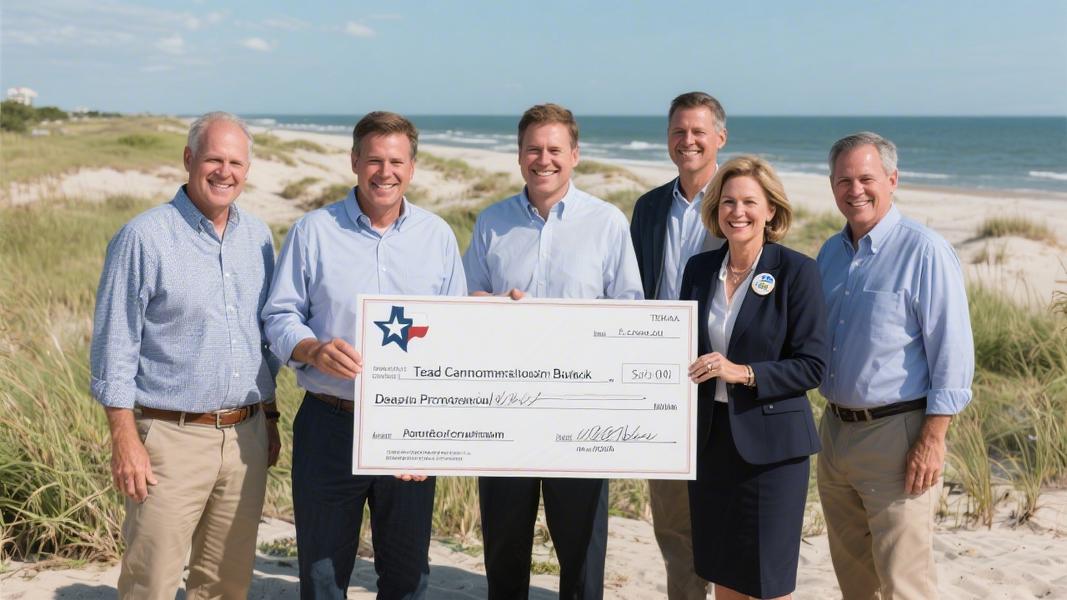
The Texas General Land Office (GLO) has announced more than $84.6 million in coastal improvement funding distributed across 14 Gulf Coast counties, part of a sweeping dual-program push through the Coastal Management Program (CMP) Grant Cycle 31 and CEPRA Cycle 14. The awards, announced by Land Commissioner Dawn Buckingham, M.D., at check presentations in Corpus Christi, Brownsville, and League City, represent one of the state’s most significant recent investments in shoreline resilience and habitat conservation.
Ducks Unlimited Gets a Major Slice
Among the headline awards, the GLO directed approximately $13.15 million to Ducks Unlimited Inc. through CEPRA Cycle 14 for shoreline protection work spanning Jefferson, Chambers, and Matagorda counties. The scope is broad: breakwater structures in Jefferson County, nature-based shoreline protection segments designed to halt marsh loss and cultivate oyster habitat in Chambers County, and tidal marsh preservation on public land in Matagorda County. It’s the kind of multi-pronged approach that coastal scientists have long argued is more durable than single-fix solutions.
Commissioner Buckingham, who practiced medicine on the Texas coast before entering public office, didn’t shy away from the personal stakes. “The Texas coast was my home for many years, and as Land Commissioner, I am dedicated to ensuring our beaches are clean, safe, and enjoyable for all Texans,” she said. “By awarding these funds to Ducks Unlimited, Inc. through CEPRA, the GLO is committed to ensuring the shorelines in Jefferson, Chambers, and Matagorda counties remain strong and resilient for our future generations.”
What CEPRA and CMP Actually Do
Not everyone tracks the acronyms, so here’s the short version. CEPRA — the Coastal Erosion Planning and Response Act — funds projects that directly combat shoreline erosion through beach nourishment, dune restoration, shoreline stabilization, and habitat work. It draws from the Texas Legislature, the state’s Hotel Occupancy Tax, federal GOMESA revenues, and partner matching funds. CMP, meanwhile, is a federally anchored program backed by NOAA and GOMESA that leans harder into habitat preservation, invasive species removal, coastal water quality, and public beach access improvements. Together, they cover a lot of ground — literally.
The Upper Gulf Coast Region alone pulled in roughly $39.06 million from the combined CMP Cycle 31 and CEPRA Cycle 14 awards, announced separately at a League City event, according to GLO disclosures.
A Coast That Can’t Afford to Wait
Why does this matter so urgently? Texas’s Gulf Coast is one of the most erosion-prone stretches of shoreline in the country. Subsidence, storm surge, and rising sea levels have been gnawing at marshes and beaches for decades — and marshes, in particular, serve as a first line of defense against hurricane damage for inland communities. Losing them isn’t just an ecological problem. It’s a public safety one.
Buckingham made that case plainly at the broader announcement. “As someone who spent more than a decade living on the Texas coast, ensuring our communities, wildlife, and their habitats are safe and thriving is of utmost importance,” she stated. “By dedicating this crucial assistance to these impactful projects, the GLO is ensuring our Texas coast will continue to thrive and remain resilient for generations to come.” The framing — community, wildlife, habitat, all in one breath — reflects how intertwined those concerns have become in coastal policy circles.
Still, funding cycles don’t last forever. The GLO confirmed that CMP Cycle 32 is currently open for applications, while CEPRA funding isn’t expected to reopen until March 2027. For counties and organizations eyeing the next round, the clock is already ticking on one and paused on the other, as noted by local coverage of the announcements.
The Bigger Picture
Fourteen counties. Eighty-four million dollars. Oyster reefs, breakwaters, dune restoration, invasive species removal, and new public beach access points — all moving forward at once. That’s not a minor administrative action; it’s a coordinated bet that proactive investment now is cheaper than reactive disaster recovery later. Given the storm history along the Texas Gulf Coast, that’s not a hard argument to make.
The question is whether the funding keeps pace with the erosion. On a coastline that doesn’t stop moving, $84.6 million is a serious commitment — but the marshes, as they always have, will be the ones keeping score.
