
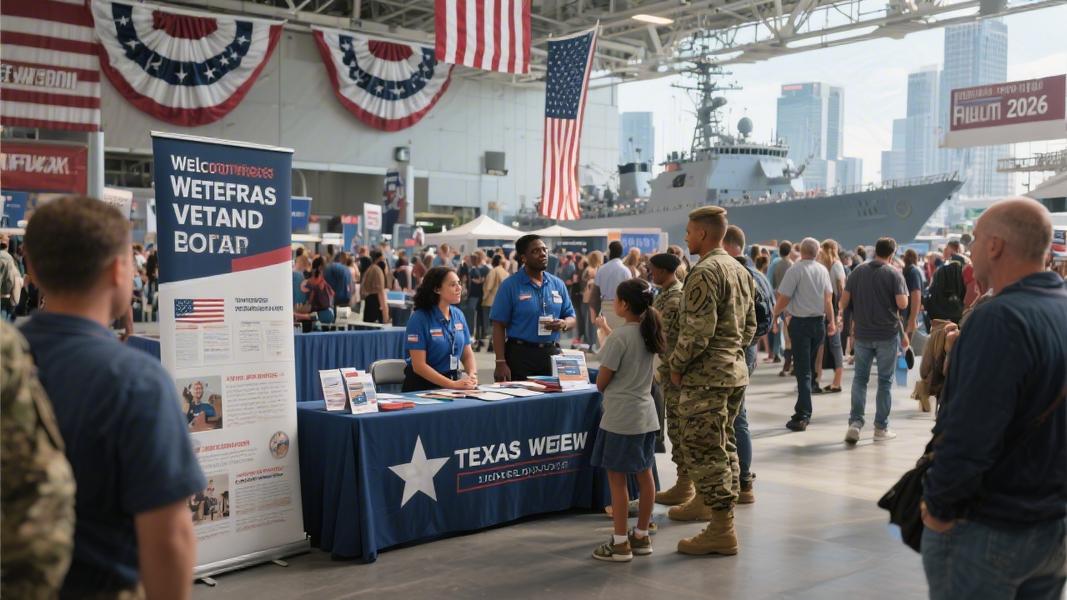
Texas veterans have a new reason to show up to Houston’s waterfront this spring — and it’s not just for the ships.
Texas Land Commissioner and Veterans Land Board Chairwoman Dawn Buckingham has announced that the Texas Veterans Land Board (VLB) will station a resource table at two major events during the 2026 Fleet Week in Houston — the Fleet Week Expo and the Exhibition at Sylvan Beach. The move is a deliberate push to put state benefits directly in front of the veterans and military families who need them most, in a setting where they’re already showing up.
Buckingham’s office confirmed the VLB “will have a resource table at two events during the 2026 Fleet Week in Houston: the Fleet Week Expo and the Exhibition at Sylvan Beach.” It’s the kind of outreach that sounds simple on paper but carries real weight for veterans who may not know what they’re entitled to under Texas law.
What the VLB Actually Offers
Here’s the thing about the Veterans Land Board that often surprises people: it’s not a small program. The VLB is widely regarded as offering the most robust state benefits package in the nation. That includes land loans requiring as little as 5% down — a figure that stands out in a housing market that’s been brutal to first-time buyers for years.
The VLB finances purchases of at least one acre of land anywhere in Texas, home loans for primary residences, and home improvement loans — all operating alongside but independent of federal VA loans. It follows Texas rules, not federal ones, which can make a meaningful difference depending on a veteran’s situation. The program has been detailed as a complement to VA loans rather than a replacement, giving eligible Texans a layered set of financing options that most states simply don’t provide.
Beyond loans, the VLB operates nine skilled-care Texas State Veterans Homes and four Texas State Veterans Cemeteries across the state, plus a dedicated statewide Veterans call center. That’s a sprawling infrastructure, and it didn’t happen overnight. The board was established in 1946 specifically to help World War II veterans purchase land — one of those post-war programs that quietly evolved into something far larger than its founders likely imagined.
A Long History, A Modern Push
The VLB’s reach today looks nothing like its origins. What began as a straightforward land-access program for returning WWII servicemembers has grown into a full-service benefits operation that touches housing, healthcare, and burial services. The scope now includes state veterans homes, land sales, and a robust information network that advocates say still doesn’t get enough attention in communities that need it.
Still, awareness remains a persistent challenge. That’s partly why Fleet Week — which draws military families, active-duty personnel, and veterans in large numbers — makes strategic sense as an outreach venue. You go where the people are. The General Land Office has long framed its veterans work as a matter of honoring service through concrete action: home loans, long-term care, land access. The Fleet Week presence is that philosophy made tangible.
In a previous effort to close the information gap, former Commissioner George P. Bush overhauled the board’s digital footprint entirely. Bush unveiled “the redesigned and streamlined Texas Veterans Land Board (VLB) website — www.texasveterans.com” — consolidating loan information, land sales, benefits fairs, and contact options into a single, more navigable hub. The range of programs now visible on that site — three loan programs, nine veterans homes, four cemeteries, and the call center — reflects just how much the VLB has expanded since its postwar founding.
How to Reach the VLB
For veterans who can’t make it to Fleet Week, the Texas Veterans Call Center operates Monday through Friday, 7:30 a.m. to 5:30 p.m. CT, at 1-800-252-8387. The line is staffed by specialists equipped to walk veterans through loan eligibility, home and land programs, and access to state veterans homes and cemeteries.
That number is worth writing down. In a state with one of the largest veteran populations in the country, it’s a direct line to benefits that — for all the VLB’s size and history — too many Texans still don’t know exist.
