
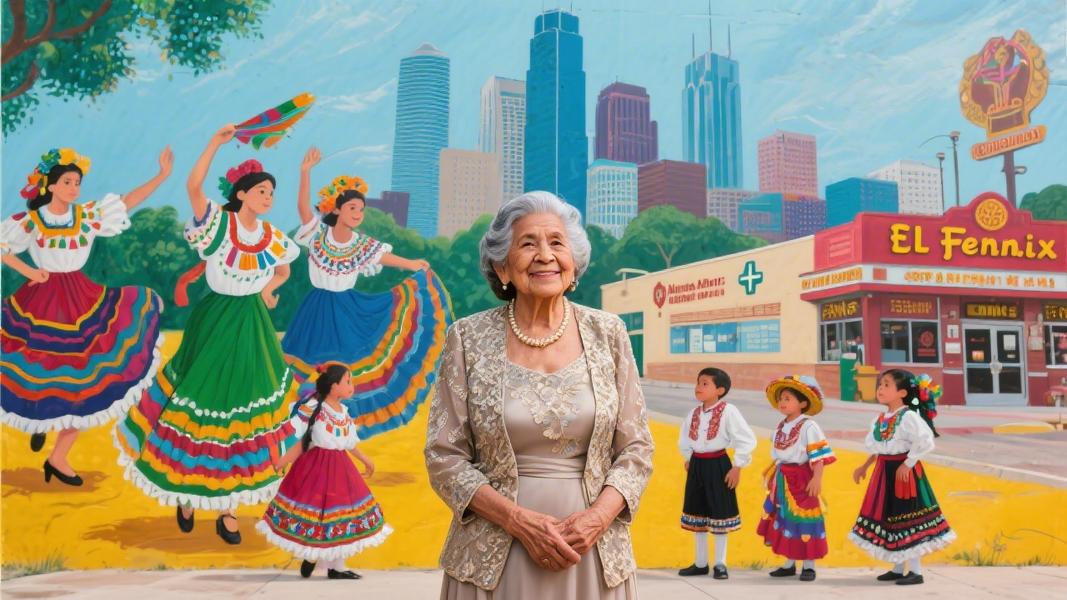
She broke barriers at Dallas City Hall, then spent the rest of her life making sure the community that sent her there had something to show for it. Anita Nanez Martinez, the first Mexican-American elected to the Dallas City Council, died in April 2026 at the age of 100.
Martinez’s death closes a chapter in Dallas history that stretched across more than a century — from her birth on December 8, 1925, in a west Dallas neighborhood residents still call “Little Mexico,” to a legacy that reshaped city services, cultural life, and political representation for generations of Latinos in North Texas. She was, by any measure, a figure who refused to be symbolic when she could be useful.
A Seat at the Table — and a To-Do List
When Martinez won her council seat in 1969, she didn’t arrive with talking points. She arrived with a list. Before taking office, she recalled asking West Dallas residents directly what ten improvements they needed most — and then she delivered them. “In a few years the area had better sanitation, a health clinic, street lights, paved streets, a library, a recreation center and other basic city services,” she said.
That approach — unglamorous, methodical, stubborn — defined her four-year tenure. It’s the kind of governing that doesn’t generate many headlines at the time but tends to look pretty significant in retrospect. West Dallas had long been underserved. Martinez treated that not as a talking point but as a repair order.
Among her most enduring achievements was the recreation center she helped bring to West Dallas, which her fellow council members voted to name The Anita N. Martinez Recreation Center before she left office in 1973. It wasn’t an empty honor. She noted that to this day, the facility remains one of the most used of its kind citywide — a distinction that says something about both the need she identified and the permanence of what she built.
Culture as Infrastructure
What came next surprised some people. After leaving the council, Martinez could have pivoted to lobbying, consulting, the usual post-office trajectories. Instead, she started a dance company.
The Anita N. Martinez Ballet Folklorico was born inside that same recreation center she’d fought to build. It taught traditional Mexican dance to young people in a neighborhood that had been told, in ways both explicit and structural, that its culture didn’t belong in the civic fabric of Dallas. Martinez disagreed. Through the organization, she created, in the words of those who followed her, “a space where generations of young people have discovered their identity, celebrated their culture, and believed in their dreams.”
That’s not incidental to her political legacy. It’s an extension of it. Martinez understood that paved streets and street lights were necessary — and so was pride.
After the Council: A Life That Kept Moving
She wasn’t exactly idle after 1973. The Nixon administration tapped her to evaluate the effectiveness of the Peace Corps across North Africa, the Near East, Asia, and the Pacific — a sweeping assignment that reflected a recognition of her organizational instincts even if it came from an unlikely corner of Washington. Martinez later described the appointment matter-of-factly, as she described most things.
Her personal life was woven tightly into the fabric of Dallas as well. She was married to Al Martinez, whose family owned the iconic El Fenix restaurant, and she served as program director of the Dallas Restaurant Association Auxiliary — roles that kept her embedded in the city’s business and civic circles even outside of elected office.
In 2022, Southern Methodist University presented Martinez with an honorary Doctor of Humane Letters degree, recognizing her decades of contributions to Dallas’s civic and cultural life. She was 96 years old at the time. Still showing up.
What a Century Looks Like
How do you measure a life like hers? By the health clinic that served families who had none. By the teenagers who learned to dance in a recreation center that almost wasn’t built. By the simple fact that a woman from “Little Mexico” walked into Dallas City Hall in 1969 and changed what that building looked like — and what it did.
Martinez served from 1969 to 1973. She lived until 2026. That’s more than fifty years of watching the seeds take root — the streets she paved, the dances she preserved, the doors she cracked open for those who came after her. Not a bad thing to spend a century on.
She didn’t just make history. She made sure her neighborhood had a library to keep it in.
