
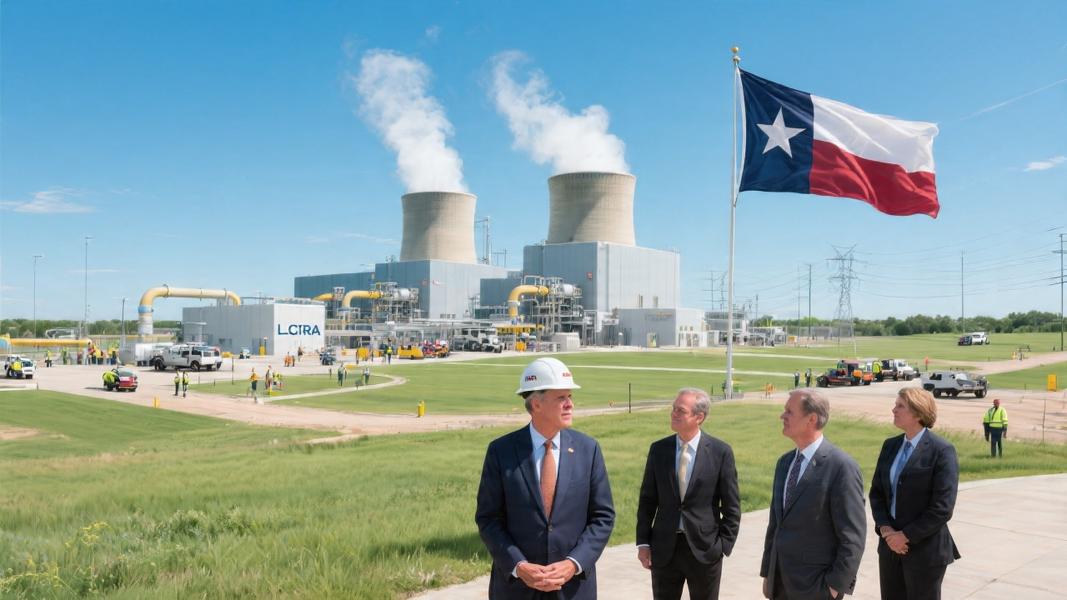
Texas just added another layer to its power grid — and this time, it showed up early. Governor Greg Abbott and the Lower Colorado River Authority announced Tuesday that the second unit of the Timmerman Peaker Power Plant in Maxwell is fully operational, arriving a full month ahead of schedule.
The milestone completes the 380-megawatt facility in Caldwell County, doubling the plant’s output and pushing enough electricity onto the grid to power more than 100,000 Texas homes during peak demand. For a state that has spent years chasing its own appetite for power — through brutal summers, catastrophic winter freezes, and a relentlessly expanding economy — the early finish is the kind of news grid operators don’t take for granted.
A Plant Built for the Worst Days
The Timmerman plant isn’t designed to run around the clock. It’s a peaker — meaning it’s engineered to fire up fast when demand spikes and the grid starts sweating. Each of the facility’s two units houses 10 Wärtsilä 18V50SG engines, each rated at roughly 18.8 megawatts, for a combined capacity of just under 190 MW per unit. That’s a lot of iron sitting ready to spin up on short notice.
LCRA Board Chair Stephen F. Cooper put it plainly: “This plant stands ready to provide power within minutes on the hottest summer days, the coldest winter nights, and everything in between.” That’s not marketing language — it’s a direct reference to the twin vulnerabilities Texas has exposed in recent years, the kind that left millions without heat during the February 2021 winter storm and sent electricity prices into the stratosphere during summer heat events.
Governor Abbott, for his part, framed the announcement in the broader context of the state’s ongoing grid buildout. “Texas is rapidly adding power to the state grid,” he said. “LCRA’s investments in generation through the Texas Energy Fund will help ensure reliability for all Texans as we fortify the state’s ability to power homes.” The Texas Energy Fund, created through a 2023 voter-approved measure, has become a central mechanism for financing exactly this kind of dispatchable thermal generation.
Why the Early Completion Matters
Here’s the thing about peaker plants: timing is everything. A unit that comes online in May instead of June might seem like a rounding error on a construction timeline. But in Texas, where ERCOT has been projecting tight reserve margins heading into summer, a month can mean the difference between a managed grid and an emergency alert.
LCRA’s acting general manager and CFO, Jim Travis, didn’t sugarcoat the urgency. “The vibrant Texas economy is showing no signs of slowing down, and that means we need additional reliable power available sooner rather than later,” he said. “Our state is setting new demands for power regularly, and LCRA is pleased to help answer the call by doubling the output of the Timmerman plant and bringing our newest unit online a month early.”
That demand pressure is real and measurable. ERCOT’s April 2026 Monthly Operational Capacity Report noted expected increases in installed capacity, specifically calling out 189 megawatts of new natural gas — a figure that lines up almost precisely with Timmerman’s second unit. Dispatchable thermal resources, the report emphasized, remain a critical piece of reliability planning as renewable penetration grows.
Inside the ERCOT Queue
The project’s path through regulatory channels was relatively swift. Timmerman Phase 2 entered the ERCOT interconnection queue under project identifier 25INR0503, carrying a listed capacity of 188.4 MW and a proposed completion date of April 7, 2026 — a date it essentially met, give or take two weeks. For large-scale generation projects in Texas, that’s a tight turnaround from queue entry to commercial operation.
Still, it’s worth noting what this plant is and isn’t. Timmerman is fast, flexible, and strategically located in Central Texas. What it’s not is baseload. It won’t be churning out electrons on a quiet Tuesday in March. Its value is in the margins — those dangerous hours when the grid is stretched thin and every available megawatt counts. That’s a role Texas increasingly needs filled, and one that natural gas peakers are uniquely suited to play in the current energy mix.
The Bigger Picture
Texas has added enormous amounts of solar and wind capacity in recent years — more than any other state. But intermittency is still intermittency. The sun sets. The wind stops. And on those evenings in August when temperatures don’t drop and air conditioners keep running, something has to fill the gap. That’s the structural argument for plants like Timmerman, and it’s an argument that’s gotten harder to dismiss since 2021.
The LCRA, which operates as a wholesale electricity provider serving cooperatives and municipalities across Central Texas, has leaned into that argument with the Texas Energy Fund backing. The Timmerman plant — both units now fully operational — represents one of the more tangible deliverables from that investment strategy.
Whether it’s enough is a separate question. Texas’s load growth, fueled by data centers, semiconductor fabs, and a population that keeps arriving, has a way of outpacing even the most aggressive infrastructure timelines. But for now, 380 megawatts of fast-response generation is sitting in Maxwell, ready to answer the call — and it got there ahead of schedule. In the Texas power business, you take the wins when you get them.
