
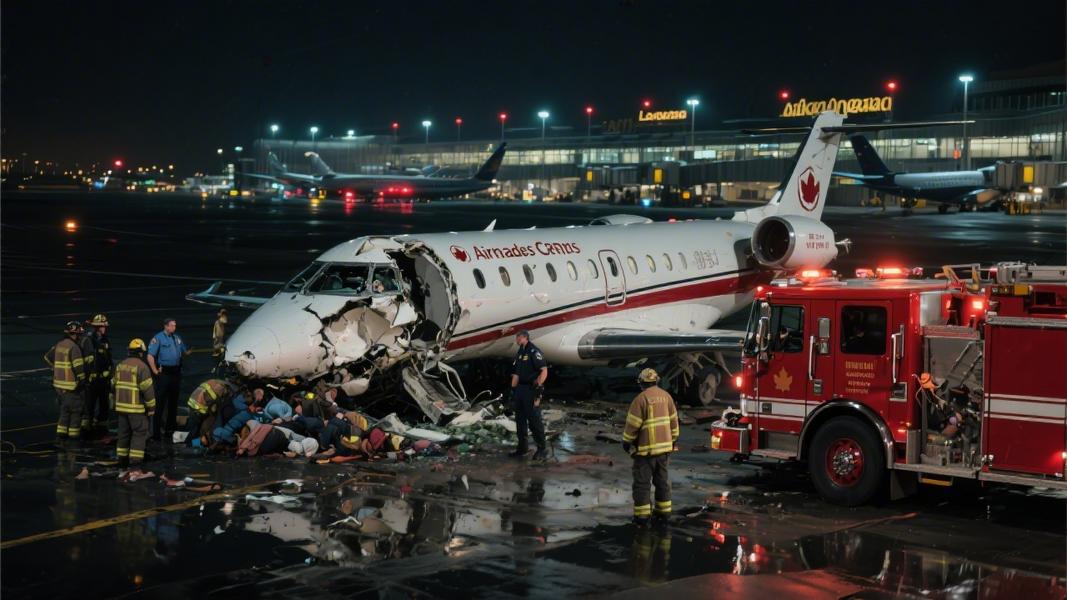
Two people are dead and a major New York airport was forced to shut down Sunday night after a regional Air Canada plane collided with a Port Authority vehicle on the ground at LaGuardia Airport — a jarring incident that sent shockwaves through one of the country’s busiest travel hubs.
The collision, which occurred after dark on Sunday, prompted officials to close LaGuardia entirely, stranding travelers and grounding flights at an airport that handles tens of millions of passengers each year. The full circumstances of how a plane and a ground vehicle ended up in the same deadly place at the same time remain under investigation.
What We Know So Far
The aircraft involved was a regional plane operating under the Air Canada banner. A Port Authority vehicle — the agency that owns and operates LaGuardia — was struck in what authorities confirmed was a fatal ground collision. Two people died as a result. Beyond that, specific details about the sequence of events, the identities of those killed, and the precise location on the airfield were still being pieced together in the immediate aftermath.
It’s the kind of incident that air safety investigators dread — not a mechanical failure at 30,000 feet, but something that happened on the ground, in the dark, where the margins for error are supposed to be controlled and predictable. And yet, here we are.
Airport Closure and the Ripple Effect
LaGuardia’s closure didn’t just affect a handful of flights. This is New York City — one of the most congested airspaces in the world. When LaGuardia goes dark, the disruption fans out fast. Passengers already in terminals were left waiting for word on whether their flights would resume. Inbound aircraft were presumably diverted or held. The downstream delays, even after the airport eventually reopened, were certain to cascade well into the following day.
Still, the operational chaos is almost secondary. Two people didn’t go home Sunday night. That’s the story here.
Air Canada and Port Authority Yet to Detail Roles
Neither Air Canada nor the Port Authority of New York and New Jersey had, at the time of initial reports, released detailed statements explaining what their personnel were doing in the moments before impact. That’s not unusual this early in an investigation — but it’s exactly the kind of information that investigators will be pressing hard to establish. Who authorized the vehicle to be where it was? What were the pilots told? What did the tower see?
Questions like those don’t get answered in hours. They get answered in months, sometimes longer, after cockpit voice recordings, ground radar data, and witness accounts are all carefully assembled into something resembling a clear picture.
A Rare But Not Unheard-Of Danger
Ground collisions at airports — so-called runway and taxiway incursions — are among the scenarios that aviation safety regulators work hardest to prevent. The FAA tracks hundreds of incursion events every year across U.S. airports, the vast majority of them minor. Fatal ones are rare. But “rare” isn’t the same as “impossible,” and Sunday night at LaGuardia is a brutal reminder of that distinction.
LaGuardia, it’s worth noting, is not a sprawling airport with miles of open tarmac. It’s compact, squeezed onto a peninsula in Queens, with runways that sit close together and ground operations that require constant coordination. That layout has long made it one of the more operationally complex airports in the country to manage — even on a quiet night.
What Comes Next
Federal investigators — almost certainly including the National Transportation Safety Board — were expected to deploy to the scene. The NTSB typically takes the lead in aviation accident investigations, and a fatal collision involving a commercial aircraft would squarely fall within their jurisdiction. Their process is methodical, deliberate, and often frustratingly slow for a public hungry for answers.
Air Canada, for its part, will face questions about the specific regional carrier operating the flight, the crew’s experience, and what communications passed between the cockpit and ground control in the minutes before the collision. The Port Authority will need to account for why its vehicle was in the aircraft’s path — or vice versa.
For now, LaGuardia is a crime scene and a crash site wrapped into one, and the answers that matter most — why two people died on a Sunday night at one of America’s most familiar airports — won’t come quickly or easily.
In aviation, they rarely do.
