
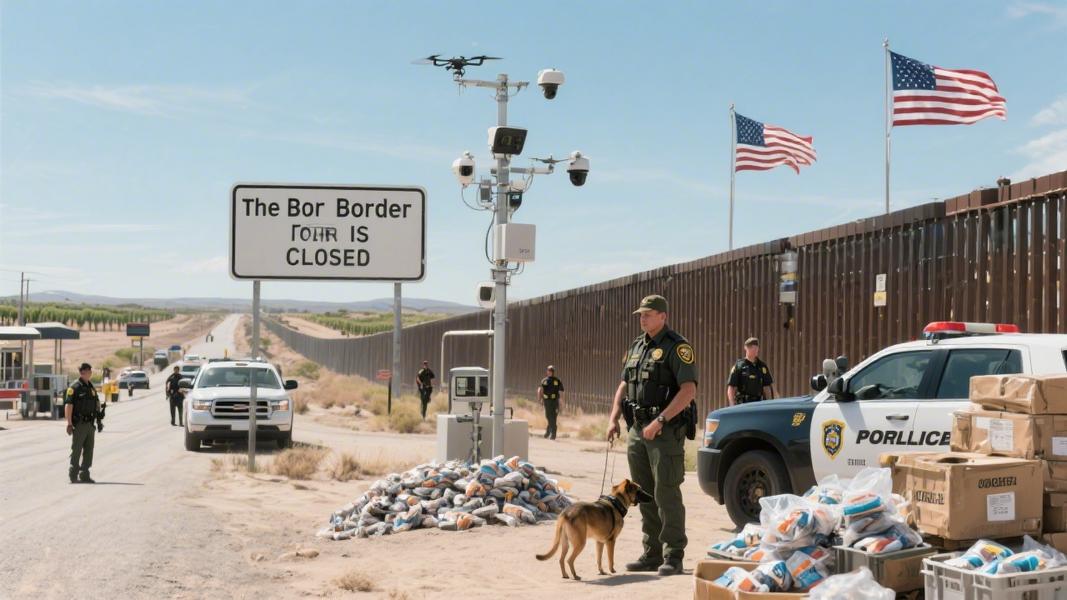
For eleven straight months, not a single migrant has been released into the U.S. interior from the southern border. Not one. That number — zero — has become the defining statistic of the Trump administration’s immigration enforcement push, and federal officials aren’t shy about saying so.
The Department of Homeland Security confirmed this week that March 2026 marked the 11th consecutive month of zero border releases, as southwest border apprehensions fell to 8,268 — a 90% decline from the 33-year monthly average and a staggering 97% drop from the Biden administration’s peak in December 2023. The first six months of fiscal year 2026 now represent the lowest border encounter figures in recorded history, according to the agency.
DHS Secretary Markwayne Mullin framed it in blunt terms. “Eleven straight months of ZERO releases at the border,” he stated. “Under President Donald Trump’s leadership, we are delivering the most secure border in American history. The world knows America’s borders are closed to lawbreakers.”
The Numbers Behind the Milestone
To understand just how dramatic the shift is, consider the math. March 2026’s daily apprehension average was 267 people. At the height of the previous administration, Border Patrol was processing roughly 336 migrants per hour. That’s not a typo — per hour. Today’s daily average is less than what agents once handled in a single sixty-minute window during peak crisis months.
Southwest border apprehensions have now stayed below 9,000 per month for 14 consecutive months, and the daily average is running 95% lower than under the Biden administration. CBP Commissioner Rodney Scott credited a combination of policy, personnel, and infrastructure for the sustained results. “America First policies, real consequences, and a unified federal effort — backed by personnel, infrastructure, and technology — are how we’ve delivered the most secure border in U.S. history,” he said. “This isn’t temporary — it’s the new normal.”
That last phrase — the new normal — is clearly intentional. The administration wants these figures to be seen not as a temporary dip, but as a structural reset of how the border operates.
Deportations and Voluntary Departures
It’s not just the crossings that have slowed. The administration has simultaneously ramped up removals on a scale that, frankly, has few modern precedents. The White House reported that more than 605,000 individuals have been formally deported since Trump returned to office, with an additional 1.9 million estimated to have self-deported — bringing the total number of departures to over 2.5 million.
Self-deportation — once a politically mocked concept — appears to have become a measurable phenomenon, driven by stepped-up interior enforcement and a broader signaling effect that the administration has worked hard to project both domestically and internationally. Whether those self-deportation figures hold up to independent scrutiny remains an open question, but the sheer scale of the claim reflects the administration’s confidence in its enforcement posture.
Drug Seizures Surge Even as Crossings Fall
Here’s where the story gets more complicated. Even as illegal crossings have plummeted, drug interdictions are climbing — and sharply. CBP seized more than 65,000 pounds of narcotics nationwide in March alone, including 613 pounds of fentanyl. That represents a 27% increase in drug seizures compared to March 2024, and a 24% jump for the first half of FY 2026 versus the same period in FY 2024.
Fentanyl trafficking at the southern border, meanwhile, has actually decreased 56% year-over-year — a figure officials attribute to enhanced screening at ports of entry rather than any reduction in cartel activity. CBP also reports stopping more than 10,000 individuals with ties to narco-terrorism from entering the country during this period.
The apparent paradox — more drugs seized, less fentanyl coming through — reflects a shift in where and how smugglers operate, as well as what CBP says is a significantly improved detection infrastructure at legal crossing points. Still, critics have long argued that cracking down on illegal crossings pushes trafficking activity toward ports of entry, which are harder to fully screen at high volume.
Trade, Counterfeits, and Forced Labor
Border enforcement, it turns out, is about a lot more than people and drugs. CBP processed $323 billion in imports in March 2026 and identified $24 billion in duties for collection — figures that underscore the agency’s dual role as both a security and an economic enforcement body.
On the consumer protection front, agents seized 2,776 shipments of counterfeit goods valued at more than $1.1 billion, and flagged 304 shipments — worth over $12 million — for potential forced labor violations under the Uyghur Forced Labor Prevention Act and related statutes. These aren’t headline-grabbing numbers in the same way migration data is, but they represent a significant layer of enforcement that often gets lost in the immigration debate.
Agriculture and Biosecurity Operations
Less glamorous, but arguably just as consequential for the long-term economy: CBP’s agriculture specialists issued 7,722 emergency action notifications for restricted or prohibited plant and animal products in March, conducted more than 106,000 positive passenger inspections, and handed out 761 civil penalties for undeclared agricultural items. A single invasive pest slipping through a port of entry can cost American farmers hundreds of millions of dollars. It’s the kind of enforcement that rarely makes the front page — until it fails.
What It All Adds Up To
The administration’s border record is, by the raw numbers, historically unusual. Eleven months of zero releases. Apprehensions at a 33-year low. Deportations and departures totaling 2.5 million. Drug seizures up nearly a quarter year-over-year. These aren’t figures any prior administration — Republican or Democrat — has posted simultaneously.
That said, the political and human context around these numbers is anything but simple. Immigration courts are strained, legal challenges to enforcement operations continue, and the humanitarian implications of mass deportation at this scale remain deeply contested. The administration, for its part, has shown little interest in relitigating those debates — it’s running on results.
Commissioner Scott’s words may be the most telling signal of where things are headed: “We’re building on what works, refining our approach, and locking in real border security.” The emphasis on locking in suggests this isn’t being treated as a campaign talking point. It’s being treated as policy architecture — something designed to outlast a news cycle.
Whether it does will depend on courts, Congress, and conditions that no administration fully controls. But for now, that number — zero — is doing a lot of heavy lifting.
