
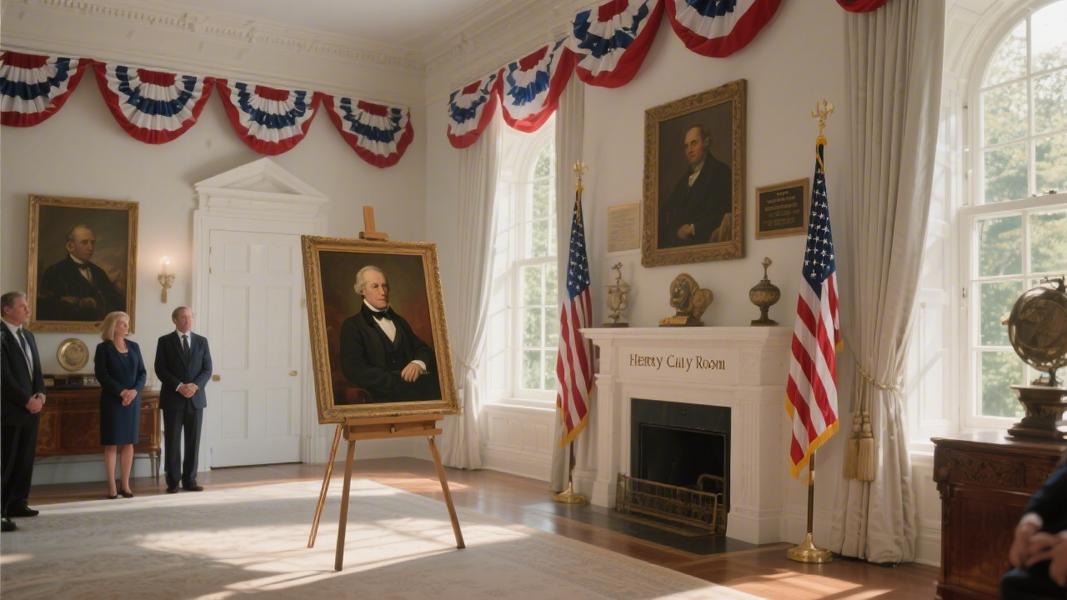
President Trump has signed a proclamation designating April 12, 2026, as an official day of celebration honoring one of American history’s most consequential — and complicated — political figures. The occasion: the 249th birthday of Henry Clay, the Kentucky statesman whose career defined an era and whose legacy still sparks debate.
The proclamation, issued by the White House, goes beyond symbolic gesture. It includes a directive to redesignate Room 208 of the Eisenhower Executive Office Building as the Henry Clay Room, a concrete nod to a man who shaped the architecture of American governance long before the building itself existed. “I, DONALD J. TRUMP, President of the United States of America, by virtue of the authority vested in me by the Constitution and the laws of the United States, do hereby proclaim April 12, 2026, as a day of celebration in honor of the life of Henry Clay,” the document reads.
A Life Built on Oratory, Ambition, and Deal-Making
Clay was born on April 12, 1777, in Hanover County, Virginia — a detail that gives the 2026 proclamation its neat numerical hook. He died on June 29, 1852, having served as the seventh Speaker of the House and the ninth Secretary of State, among a string of other roles that would exhaust a modern résumé. Few politicians in American history held more offices, ran for more positions, or lost more gracefully — or at least more productively — than Henry Clay.
He moved to Lexington, Kentucky, in 1797, married Lucretia Hart two years later, and quickly built a reputation that extended well beyond the courtroom. His legal skills were formidable. His oratory, by all accounts, was something else entirely — the kind that stopped rooms and started careers.
The American System and the Art of the Compromise
What made Clay genuinely influential wasn’t just his speaking voice. It was his vision. He developed what became known as the American System — an economic framework that called for federal investment in infrastructure, a national bank, and high protective tariffs designed to shield domestic industry from foreign competition. It was, in many ways, an early blueprint for industrial nationalism.
But it’s his role as a legislative dealmaker that cemented his place in the history books. Clay earned the nickname “The Great Compromiser” — not exactly a term of endearment in every political era, but one that carried genuine weight in his. He brokered the Missouri Compromise of 1820, one of the earliest major legislative attempts to manage the explosive question of slavery’s expansion into new territories. Three decades later, he came back to the table with the Compromise of 1850, a sprawling legislative package that addressed California’s statehood, the boundaries of Texas, and the thorny question of slavery in newly acquired territories.
That’s the catch, of course. Compromise, in Clay’s time, often meant deferring the hardest moral reckonings. The deals he struck bought time — but the underlying tensions he papered over eventually erupted into the Civil War, less than a decade after his death.
Three Presidential Runs. Zero Wins.
How does a man so dominant in Congress never reach the presidency? Clay ran three times — in 1824, 1832, and 1844 — and lost all three. In 1824, he didn’t even make it to the Electoral College runoff, though he wielded enough influence in the House to help deliver the presidency to John Quincy Adams, under whom he then served as Secretary of State. Critics called it a “corrupt bargain.” Clay called it politics.
Still, the losses stung. He was a figure who seemed built for the presidency — commanding, strategic, beloved in his home state — and yet the office always found a way to slip past him.
Ashland and the Shadow of Slavery
It’s not that simple to celebrate Clay without confronting the full picture. He owned the Ashland plantation in Kentucky, a sprawling estate that grew to somewhere between 500 and 600 acres. At various points during his lifetime, he enslaved between 60 and 122 people on that land. Clay was, by the standards of his era, a moderate on slavery — he supported gradual emancipation and colonization schemes — but he was also, without question, an enslaver who profited from forced labor.
That tension is baked into his legacy, and any serious accounting of his life has to hold both things at once: the legislative genius and the moral failure. The proclamation doesn’t dwell there, but historians do.
Death, Legacy, and Lincoln’s Grief
Clay died of tuberculosis on June 29, 1852, and became the first American statesman to lie in state at the United States Capitol — a distinction that speaks to how thoroughly he had defined the institution. Abraham Lincoln, then a relatively obscure Illinois politician, delivered an admiring eulogy that revealed how deeply Clay had shaped the next generation of American leaders. Lincoln’s later approach to union-preservation bore more than a passing resemblance to the man he mourned.
Now, nearly 174 years after his death, a room in the building that sits next to the White House will carry his name. Whether that’s a fitting tribute to a genuinely towering figure, or a selective reading of a complicated man, probably depends on which part of his story you’re standing in.
