
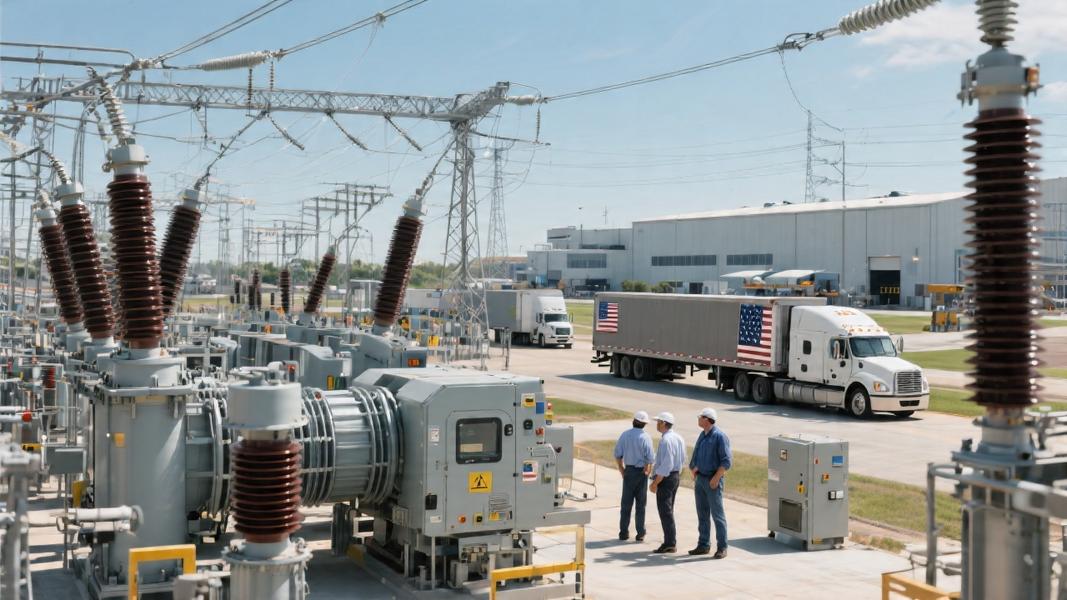
President Trump signed a sweeping executive determination on Sunday invoking wartime industrial powers to shore up America’s crumbling electric grid — a move that signals just how seriously the administration views the country’s energy vulnerabilities.
The Presidential Determination, dated April 20, 2026, activates Section 303 of the Defense Production Act of 1950 — a Cold War-era statute that gives the president extraordinary authority to mobilize domestic industry for national defense purposes. The directive targets a surprisingly unglamorous but critical list of components: transformers, transmission lines, substations, high-voltage circuit breakers, power control electronics, and the electrical core steel needed to build them. It’s the kind of infrastructure most Americans never think about — until the lights go out.
A Grid in Crisis
The backstory here matters. Back on January 20, 2025, Trump issued Executive Order 14156, declaring a National Energy Emergency under the National Emergencies Act. The order was blunt in its diagnosis, finding that “America’s inadequate energy production, transportation, and infrastructure constitute an unusual and extraordinary threat to the Nation’s economy, national security, and foreign policy.” Sunday’s determination is, in many ways, the industrial follow-through on that declaration — the moment where rhetoric becomes procurement policy.
How bad is it, exactly? According to the determination itself, pretty bad. The document states plainly that “without Presidential action under section 303 of the Act, United States industry cannot reasonably be expected to provide these capabilities for the needed industrial resource, material, or critical technology items in a timely manner due to limited domestic production capacity, extended procurement timelines, foreign supply dependence, and insufficient capital investment.” That’s a frank admission from any administration — that the market, left alone, simply won’t fix this fast enough.
The specific items named in the determination read like a parts list for the backbone of modern civilization. Transformers. Substations. Protective relay systems. Capacitor banks. Raw materials and manufacturing tools. These aren’t exotic weapons systems — they’re the components that keep hospitals running, water treatment plants online, and financial systems humming. And right now, the U.S. can’t make enough of them fast enough, at least not domestically. A significant share of large power transformers, for instance, are sourced from foreign manufacturers, with lead times that can stretch years.
The Legal Mechanism — and Why It’s Significant
Section 303 of the Defense Production Act, codified at 50 U.S.C. 4533, is one of the more powerful tools in a president’s industrial policy arsenal. Under normal circumstances, invoking it requires satisfying a checklist of conditions — a process designed to ensure the authority isn’t used casually. But Trump’s determination goes a step further, waiving those procedural requirements entirely.
The language is worth reading carefully. The determination states that Trump has “declared a national emergency under Executive Order 14156” and further finds that “action to expand the domestic capability to develop, manufacture, and deploy grid infrastructure and supporting industrial supply chains is necessary to avert an industrial resource or critical technology item shortfall that would severely impair national defense capability.” On that basis, he invokes Section 303(a)(7) to waive the standard requirements of Sections 303(a)(1) through (a)(6). That’s not a minor procedural footnote — it’s a significant acceleration of executive power.
Still, it’s not without precedent. The Biden administration used similar DPA authority to expand domestic production of large-capacity battery materials, invoking Title III mechanisms to push investment into supply chains the private sector was moving too slowly to build. The Trump White House has now applied the same legal scaffolding to the grid — a notable instance of continuity beneath the surface-level political drama.
Who’s Responsible Now
The memorandum directs the Secretary of Energy to carry out its provisions — putting the department squarely in charge of translating the presidential determination into actual contracts, investments, and industrial commitments. The authority granted under Section 303 includes the ability to make purchases, issue purchase commitments, and provide loans to expand productive capacity. In practice, that means the Energy Department could begin directing federal dollars toward transformer manufacturers, steelmakers, and electronics suppliers to incentivize domestic production at scale.
That’s the catch, though. Invoking the authority is one thing. Actually rebuilding a domestic manufacturing base for grid hardware — one that atrophied over decades of offshoring and underinvestment — is another matter entirely. Industry analysts have long warned that even with aggressive federal support, standing up new transformer manufacturing capacity takes years, not months. The supply chain for electrical core steel, in particular, is deeply entangled with foreign producers.
The Bigger Picture
Zoom out, and this determination fits into a broader pattern of the Trump administration treating energy infrastructure as a national security asset rather than purely a market question. That framing — grid reliability as defense readiness — has been gaining traction across both parties for years, driven by a confluence of threats: aging infrastructure, extreme weather events, and growing concerns about cyberattacks and physical sabotage targeting power systems.
What’s different now is the legal lever being pulled. The Defense Production Act carries real teeth. It doesn’t just encourage industry — it can compel it, fund it, and prioritize it in ways that standard regulatory or subsidy tools can’t. Whether the administration moves aggressively to use those powers, or whether Sunday’s determination functions more as a political signal than an operational blueprint, remains to be seen.
For now, the lights are still on. The question this determination quietly raises is whether Washington has finally decided it can’t afford to wait until they’re not.
