
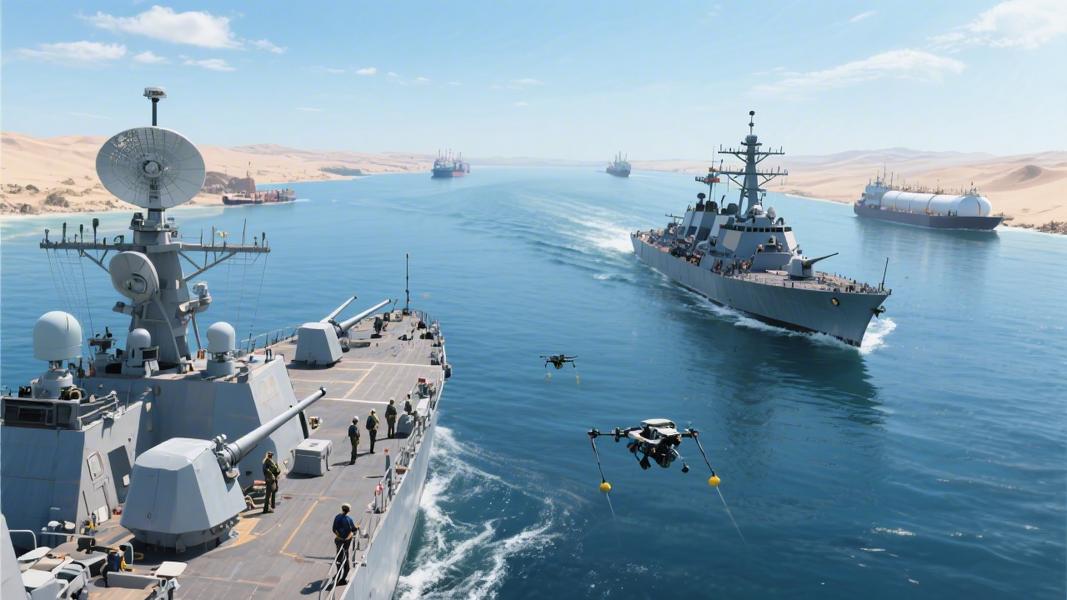
The U.S. military has begun clearing sea mines from the Strait of Hormuz, one of the world’s most critical shipping chokepoints, after Iran’s Islamic Revolutionary Guards Corps laid explosives across the waterway — a move Washington is calling both dangerous and unacceptable.
Two U.S. Navy destroyers, the USS Frank E. Peterson and the USS Michael Murphy, transited the strait this week and entered the Arabian Gulf as part of what the military describes as a broader mission to restore safe passage. At stake is a waterway that handles roughly a fifth of the world’s oil supply. The operation marks one of the most direct and consequential confrontations between American naval forces and Iran in recent memory.
A Warning, Then Action
It didn’t start quietly. Before the destroyers moved in, U.S. Defense Secretary Pete Hegseth made clear the military’s posture had shifted well beyond rhetoric. “CENTCOM has been eliminating inactive mine-laying vessels in the Strait of Hormuz — wiping them out with ruthless precision,” he declared. “We will not allow terrorists to hold the Strait of Hormuz hostage.” That’s not the language of a department still weighing its options.
U.S. Central Command confirmed the elimination of multiple Iranian vessels involved in the mine-laying effort, including 16 minelayers operating near the strait. The warning that accompanied those strikes was blunt: “If for any reason mines were placed, and they are not removed forthwith, the Military consequences to Iran will be at a level never seen before. If, on the other hand, they remove what may have been placed, it will be a giant step in the right direction!”
Clearing a Path — Literally
So what does “clearing the strait” actually look like in practice? Admiral Brad Cooper, the CENTCOM commander overseeing the operation, offered some clarity. “We began the process of establishing a new passage and we will share this safe pathway with the maritime industry soon to encourage the free flow of commerce,” he said. The implication is that shipping lanes are being actively rerouted and verified — a process that takes time, specialized equipment, and nerves.
The two destroyers are operating as part of that effort, with the mission framed not merely as a response to an immediate threat but as a deliberate reassertion of American control over one of the world’s most strategically sensitive corridors. The USS Frank E. Peterson and USS Michael Murphy transited under what CENTCOM described as a broader mandate to ensure the strait is “fully clear.”
Civilians Caught in the Middle
Still, there’s a human dimension here that’s easy to lose in the operational briefings. CENTCOM issued a stark advisory warning civilians to stay away from Iranian port facilities being used by naval forces. “U.S. forces urge civilians in Iran to immediately avoid all port facilities where Iranian naval forces are operating,” the statement read — a signal that those locations no longer carry protected status under international law. That’s not a small thing. It means the U.S. military is formally treating those ports as legitimate military targets.
The warnings put ordinary Iranians in a difficult position — caught between a government that placed the mines and a foreign military now actively dismantling both the ordinance and, apparently, the infrastructure supporting it.
Escalation on a Hair Trigger
But it’s not that simple, of course. CENTCOM has also urged the IRGC to conduct its naval exercises safely and to avoid behavior that could threaten freedom of navigation — language that sounds almost diplomatic alongside the simultaneous elimination of Iranian vessels. The dual messaging reflects the tightrope Washington is walking: firm enough to deter, careful enough not to ignite something larger.
Talks between the U.S. and Iran over Tehran’s nuclear program have been continuing in Pakistan, even as destroyers move through contested waters and defense secretaries make statements about “ruthless precision.” That’s the world right now — negotiations and naval operations running in parallel, each side apparently betting the other won’t push it all the way.
Whether the mines are fully cleared, whether Iran backs down, and whether that “safe pathway” Admiral Cooper promised actually opens for commercial shipping — all of that remains to be seen. What isn’t in question is that the Strait of Hormuz, for the moment, is a very different place than it was a week ago.
