
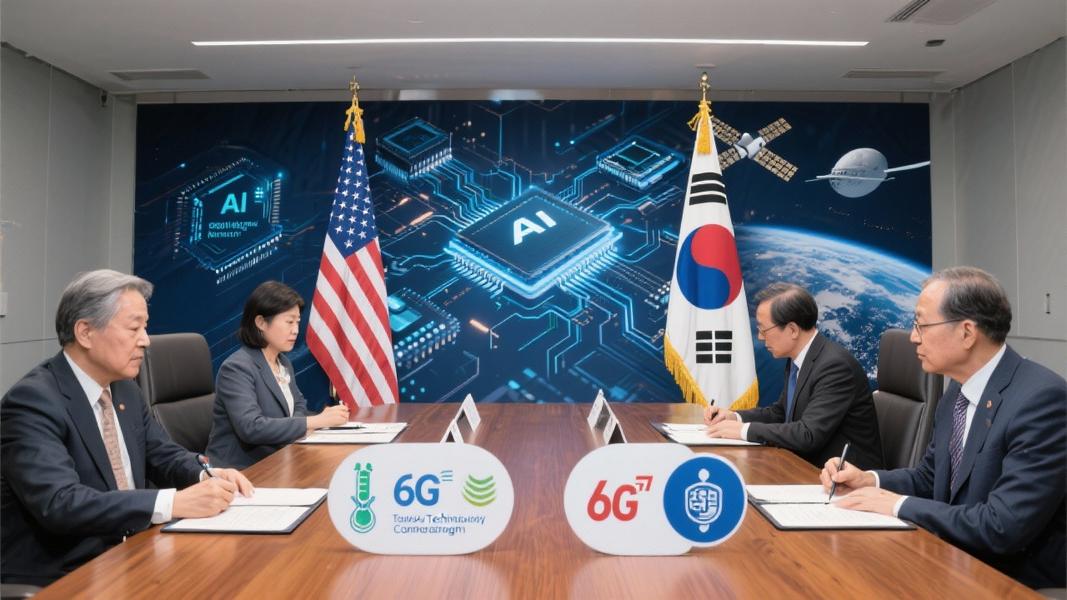
The United States has signed major technology cooperation deals with Japan and South Korea, marking a significant shift in how America approaches technological partnerships with its key Asian allies. The newly minted “Technology Prosperity Deals” aim to accelerate collaboration in cutting-edge fields including artificial intelligence, quantum computing, and next-generation communications.
The agreements, finalized last week, represent the Trump administration’s push to cement America’s technological leadership through strategic bilateral partnerships rather than going it alone. White House officials described the deals as a framework to align regulatory approaches, speed up research and development, and bolster national security in an increasingly competitive global tech landscape.
Strategic Realignment
“The Trump Administration is redefining American technological leadership by driving bilateral collaborative partnerships with allies like Japan and Korea,” said Michael Kratsios, Assistant to the President and Director of the White House Office of Science and Technology Policy. “Each Technology Prosperity Deal offers great opportunities to accelerate scientific discovery and lead the world into a new era of innovation driven by the US and our partners.”
The U.S.-Japan deal specifically targets cooperation in AI, quantum computing, biotechnology, space exploration, 6G communications, and fusion energy. Meanwhile, the agreement with South Korea focuses on similar areas with particular emphasis on synthetic biology and quantum technology, according to officials familiar with the negotiations.
What’s behind this sudden diplomatic push for technological alliance-building? Experts suggest it’s no coincidence these deals emerge amid intensifying competition with China in advanced technology sectors.
South Korean Science Minister Bae Kyung-hoon highlighted the forward-looking nature of the agreement. “The memorandum of understanding is a symbol of cooperation for the prosperity of future generations, just as its title suggests,” he noted during the signing ceremony.
AI at the Forefront
Both agreements place artificial intelligence at the center of cooperation efforts. “AI promises a new Golden Age of Innovation by empowering individuals and supercharging progress across sectors like healthcare, advanced manufacturing, and education,” the White House stated in materials related to the U.S.-Korea deal.
The partnerships extend beyond government agencies. Industry insiders describe extensive provisions for private sector involvement, especially in building resilient supply chains for critical technologies. This public-private approach reflects lessons learned during recent supply chain disruptions that exposed vulnerabilities in technology manufacturing and distribution.
South Korea’s position in this arrangement has been characterized by some policy experts as that of a “critical technology wingman” for the United States. A recent Carnegie Endowment report examines how this relationship could benefit both nations, particularly as the U.S. navigates its complex technological competition with China.
Beyond Government
The private sector’s role cannot be overstated. Both deals emphasize corporate partnerships and research collaboration across borders. Technology companies in all three countries stand to benefit from streamlined regulatory frameworks and increased investment in joint research initiatives.
“These aren’t just diplomatic documents gathering dust,” said one industry analyst who requested anonymity to speak candidly. “They’re roadmaps for how allied countries can pool resources and talent in areas where going solo is increasingly difficult.”
The agreements also address sensitive issues like intellectual property protection and technology transfer restrictions, though specific details remain closely held. Security considerations loom large, with provisions for safeguarding critical technologies from unauthorized access or exploitation.
Forging a robust U.S.-ROK technology alliance represents a priority for both countries, with experts highlighting the importance of private sector involvement in creating resilient supply chains.
The Technology Prosperity Deals may signal a new era in how democratic nations approach technological development—less as individual competitors and more as collaborative partners in an increasingly complex global landscape where scientific leadership translates directly to economic and strategic advantage.
