
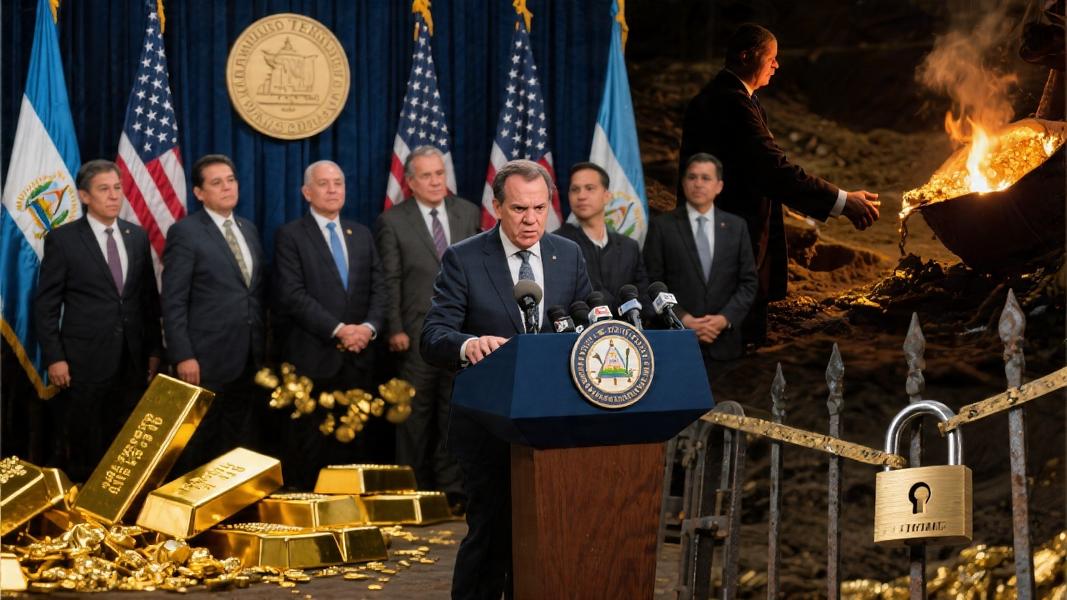
The United States just tightened its grip on Nicaragua’s gold trade — and this time, it went straight for the family.
On April 16, 2026, the U.S. Department of the Treasury’s Office of Foreign Assets Control (OFAC) announced sweeping new sanctions targeting five individuals and seven companies operating in Nicaragua’s gold sector. The targets range from regime-linked mining firms and government officials to the adult sons of President Daniel Ortega and his wife and co-ruler, Rosario Murillo. The action, Treasury says, is a direct response to a pattern of confiscation, financial manipulation, and political entrenchment that’s been building for years — funded, in large part, by gold.
“The Murillo-Ortega dictatorship has sought to fill its own coffers through the use of these gold companies and co-conspirators by confiscating American investments in Nicaragua and using it to generate funds to maintain its political power,” Secretary of the Treasury Scott Bessent stated in the department’s official announcement. It’s a blunt accusation — and it comes with teeth.
A Network Built on Concessions and Control
The sanctions didn’t emerge out of nowhere. Since at least 2020, the Ortega-Murillo regime has been quietly restructuring Nicaragua’s mining sector into what Treasury describes as a web of front companies, all funneling foreign currency back to the regime’s inner circle. At the center of that network: two previously sanctioned figures, Laureano Ortega Murillo — another son of the ruling couple — and Salvador Mansell Castrillo, who together have managed a sprawling portfolio of mining operations designed to keep the regime financially solvent and politically untouchable.
That’s not a new playbook. Back in June 2022, OFAC sanctioned ENIMINAS, the state mining entity created in 2017 to regulate gold concessions and joint ventures. Profits, investigators found, were being quietly routed to regime insiders. Then, in May 2024, the Treasury went after COMINTSA — a company owned by Mansell Castrillo — along with Capital Mining Investment Nicaragua, both of which had been operating in the gold sector to generate hard currency for a government that desperately needs it. COMINTSA had received fresh gold concessions as recently as 2023, after another company’s license was conveniently revoked.
The pattern is almost elegant in its cynicism. A company gets sanctioned. Its concessions get transferred. A new company steps in. Repeat.
The Sons Step Into the Spotlight
Among the newly designated individuals, two names stand out: Maurice Facundo Ortega Murillo and Daniel Edmundo Ortega Murillo — both sons of the ruling couple, both now formally embedded in the machinery of the Nicaraguan state. Maurice serves as the Presidential Delegate for Sports, overseeing the Nicaraguan Institute of Sports. Daniel heads the Communication and Citizenship Council of Nicaragua. Their designations, Treasury notes, are based on their roles as officials of the Government of Nicaragua — a government Washington no longer treats as a legitimate partner in any meaningful sense.
It’s worth pausing on that. The Ortega-Murillo regime has, over the years, placed family members across nearly every lever of institutional power. Sanctioning two more sons isn’t just a symbolic gesture — it’s a signal that the U.S. is mapping the entire apparatus and intends to squeeze it from every angle.
The Companies: Gold Moving Through American Systems
So which firms actually made the list? The seven sanctioned companies tell a story of their own. Exportadora de Metales Sociedad Anonima (EMSA) sells gold directly in the United States and, according to Treasury, transfers profits in ways that may be funding paramilitary groups. Grupo Minero Xiloa S.A. buys and exports artisanal gold — and does it using the U.S. financial system. Nicaragua Xinxin Linze Mineria Group S.A., known as Xinxin, shipped more than $25 million in gold to the United States in 2025 alone. Also designated: Thomas Metal S.A. and Brother Metal S.A., each granted tens of thousands of acres in mining concessions.
Then there’s the seizure story — and it’s a particularly brazen one.
A Stolen Plant and the Companies Behind It
In 2025, BHMB Mining Nicaragua S.A. — a U.S.-owned operation — had its processing plant forcibly taken. The companies that participated in that seizure, Treasury says, were Zhong Fu Development S.A. and Santa Rita Mining Company S.A. Two individuals tied directly to Zhong Fu — Feiwu Bian and Anibal Vladimir Matus Buitrago — were personally involved in the confiscation and are now sanctioned as well.
Also on the list: Santiago Hernan Bermudez Tapia, Nicaragua’s Vice Minister of Energy and Mines; Nelson Francisco Sobalvarro, who transferred mining concessions away from the already-sanctioned COMINTSA; and Lester Matus Tamariz, who facilitated the transfer of those concessions to Zhong Fu. It’s a tight, interlocking circle — and Treasury appears to have traced it carefully before pulling the trigger.
What the Sanctions Actually Do
For anyone unfamiliar with how OFAC designations work: these sanctions freeze any U.S.-based assets belonging to the designated parties and prohibit Americans from doing business with them. Companies that continue transacting with sanctioned entities risk secondary exposure. In practice, it means these gold firms can’t legally sell into U.S. markets, can’t use U.S. correspondent banks, and can’t access the dollar-denominated global financial system without putting their partners at serious legal risk.
Still, enforcement is never simple. Nicaragua’s gold has historically found its way into international markets through intermediaries, and the regime has shown considerable creativity in routing around financial pressure. The 2022 ENIMINAS sanctions didn’t stop the gold trade — it just reshuffled who was running it.
But each new round of designations narrows the field a little further, names names that hadn’t been named before, and makes it harder for international banks and traders to claim ignorance. That cumulative pressure, U.S. officials argue, is the point.
Whether it’s enough to meaningfully destabilize a regime that has already weathered years of international isolation — expelled foreign missionaries, jailed bishops, stripped hundreds of citizens of their nationality — is a different question entirely. The Ortega-Murillo government has never shown much interest in changing course under external pressure. Gold, for now, remains one of the few reliable revenue streams it has left. And Washington, it seems, has decided that’s exactly where to keep pressing.
