
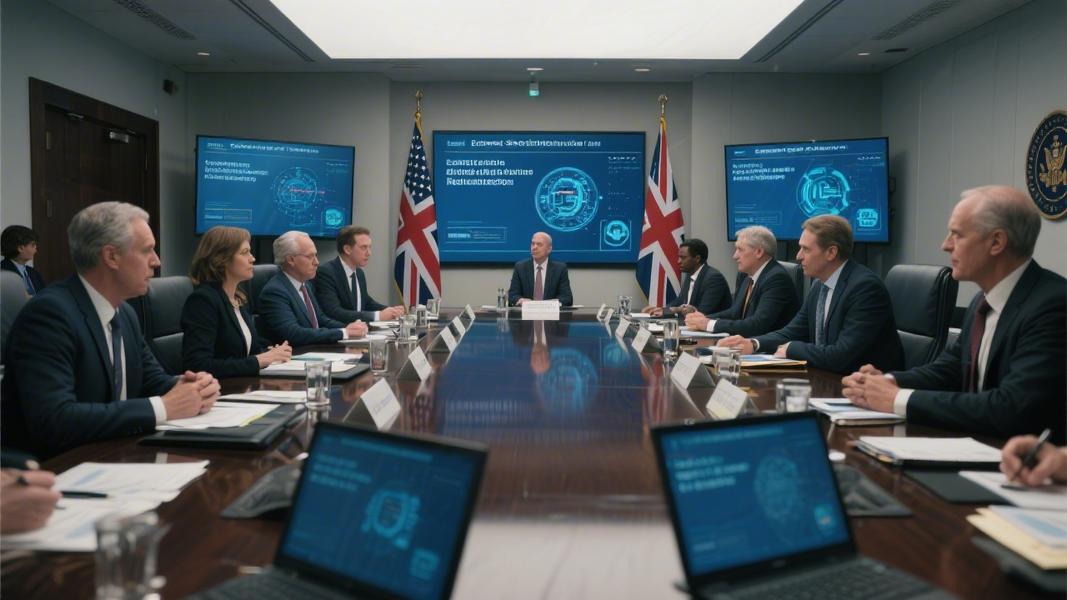
Washington and London are tightening their financial embrace — and they’re doing it fast. The two governments convened their 12th official financial regulatory meeting this February, signaling that transatlantic cooperation on markets, digital finance, and regulatory reform is accelerating well beyond diplomatic pleasantry.
The U.S.-UK Financial Regulatory Working Group met on February 25, 2026, hosted by the U.S. Department of the Treasury in Washington, DC. It brought together a formidable roster of regulators: senior officials from HM Treasury, the Federal Reserve, the CFTC, the FDIC, the OCC, the SEC, the Bank of England, and the Financial Conduct Authority. That’s not a small room. The breadth of representation alone suggests both sides are treating this as something more than a routine check-in.
A Working Group With Real Momentum
The group has been meeting biannually for years, publishing joint statements after each session to reflect shared commitments on bilateral financial cooperation. The 11th meeting took place in London on June 3, 2025 — covering similar terrain: the economic outlook, regulatory developments, digital finance, and the investment environment. What’s different now is the institutional architecture being built around those conversations.
Four major themes drove the February agenda: the economic and financial stability outlook, the newly formed Transatlantic Taskforce for Markets of the Future, digital finance and innovation, and broader regulatory modernization. It’s a wide aperture, but each item connects to the same underlying question — how do two of the world’s most powerful financial systems stay aligned when the global landscape keeps shifting?
The Taskforce That Could Define a Generation of Markets
Perhaps the most consequential development to emerge from this bilateral relationship is the Transatlantic Taskforce for Markets of the Future, known as the TTMF. It was established in September 2025 by U.S. Treasury Secretary Scott Bessent and UK Chancellor Rachel Reeves during President Trump’s state visit to the United Kingdom — an unusual moment of policy convergence amid an otherwise unpredictable geopolitical climate.
“In September 2025, as part of President Trump’s state visit to the UK, Secretary of the Treasury, Scott Bessent, and Chancellor of the Exchequer, Rachel Reeves, established the Taskforce to enhance the deep and historic connection between the world’s leading financial hubs in the UK and the United States,” according to Treasury documents. The TTMF held industry engagement sessions in London on January 26, 2026, and is expected to deliver formal recommendations through the Working Group by summer 2026. That’s a tight timeline for something with this much ambition.
The UK’s Regulatory Recalibration
What does London actually want from all this? Rob Moulton, a partner at Latham & Watkins who closely tracks UK financial regulation, offered a sharp read on where British regulators are headed. He describes 2026 as a year of deliberate recalibration — a shift in how the UK thinks about risk and, more pointedly, about who it’s aligning with.
“The focus is far more on being internationally aligned than trying to unnecessarily dilute our legal or regulatory framework for financial services in the UK,” Moulton said. That’s a careful formulation. It’s not deregulation for its own sake. It’s a repositioning — away from reflexive harmonization with European standards post-Brexit, and toward a broader international framework where Washington, not Brussels, increasingly sets the tone.
Still, that shift carries its own complications. International alignment sounds tidy in a joint statement. In practice, it means navigating divergent political pressures on both sides of the Atlantic, where “modernization” can mean very different things depending on who’s in office.
Why It Matters Beyond the Beltway
It would be easy to dismiss this as a biannual ritual — regulators shaking hands, issuing communiqués, flying home. But the TTMF’s mandate, the density of agency participation at the February session, and the explicit focus on digital finance and innovation suggest something more durable is taking shape. Markets don’t wait for governments. But when two of the world’s largest financial jurisdictions start building shared infrastructure for how they’ll regulate the next generation of assets, instruments, and platforms — that’s worth watching closely.
The summer 2026 recommendations from the TTMF will be the real test. If they’re substantive, this Working Group may look less like a diplomatic formality and more like the quiet scaffolding of a new transatlantic financial order. If they’re not — well, there’s always the 13th meeting.
