
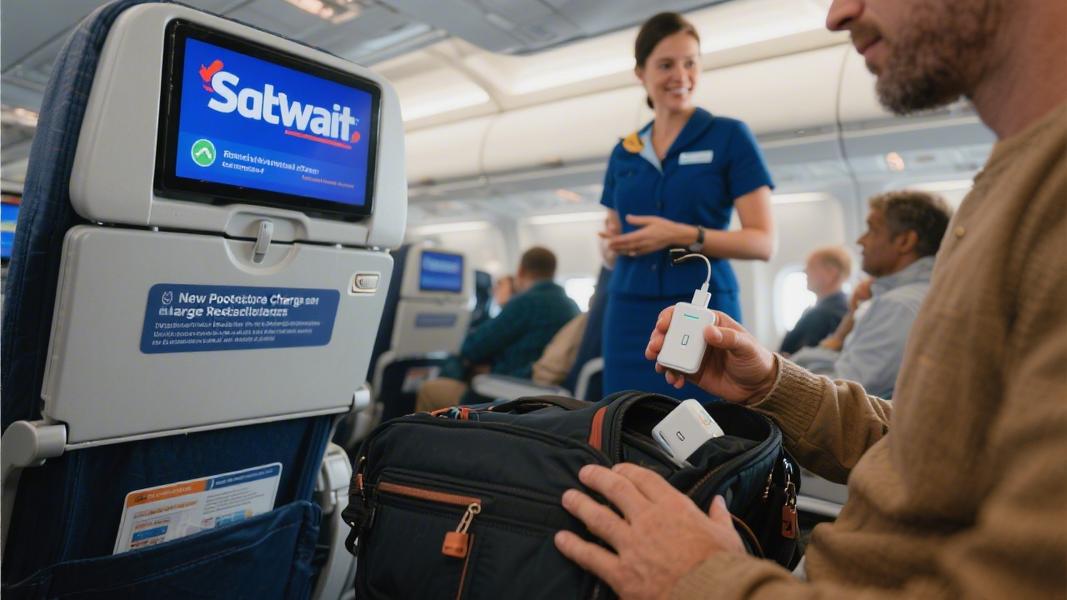
Southwest Airlines is cracking down on portable chargers — and if you’re the type to stuff a power bank in the overhead bin before settling in, that habit is about to cost you.
The Dallas-based carrier is rolling out new restrictions on lithium-ion battery-powered portable chargers, limiting passengers to a single device rated at 100 watt-hours or less. The rules take effect April 20, 2026, and they go further than a simple quantity cap. Chargers won’t be allowed in overhead bins or checked baggage — they’ll need to stay in an under-seat carry-on or on your person. And if a charger is actively powering a device, it has to remain visible, out in the open, where crew members can see it. The goal, Southwest says, is to reduce the risk of onboard fires before one becomes something much worse.
A Growing Problem at 35,000 Feet
How bad is it, really? Bad enough that federal regulators have been sounding alarms for years. The Federal Aviation Administration reported 97 air incidents involving lithium batteries in the past year alone — and that number has climbed every single year since 2020. These aren’t minor hiccups. Lithium battery fires are fast, they’re intense, and in an aircraft cabin, containment is anything but guaranteed.
Southwest, to its credit, isn’t waiting for a catastrophic incident to force its hand. The airline confirmed the new policy was first communicated internally through a memo from Dave Hunt, the carrier’s vice president of safety and security, framing the move as a proactive step to “further mitigate risk of onboard fires.” That’s corporate-speak, sure, but the underlying concern is entirely real.
What Changes — and What Doesn’t
Starting April 20, passengers will only be permitted to bring one lithium portable charger aboard — a meaningful restriction for frequent travelers who routinely pack two or three. That charger must stay accessible and in sight. Tossing it in a checked bag is out. Stowing it overhead is out. It’s a notable shift in how airlines think about managing battery risk, moving from passive rules to something closer to active visibility requirements.
Still, don’t expect Southwest gate agents to start rifling through carry-ons. The airline has made clear it won’t be conducting bag searches to enforce compliance. Instead, it plans to rely on pre-trip communications, check-in notifications, digital signage, and in-airport announcements to get the word out. Whether that’s enough to change deeply ingrained passenger habits — well, that’s a different question entirely.
The Broader Context
Southwest isn’t operating in a vacuum here. The airline industry has been wrestling with lithium battery policy for years, and the FAA’s data makes a compelling case that the status quo isn’t working. Ninety-seven incidents in a single year. Every year worse than the last. The trajectory is hard to ignore, and carriers that move early on tighter restrictions may find themselves ahead of eventual federal mandates rather than scrambling to comply with them.
That said, it’s not just about regulation. A fire on a commercial aircraft — even one that’s quickly contained — is the kind of event that reshapes public confidence in a carrier. Southwest, still navigating its reputation in the wake of the 2022 operational meltdown, has its own reasons to be especially attentive to optics right now. A proactive safety announcement is, among other things, a message to the flying public: we’re paying attention.
For most passengers, the adjustment will be minor — one charger, keep it handy, don’t hide it away. But the rule reflects something larger: the everyday devices we carry have quietly become one of commercial aviation’s more stubborn safety challenges, and the industry is only beginning to figure out how to manage them at scale.
The overhead bin, it turns out, is no place for a power bank anymore. Whether travelers actually listen is the part nobody’s quite figured out yet.
