
U.S. Justice Department Trains Indonesian Officials to Combat Illegal Timber and Wildlife Trafficking
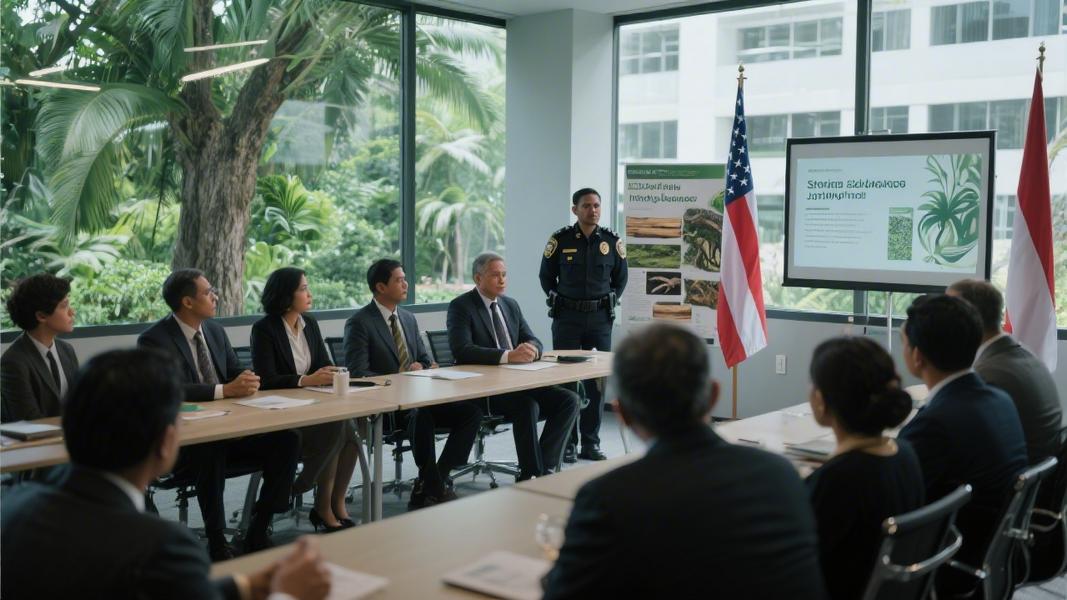
In a world where illegal logging accounts for up to 30 percent of global timber trade, the fight against environmental crime is crossing borders. Last month, the U.S. Department of Justice’s Environment and Natural Resources Division (ENRD) conducted a specialized training workshop for 25 Indonesian law enforcement officials, prosecutors, and judges focused on combating illegal timber and wildlife trafficking crimes.
The training, held in partnership with the Indonesian Center for Environmental Law and the Independent Forest Monitoring Network, represents an escalation in international cooperation to address what has become one of the most profitable forms of transnational crime worldwide. Funded by the U.S. State Department, the initiative brought together expertise from multiple American agencies including Customs and Border Protection, Fish and Wildlife Service, Forest Service, and Homeland Security Investigations.
A Global Problem With Local Impacts
Why focus on Indonesia? The Southeast Asian nation sits at a critical junction of global timber supply chains, where distinguishing between legal and illegal timber remains dauntingly complex. Timber stands as the most valuable wildlife commodity in trade globally, yet its supply chains present perfect cover for illegal operators.
“The difficulty in telling the difference between legal and illegal species is a major enabler of illegal timber trade,” notes TRAFFIC, an NGO monitoring wildlife trade. The organization regularly holds legality training workshops across Southeast Asia to help companies comply with various national requirements.
The environmental stakes couldn’t be higher. Illegal logging, which accounts for 15-30 percent of all timber traded globally, devastates ecosystems, accelerates climate change, and undermines legitimate forestry operations.
The Lacey Act: America’s Legal Weapon
Central to the workshop was discussion of the U.S. Lacey Act, which since 2008 has made it illegal to import plants and plant products harvested or exported in violation of another country’s laws. The legislation has become a powerful tool in the American legal arsenal against illegal logging.
“Since 2008, it has made it illegal to import into the United States plants and plant products that have been harvested and exported in violation of the laws of another country,” the U.S. Fish and Wildlife Service explains.
But the training covered more than just timber. Workshop participants also examined Indonesian criminal code and procedure, and disturbingly, the prosecution of animal cruelty videos – specifically “crush videos” that have become a dark corner of wildlife trafficking.
In a particularly troubling development, individuals in Indonesia have created monkey torture videos for distribution to people in the United States, leading to prosecutions by the ENRD. These cases highlight how wildlife crime increasingly intersects with other forms of exploitation and cruelty.
Building International Capacity
Can training workshops really make a difference against such well-organized criminal enterprises? Officials believe they’re essential to building the international capacity needed to identify, intercept and prosecute environmental crimes that cross borders.
The complexity of global supply chains makes enforcement particularly challenging. That’s why TRAFFIC and other organizations regularly conduct legality training workshops across Southeast Asia, helping companies importing and exporting timber products comply with requirements like the US Lacey Act, EU Timber Regulation, and Australian Illegal Logging Prohibition Act.
For Indonesia, a country with some of the world’s most biodiverse forests, effective enforcement doesn’t just protect trees – it preserves entire ecosystems and the communities that depend on them.
As illegal logging and wildlife trafficking continue to threaten global biodiversity, these cross-border partnerships may represent one of the best hopes for ensuring that the world’s forests remain standing – legally harvested, properly documented, and sustainably managed.
