
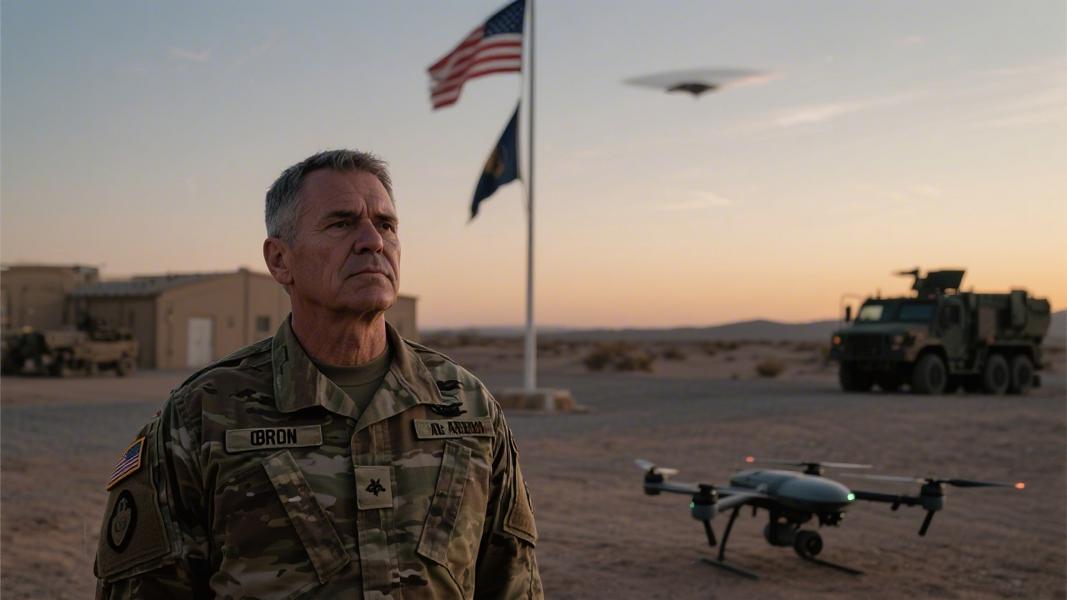
An American soldier is dead, killed by a drone strike in Kuwait. It’s the kind of headline that still has the power to stop a reader cold, even after decades of war.
The Department of War confirmed on March 4, 2026, that Maj. Jeffrey R. O’Brien, 45, of Indianola, Iowa, was killed on March 1, 2026, in Port Shuaiba, Kuwait, during an unmanned aircraft system attack. He was supporting Operation Epic Fury at the time of his death. The department announced that O’Brien was assigned to the 103rd Sustainment Command in Des Moines, Iowa, and that the incident remains under investigation.
He was 45 years old. A logistics officer. A man from Iowa who, by all accounts, had dedicated a significant portion of his adult life to a uniform. The circumstances of his death — a drone, a port facility, a support mission — reflect how profoundly the nature of warfare has shifted, even in places not always associated with front-line combat.
A Generation Shaped by Continuous Service
O’Brien’s death arrives at a moment when the human cost of sustained military engagement is being felt across communities in ways both visible and quietly personal. The men and women who’ve worn the uniform over the past two-plus decades have carried that weight into every corner of American life — into schools, hospitals, universities, and small towns.
Take Hudson Falls, New York. The Hudson Falls Central School District’s Wall of Distinction honors a graduate from the class of 2002 — a Lieutenant Colonel who attended West Point, served 17 years on active duty, deployed to Afghanistan in 2010 and earned a Bronze Star, and led humanitarian missions out of Fort Bragg. One soldier. One small upstate district. It’s a story repeated in thousands of towns across the country.
At the University of Alabama at Birmingham, the institution has made a point of recognizing veterans on staff — people who transitioned from combat roles into classrooms and clinics without much fanfare. Joseph Mulready, an Army First Sergeant and Master Sergeant who now works as a Biomedical Equipment Technician, received the Bronze Star with Two Oak Leaf Clusters. When asked what stayed with him most from his service, he didn’t talk about firefights or medals. “The opportunity to work with people from all over the world,” he said. “I worked directly with the German, Italian, Albanian, Iraqi, and New Zealand Armies.”
That’s the kind of answer that catches you off guard. Not heroics — connection. Mulready also provided election security across the Balkans and Southwest Asia, and what he described wasn’t tactical victory. It was something quieter. “I witnessed firsthand the gratitude and hopefulness of a people previously oppressed now having the ability to vote in a fair election for the first time,” he recalled. There’s something almost unbearably earnest about that, especially in the current climate.
From the Desert to the Classroom
Still, service doesn’t always look like a Bronze Star citation. Randy Moore, a Navy Lieutenant Commander and Assistant Professor of Nursing at UAB, received a Navy Commendation Medal and a Navy Unit Citation Medal. In 2006, he was applying everything he’d learned inside a Combat Surgical Hospital in Iraq. “Taking all the education and experience that I had learned and applying it to provide U.S. level care in a remote Combat Surgical Hospital in the deserts of Iraq during 2006 to help all of our warfighters,” he explained, describing what had impacted him most. He now teaches nursing. The pipeline from battlefield medicine to bedside care is shorter than most people realize.
Rosylen Quinney, an Army E-4 who now serves as a Clinical Research Coordinator at UAB, carries a different kind of résumé. Her decorations include the National Defense Service Medal, the Southwest Asia Service Medal with three Bronze Service Stars, the Kuwait Liberation Medal, a Sharpshooter Badge, and a Marksman Badge with Grenade Bar. She deployed. She qualified. She came home and went to work in a research lab. No ceremony required.
The Long Shadow of War-Related Illness
What doesn’t always make it into the official record — or the Wall of Distinction — is what service does to the body over time. Researchers have spent decades trying to quantify that damage. A landmark study published in the Annals of Internal Medicine examined war-related syndromes stretching from the U.S. Civil War all the way through the Persian Gulf War, analyzing mortality data, the emergence of Gulf War Syndrome, and the pattern of unexplained illnesses that seem to follow veterans home from every major conflict. The findings weren’t tidy. They rarely are.
How many more investigations will it take? The drone that killed Maj. O’Brien in Kuwait is the latest chapter in a story that’s been accumulating for generations — one written in Bronze Stars and service medals, in combat hospitals and voting booths in the Balkans, in the quiet offices of university hospitals where veterans now treat the sick and train the next generation of caregivers.
The incident in Port Shuaiba is still under investigation. But the life it ended — and the lives still shaped by decades of service — those don’t require an investigation to understand. They just require paying attention.
