
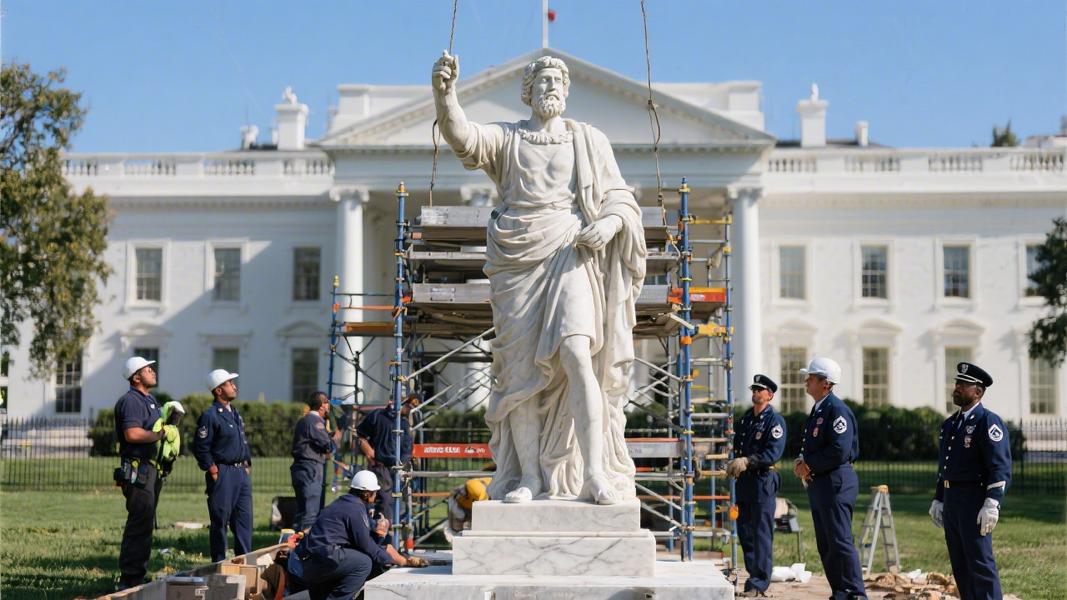
A marble Christopher Columbus has arrived at the White House — and the Trump administration wants you to know exactly what that means.
The statue, a replica of one that was toppled and hurled into Baltimore’s Inner Harbor during the summer of 2020, has been installed on the grounds of the Eisenhower Executive Office Building, just steps from the West Wing. It’s a deliberate, symbolic move by the Trump administration — part of a broader campaign to reclaim and reassert what officials describe as America’s founding heritage, one monument at a time.
A Statement in Stone
The White House didn’t leave much room for interpretation. “In this White House, Christopher Columbus is a hero, and President Trump will ensure he’s honored as such for generations to come,” the administration declared on X. Spokesman Davis Ingle echoed that message in a written statement, adding that Columbus “will continue to be honored as such by President Trump.” Short, punchy, and very much on-brand.
The original statue in Baltimore was pulled down on July 4, 2020 — Independence Day, notably — amid the nationwide wave of protests that followed the death of George Floyd. Demonstrators argued that Columbus symbolized colonization, violence, and the erasure of Indigenous peoples. The statue’s removal was one of dozens across the country that summer, as monuments to contested historical figures came down in cities from coast to coast.
Where It Came From
This particular replica is mostly marble, crafted by sculptor Will Hemsley, who works out of Centreville, Maryland. It was loaned to the federal government by Italian American Organizations United, a group that has long championed Columbus as a symbol of Italian-American identity and contribution to American history. The organization’s president, John Pica, didn’t hide his satisfaction. “We are delighted the statue has found a place where it can peacefully shine and be protected,” Pica said — a pointed reference, surely, to what happened to the last one.
Maryland House of Delegates member Nino Mangione was equally enthusiastic. He called the placement a victory and took a swipe at those who’ve pushed to remove Columbus monuments, characterizing them as people intent on erasing history. “It is a thrill and an honor to see his likeness in Washington, D.C., where millions can see it and reflect on his contributions to the United States of America,” Mangione stated.
The Bigger Picture
But it’s not that simple, is it? The debate over Columbus — his legacy, his symbolism, his place in the American story — has never really been about one statue. It’s about who gets to decide which history is worth honoring, and where. The Trump administration has made that fight a centerpiece of its cultural agenda, signing executive orders to restore monuments and protect federal statues from removal. Placing a Columbus replica within eyeshot of the White House is, in that sense, less an act of commemoration than a declaration of intent.
Italian-American communities have historically held Columbus close — as proof of their own place in the American narrative, their own belonging. That’s a real and legitimate attachment. Critics, meanwhile, argue that celebrating Columbus requires papering over a history of brutality toward Indigenous peoples that’s equally real and equally documented. Neither side is going away.
Still, for now, the statue stands — installed in one of the most politically charged zip codes in the world, protected, polished, and positioned exactly where the administration wants it. Whether that settles the argument or simply restarts it is another question entirely.
History, as it turns out, is never really finished being argued over. It just changes addresses.
