
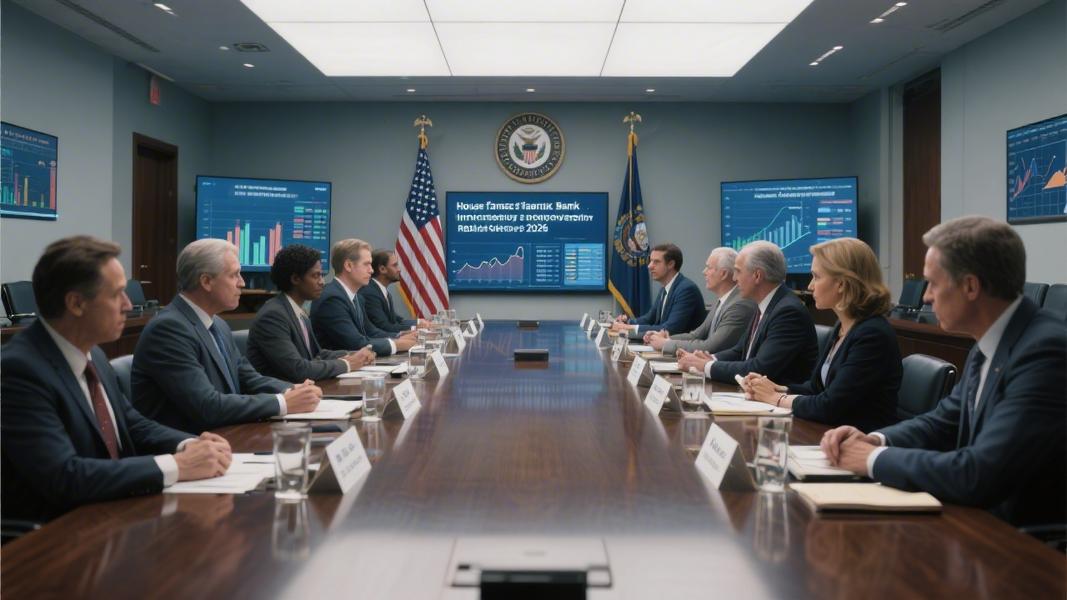
Washington’s top financial watchdog held its first major meeting of 2026 this week — and the agenda was anything but routine. From artificial intelligence’s growing footprint in capital markets to the quiet expansion of private credit, the Financial Stability Oversight Council made clear it’s watching nearly everything.
Treasury Secretary Scott Bessent chaired the March 25 session at the U.S. Department of the Treasury, convening both executive and open sessions of the Council — a body that was born out of the 2008 financial crisis and has, at various points in its history, been celebrated, scorned, and largely ignored depending on who sits in the chair. This time around, the mood was notably different from the Obama and Biden eras: less alarm, more deregulation.
A Wide-Angle View of the Financial System
Behind closed doors during the executive session, Council members received a comprehensive briefing through the quarterly financial stability monitor — a sweeping review that touched on banking sector health, household finances, financial innovation, geopolitical risks, and the investment implications of artificial intelligence. Private credit developments also made the agenda, a reflection of just how much that corner of the market has grown into something regulators can no longer afford to treat as a footnote.
Council members, according to officials, noted the resilience of the financial system and discussed ongoing agency efforts to keep pace with market developments. Whether that confidence is fully warranted is a question some outside economists continue to ask — but inside the room, the tone was measured rather than alarmed.
A separate presentation focused on tools designed to monitor household financial resilience. That means consumer credit conditions, yes, but also something that doesn’t always make it onto the FSOC’s radar: the impact of fraud on ordinary Americans. It’s a small but telling addition to the agenda — one that suggests at least some attention is being paid to Main Street, not just Wall Street.
The Open Session: Votes, Guidance, and a Push to Simplify
When the doors opened for the public portion of the meeting, the Council didn’t waste time. Members voted unanimously to publish proposed interpretive guidance on nonbank financial company designations, opening a 45-day public comment period. The vote was significant — nonbank designation has been one of the most contested issues in financial regulation for years, pitting consumer advocates against asset managers and insurers who bristle at the oversight that comes with the label.
Updates also came from three of the most powerful banking regulators in the country. The Federal Reserve, the Office of the Comptroller of the Currency, and the FDIC each provided briefings on banking supervision and ongoing regulatory reforms, including proposals to simplify regulatory capital standards — a priority that’s been building momentum across the industry. The FDIC, for its part, went further, detailing specific actions already taken: rescinding climate risk guidance, raising asset thresholds for community banks, and amending the Community Bank Leverage Ratio.
The Council also approved minutes from its December 11, 2025 meeting before adjourning.
Bessent’s Broader Vision — and Its Critics
So what does all of this add up to? It depends on who you ask.
Bessent has been unusually candid about his philosophy heading into this role. “It is my firm belief that the Financial Stability Oversight Council plays an important role in ensuring that the financial system is contributing to this vision,” he has said, adding that “too often in the past, efforts to safeguard the financial system have resulted in burdensome and often duplicative regulations.” That’s not subtle. It’s a direct rebuke of the approach taken by his predecessors — and a signal that the Council’s posture toward the private sector is being recalibrated.
At a recent Senate hearing, Bessent was even more pointed, criticizing the previous FSOC framework for having “treated nearly every single sector of the economy, financial market, and major financial institution as a potential financial stability vulnerability.” His argument, essentially, is that over-caution carries its own costs — and that growth and stability aren’t in opposition.
That argument has some supporters, particularly among community bankers who’ve long felt squeezed by rules designed for institutions ten times their size. On the stablecoin debate — which has been simmering in Congress for months — Bessent struck a notably protective tone toward smaller institutions. “Look, I’ve been a champion of these small banks,” he stated, warning that deposit volatility tied to digital currency adoption could undermine the very lending relationships that sustain rural and small-business communities. “It is the stability of those deposits that allows them to lend into their communities, ag[riculture], small business, real estate,” he continued, pledging to ensure stablecoin legislation doesn’t disrupt that equation.
Growth as Stability — A Philosophical Shift
Still, there’s a broader ideological thread running through this Council that’s worth naming directly. The framing around FSOC’s work has shifted from risk-first to growth-first. As one hearing chair put it, citing the 2025 annual report: “economic growth is essential for financial stability.” That’s not a throwaway line — it’s a reordering of priorities that will shape how the Council interprets ambiguous situations in the months and years ahead.
Bessent himself thanked FSOC members for their work on the 2025 annual report, calling it “the culmination of extensive collaboration among FSOC members” and crediting their “hard work and dedication in advancing the president’s bold vision for a better America.”
Attendees at the March 25 session included Bessent as chair, Federal Reserve Chair Jerome H. Powell, Acting Comptroller of the Currency Jonathan V. Gould, and representatives from across the federal financial regulatory apparatus — a reminder that whatever philosophical direction the Treasury sets, the Council is still a coalition, and coalitions are rarely as unified as a unanimous vote makes them appear.
The proposed guidance on nonbank designations now heads into the public comment process. How that plays out — and how aggressively the Council pursues or pulls back from oversight in the months ahead — will say a great deal about whether this kinder, gentler FSOC is a genuine recalibration or simply a long exhale before the next crisis forces the pendulum back.
