
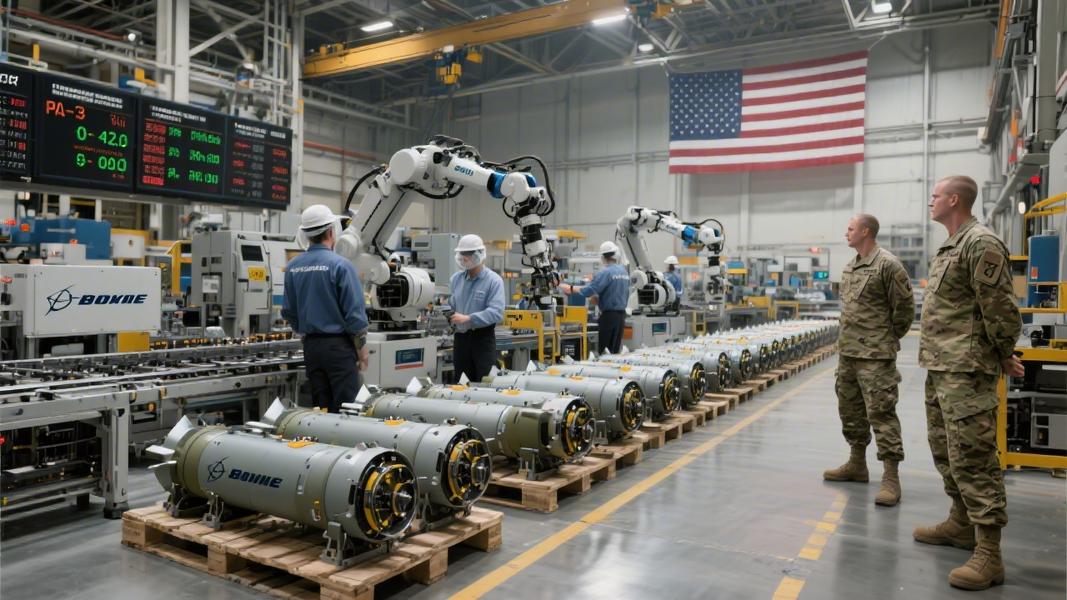
The United States is about to have a lot more interceptor missiles. A lot more.
The Department of War has signed a landmark seven-year framework agreement with Lockheed Martin to more than triple annual production of the PAC-3 Missile Segment Enhancement (MSE) — from roughly 600 missiles per year to an ambitious 2,000 by the end of 2030. It’s one of the most aggressive manufacturing scale-ups in recent American defense history, and officials are making clear they see it as a template, not a one-off.
A New Acquisition Model — And a Big Number
The deal isn’t just about volume. It’s about how the Pentagon is buying. The framework establishes a novel acquisition structure that ties shared profitability to manufacturing efficiencies — a commercial-style incentive model that defense procurement reformers have pushed for years. Under the arrangement, both the government and Lockheed Martin stand to benefit financially when production runs lean and fast. The idea, in theory, is that the contractor has skin in the game beyond just meeting a delivery schedule.
“To build a true Arsenal of Freedom, we must strengthen every link in the chain,” said Michael Duffey, Under Secretary of War for Acquisition and Sustainment. It’s the kind of line that sounds like it was written for a podium — but the underlying policy ambition behind it appears genuine.
Lockheed’s own chief executive was equally bullish. “We appreciate the Department of War’s leadership in advancing acquisition reform,” said Chairman, President and CEO Jim Taiclet, calling the agreement a “first-of-its-kind approach” that brings commercial practices to major weapons programs. “We will create unprecedented capacity for PAC-3 MSE production,” he added, “delivering at the speed our nation and allies demand while providing value for taxpayers and our shareholders.”
What the PAC-3 MSE Actually Does
Worth stepping back for a second. The PAC-3 MSE isn’t just any missile. It’s the most advanced variant in the Patriot air defense family, built with a two-pulse rocket motor that gives it extended range and the ability to intercept threats at high altitudes — ballistic missiles, cruise missiles, and increasingly, the kind of drone-and-missile saturation attacks that have defined modern conflict from Ukraine to the Middle East. Demand, in other words, isn’t theoretical. It’s urgent.
Lockheed had already been pushing hard before this deal landed. The company increased PAC-3 MSE production by more than 60 percent over the past two years, delivering more than 620 missiles in 2025 alone — a jump of over 20 percent from the prior year. That’s the baseline they’re now trying to more than triple.
Boeing’s Role: The Seeker Behind the Missile
A missile is only as good as its seeker. That’s where Boeing enters the picture. In a parallel seven-year agreement announced alongside the Lockheed deal, the Department of War contracted with Boeing to triple production capacity of PAC-3 MSE seekers — the guidance systems that allow the missile to home in on its target. Without that agreement, the Lockheed production ramp would be bottlenecked before it ever got started. Officials were clearly thinking about the full supply chain this time, not just the headline numbers.
That kind of integrated thinking has historically been the weak point in Pentagon procurement — promising big production numbers while quietly ignoring that a single subcomponent supplier can’t keep up. Whether Boeing’s ramp actually tracks with Lockheed’s ambitions remains, for now, an open question.
Bigger Picture: PAC-3 Is Just the Start
Still, the scale of what’s being attempted here is notable. The PAC-3 MSE framework is the first in what appears to be a broader acquisition transformation push. Lockheed Martin has since announced follow-on agreements to quadruple production of both the Precision Strike Missile (PrSM) and THAAD interceptors under the same acquisition model. The PAC-3 deal, in that context, looks less like an isolated contract and more like the Department of War road-testing a new playbook — one it clearly intends to use again.
The economic case is being made loudly, too. Officials and company representatives have both pointed to the thousands of American jobs the production expansion is expected to create, a framing that’s as much about domestic politics as it is about deterrence. Defense analysts have noted that the push aligns with broader pressure from allied nations — many of whom have burned through air defense stockpiles and are watching Washington’s production capacity with considerable anxiety.
Two thousand missiles a year by 2030. That’s the target. Whether the supply chains, the workforce, and the political will can all hold together long enough to actually get there — that’s the story still being written.
As Taiclet put it, the goal is delivering “at the speed our nation and allies demand.” In the current security environment, that speed can’t come fast enough.
