
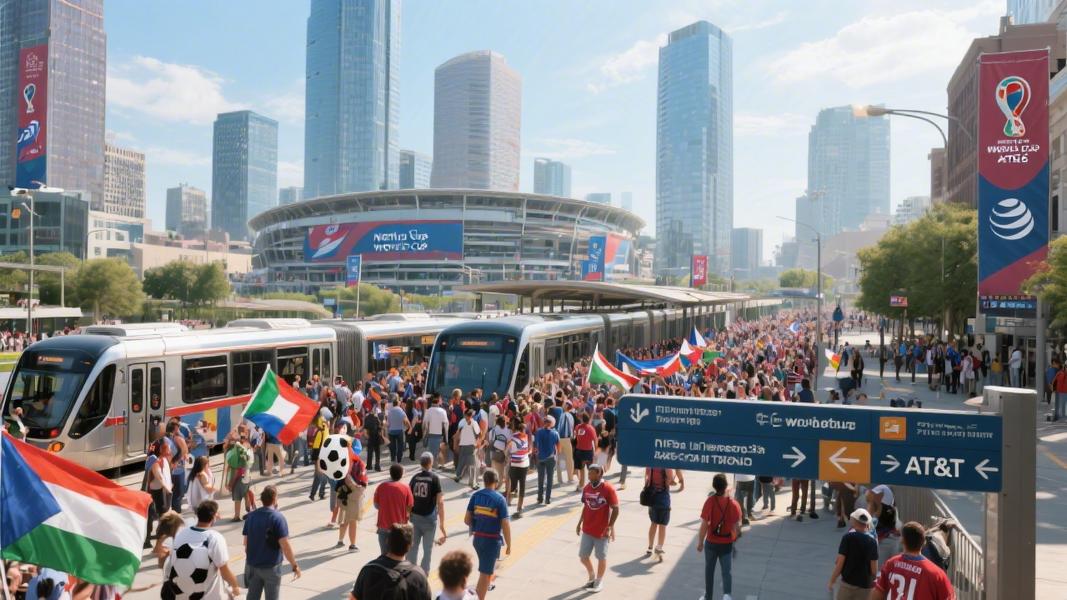
With 70 days left on the clock, North Texas officials are no longer just talking about the 2026 FIFA World Cup — they’re finally showing their hand on how to move more than 100,000 soccer fans a day without gridlocking one of America’s most car-dependent regions.
Organizers unveiled a sweeping regional transportation plan this week, laying out a multi-layered strategy of rail, charter buses, managed highway lanes, and ride-share agreements designed to funnel fans safely in and out of AT&T Stadium in Arlington. North Texas is hosting more World Cup matches than any other venue in the tournament — nine games — which means the pressure to get this right is enormous, and the margin for failure is essentially zero.
Rail, Buses, and a Whole Lot of Coordination
The backbone of the plan relies on getting fans onto trains first, then buses. Supporters traveling from Fort Worth or Arlington will board rail services — including Trinity Rail Express, TEXRail, and Dallas Area Rapid Transit — and ride to CentrePort Station, where a fleet of more than 125 charter buses will carry them the rest of the way to the stadium. “We’re working with the transit agencies — both DART, Trinity Metro, TRE, TEXRail — to make sure we have the rail service where fans can go from both Fort Worth and Arlington to CentrePort Station,” organizer Paul explained.
It’s a smart workaround for a region that wasn’t exactly built with mass transit in mind. AT&T Stadium sits in Arlington, a sprawling suburb that has no commuter rail stop directly at its doorstep. But as one official noted, that’s not entirely bad news. “The good thing about our stadium in this area is we have a lot of parking,” said Bettger. “Unlike other host cities, they don’t have the opportunity to have a lot of parking. The challenge we have is having transit to the stadium.” The plan accounts for roughly 30,000 parking spots at and near the venue — a luxury most World Cup host cities simply don’t have.
$61 Million in Federal Backing
None of this comes cheap. The North Central Texas Council of Governments is managing more than $61 million in federal funds earmarked specifically for World Cup preparedness — $51.5 million for security operations and $10.03 million for transit enhancements, including expanded service capacity and infrastructure upgrades across the region. “Extensive, collaborative planning has taken place across jurisdictions and at every level of government to strengthen our region’s preparedness,” said Maribel Martinez-Mejia, Director of Emergency Preparedness for NCTCOG, in a statement released by the City of Arlington.
Karla Windsor, Senior Program Manager for NCTCOG’s Transportation Department, put it plainly: “This investment will help ensure our region is prepared to move fans safely and efficiently throughout North Texas.” The funding will go toward everything from increasing bus frequency to improving access at fan zones and airports — essentially building a temporary transit ecosystem around an event that’s expected to draw millions of visitors over the course of the tournament.
What About the DART Controversy?
Here’s where it gets a little complicated. Several cities in the DART service area have been making noise about leaving the transit authority — a politically charged dispute that raised real questions about whether the World Cup transportation network could hold together. Organizers, for their part, are projecting calm. “From a games and fan festival standpoint, I don’t see a lot of impact,” Paul said, pointing out that key stations — including Fair Park and MLK Station — will remain operational regardless of how any municipal negotiations shake out.
Still, it’s a subplot worth watching. The tournament runs in the summer of 2026, and if transit governance disputes drag into the spring, the operational confidence officials are projecting now could face a real-world stress test. Regional mobility planning, as a peer exchange report from transportation operations experts makes clear, depends heavily on jurisdictional coordination — exactly the kind of thing that can unravel when cities start playing political hardball.
Managed Lanes, Rideshare, and the Full Picture
Beyond rail and buses, the plan includes reversible traffic flow on managed highway lanes to handle surge capacity around game days, and formal agreements with Uber and Lyft to integrate ride-share into the broader network. The full scope of the plan — buses, trains, managed lanes, rideshare, and a mountain of parking — reflects just how many moving parts are involved when you’re trying to move 70,000-plus fans per game across a metro area that was designed for the automobile and largely delivered on that promise, for better or worse.
That said, ambition and execution are different animals. The plan looks thorough on paper. Whether it holds up under the weight of nine consecutive match days, international crowds unfamiliar with North Texas geography, and the inevitable chaos of a global sporting event — that part, nobody can plan their way out of entirely.
Seventy days. The buses are chartered, the federal money is committed, and the transit agencies are at the table. Now North Texas just has to actually pull it off — in front of the entire world.
